 Pomegra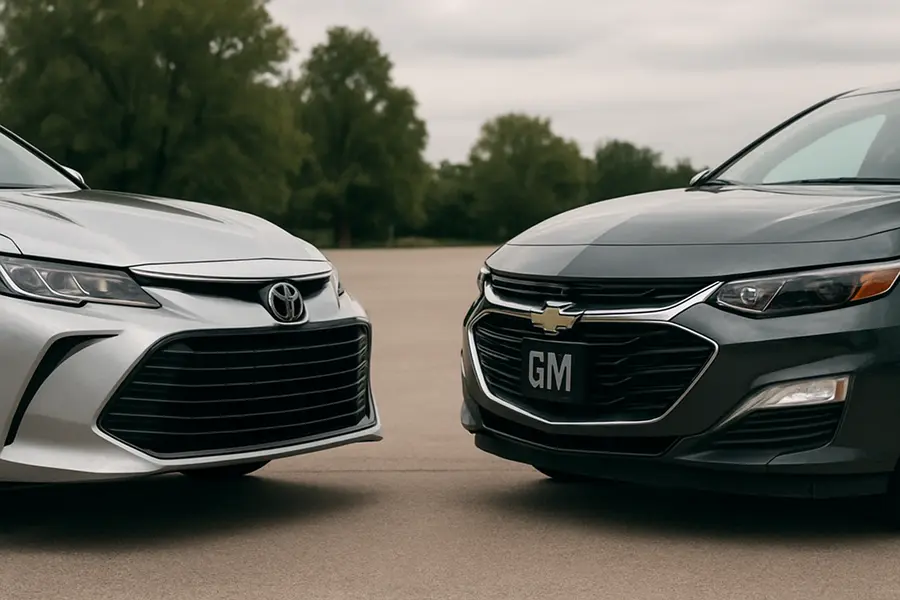
I have all the data needed. Writing the article now.
- Toyota's U.S. H1 2026 sales are forecast near 1.25M units (+1%), while GM's are projected at 1.33M (−7.2%).
- The ~83,000-unit gap would be the narrowest between the two automakers since Toyota briefly topped GM in 2021.
- GM absorbed $6.6B in EV-related charges in Q1 2026 as battery-electric vehicle sales fell 19% year-over-year.
---
Toyota Motor is on track to narrow its U.S. sales gap with General Motors to the tightest margin in five years, as surging hybrid demand lifts TM while EV write-downs and softening volume weigh on GM.
Lead
Toyota Motor (NYSE: TM) is closing the distance on General Motors (NYSE: GM) in the U.S. new-vehicle market at the fastest pace in years, according to the latest industry forecasts. Toyota is projected to sell approximately 1.25 million vehicles across the first half of 2026, a gain of roughly 1% from the year-earlier period, while GM is on track for about 1.33 million units — a decline of 7.2%. The projected gap of 83,255 vehicles is the slimmest since Toyota surpassed GM in U.S. sales for the first time ever in 2021. Whether that history repeats before year-end depends largely on how quickly American consumers keep choosing hybrids over the electrics that GM bet heavily on.What Happened
First-quarter 2026 U.S. results set the trajectory. GM sold 626,429 vehicles in Q1, a drop of 9.7% from the same period a year earlier, while Toyota posted gains anchored by a hybrid lineup that now spans more than 20 models. GM maintained the overall sales lead through Q1, but the runway is narrowing.
Toyota reported 1.18 million hybrid sales in the United States in 2025, a gain of 17.6% over 2024. Globally, the automaker sold 4.4 million hybrids in 2025, a figure no competitor came close to matching.
Market Share and the Competitive Gap
Toyota's U.S. market share is forecast to reach 15.8% in the first half of 2026, up modestly from the prior year. GM's share is projected to slide by nearly a full percentage point, to roughly 16.8%, from approximately 17.7% in full-year 2025.
A senior economist at Cox Automotive put the stakes plainly: "At these rates, and what we're seeing right now in the selling rates, GM may be looking over their shoulder here when we get to the year's end — that Toyota could potentially overtake them as the top-selling manufacturer in the U.S. market."
Strategic Context
The divergence traces directly to strategic choices made years earlier. Toyota pursued a hybrid-first, electrification-at-scale-later approach, building a deep and profitable lineup of gasoline-electric vehicles at a wide range of price points. GM, along with much of the Detroit establishment, made an earlier and more aggressive pivot to battery-electric vehicles.
That bet has proven costly in the near term. General Motors recorded $6.6 billion in EV-related charges in Q1 2026 as wholesale electric-vehicle volumes fell by approximately 23,000 units year-over-year. Broader EV and plug-in hybrid market conditions have deteriorated: combined EV and PHEV sales in the U.S. are down 22.6% and 52.8%, respectively, year to date in 2026, a decline partly attributable to the removal of federal tax credits that had supported adoption.
GM's Cadillac EV line showed resilience — deliveries rose 20% year-over-year in Q1, to roughly 9,500 vehicles — and more than 10,500 Chevrolet Equinox and Blazer EVs were sold in the quarter. But these gains were not sufficient to offset the broader volume drag from the EV transition.
Tariff Dimension
Trade policy added another layer of uncertainty for both manufacturers. GM estimated its gross tariff exposure at between $2.5 billion and $3.5 billion for 2026, a figure that improved by $500 million following a U.S. Supreme Court decision that overturned certain import duties. The company subsequently raised its full-year EBIT guidance to a range of $13.5 billion to $15.5 billion, incorporating an expected $500 million tariff refund. Toyota, which manufactures a significant share of its U.S.-sold vehicles domestically, faces a different tariff profile, though its global supply chain is not entirely insulated.
Fuel Economics as a Demand Driver
The macroeconomic backdrop is amplifying Toyota's structural advantage. Regular gasoline prices have remained above $4.00 per gallon in large portions of the United States through the first half of 2026, pushing buyers toward fuel-efficient powertrains. Toyota's hybrid lineup — spanning sedans, crossovers, SUVs, and trucks — sits precisely in the range of vehicles consumers are gravitating toward. GM's plug-in and battery-electric vehicles offer strong fuel-economy economics on a per-mile basis, but their higher up-front cost, charging infrastructure concerns, and reduced federal incentive support have tempered demand relative to the projections that underpinned GM's capital allocation.
Outlook
The competitive dynamics in the U.S. market will likely remain fluid through the second half of 2026. Toyota (TM) enters the period with sales momentum, an expanding hybrid lineup, and an all-new RAV4 entering full-rate production — a vehicle with consistently high demand and tight inventory. General Motors (GM) retains the sales leadership position for now, underpinned by its dominant full-size pickup franchise, and its improved EBIT guidance signals operational resilience despite volume headwinds.
Whether TM closes the remaining 83,000-unit gap before December depends on the rate at which RAV4 Hybrid supply normalizes, the trajectory of gasoline prices, and GM's ability to stabilize volumes in its core truck and crossover segments. If current trends hold through year-end, the U.S. auto industry's top-seller ranking could change hands for only the second time in the past five years.
Mentioned tickers: TM, GM