Pomegra
Tesla sank 7.5% on July 2 — its worst session in 11 months — despite record Q2 2026 deliveries of 480,126 vehicles that beat Wall Street estimates by more than 74,000 units.
- TSLA fell 7.5% on July 2, 2026 — its worst single session in 11 months — closing near $393.45 on elevated volume.
- Tesla delivered 480,126 vehicles in Q2 2026, a 25% year-over-year rise and a quarterly record, beating the ~406,000-unit consensus by roughly 18%.
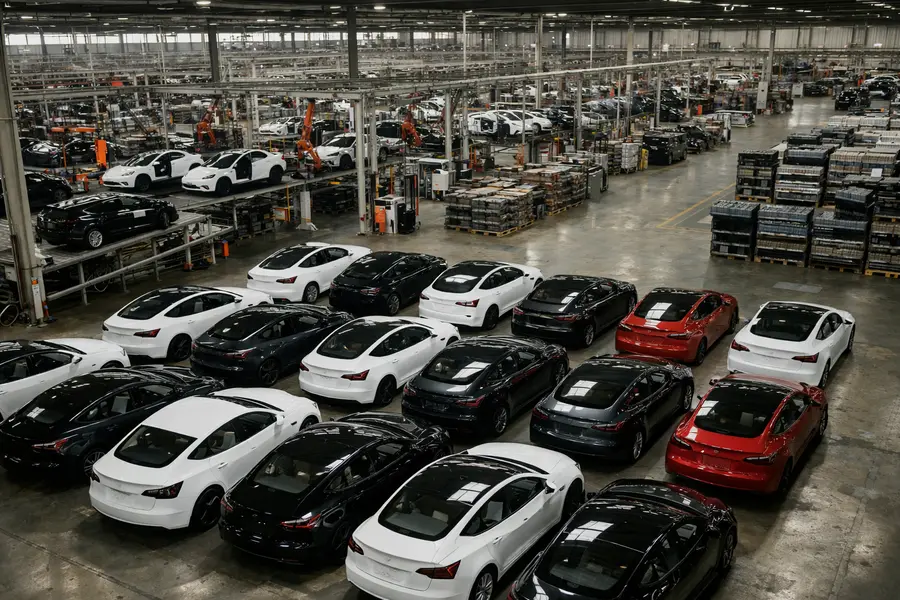
- Production of 451,758 units trailed deliveries by about 28,000 vehicles, intensifying scrutiny over inventory drawdown and margin quality ahead of the July 22 earnings call.
Lead
Tesla, Inc. (TSLA) shares fell 7.5% on Wednesday, July 2, 2026 — their steepest single-session decline in nearly a year — closing near $393.45, even as the company reported the strongest delivery quarter in its history. The sell-off arrived hours after Tesla disclosed 480,126 vehicle deliveries for the second quarter, a 25% year-over-year increase that surpassed Wall Street's consensus estimate of roughly 406,000 units by more than 18%.What Happened
Tesla deliveries for Q2 2026 marked the fourth-best quarter in company history and the most convincing year-over-year volume recovery after a prolonged stretch of demand pressure. The 480,126 vehicles delivered against a production figure of 451,758 units left deliveries running approximately 28,000 ahead of output — a gap that signals Tesla drew on existing inventory to hit the headline number rather than fulfilling a pure build-to-order pipeline. EV stocks 2026 presented a bifurcated picture alongside Tesla's results. Rivian Automotive (RIVN) outperformed expectations with 12,194 Q2 deliveries against a consensus of roughly 11,000 and lifted its full-year guidance range to 65,000–70,000 vehicles. Lucid Motors (LCID) moved in the opposite direction, delivering only 3,953 vehicles against anticipated levels near 5,000, suspending its full-year 2026 guidance entirely, and confirming an 18% workforce reduction announced in June. Tesla's energy storage segment reported 13.5 gigawatt-hours deployed in the quarter, reinforcing the Megapack business as a growing, if secondary, revenue contributor.Market Reaction
The TSLA worst day in 11 months illustrates a dynamic that has become familiar across high-multiple growth names: when a catalyst is anticipated well in advance, the positive outcome can trigger the very selling it appeared to promise a reward for. Tesla stock had gained approximately 12% across the four sessions before the delivery report as traders positioned for an upside surprise. Once that surprise was confirmed, profit-taking accelerated and volume swelled.
Valuation context amplified the move. TSLA entered the session trading near 190 times forward earnings — a multiple that leaves little room for ambiguity about execution. Any evidence that the volume gain came at the cost of margin discipline — through heavier discounting or inventory liquidation — translates quickly into multiple compression at that level.
Strategic Context
The roughly 28,000-unit gap between production and deliveries is the figure analysts are most likely to dissect on Tesla's July 22 quarterly earnings call. The distinction between logistical efficiency and price-driven inventory clearance is material: Tesla's automotive gross margin has been under pressure for several consecutive quarters, and the trajectory back to peak profitability depends on whether expanding volume is additive to earnings or subsidized by average selling price concessions.
Beyond the immediate quarter, investor framing has shifted. Where vehicle delivery totals once served as the primary proxy for corporate health, Tesla stock is increasingly assessed against progress in autonomous technology — specifically the Full Self-Driving suite, the Cybercab robotaxi platform, and the timeline for autonomous revenue to reach commercial scale. A record-setting quarter in conventional vehicle deliveries, while operationally significant, carries diminishing standalone weight against that longer-range thesis.
What Comes Next
The July 22 earnings call is the next substantive test. Investors will concentrate on automotive gross margin trajectory, average selling price trends across the model lineup, and management commentary on the Cybercab production ramp and robotaxi city deployment schedule. Guidance on FSD adoption rates and any revision to the autonomous vehicle commercial launch timeline will carry greater market influence than near-term volume projections.
As of July 2, TSLA held a Hold consensus rating across 26 analysts, reflecting divided sentiment between a bear case centered on margin compression and competitive displacement and a bull case anchored in autonomous driving optionality and energy infrastructure scale.
Outlook
Tesla's Q2 2026 delivery beat represents a clear operational milestone, but the Tesla stock sink of 7.5% on the day of the announcement underlines that the company is now evaluated on a materially different scorecard than vehicle volume alone. Margin recovery, the pace of robotaxi commercialization, and disciplined production management will determine whether TSLA can sustain — or rebuild — the premium multiple that its autonomous technology narrative has historically commanded. The July 22 earnings call will set the near-term direction.