Pomegra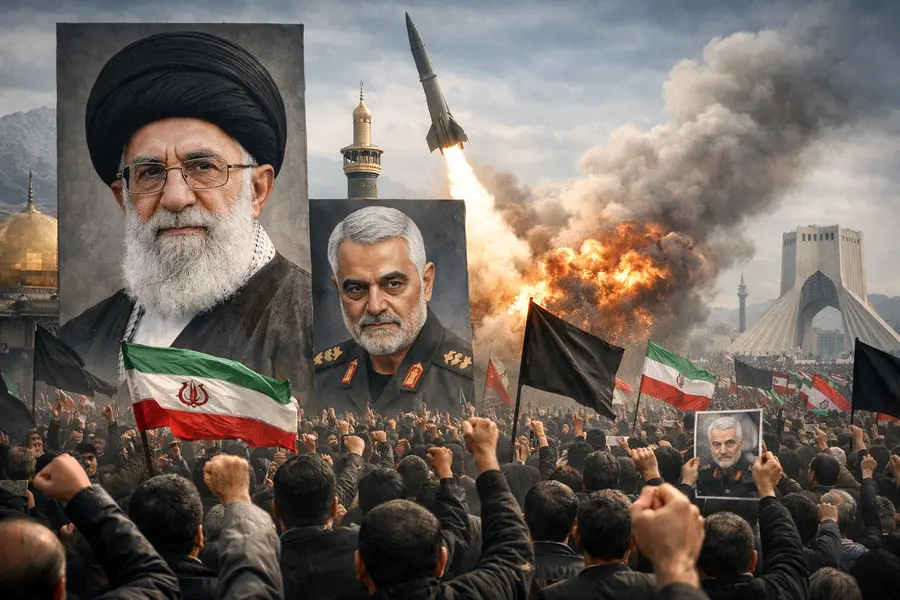
Iran's four-day state funeral for the slain supreme leader draws up to 20 million mourners as officials vow continuity and retaliation for the Ayatollah Khamenei killing.
- Iranian authorities expect 15–20 million mourners nationwide, potentially the largest state funeral in Iranian history.
- Red flags symbolizing martyrdom and revenge blanket Tehran; crowds chant "Our word is one — revenge!" at the Grand Mosalla.
- Successor Mojtaba Khamenei, appointed March 8, is absent from proceedings due to active security threats across the region.
Lead
Tehran, July 5, 2026 — Millions of black-clad mourners poured through the streets of Tehran on Saturday and Sunday for the opening days of a multi-city Khamenei commemoration marking the roughly 40th day since Ayatollah Ali Khamenei was killed in a joint U.S.-Israeli airstrike on February 28. Iranian authorities projected total attendance of 15 to 20 million across the country over a four-day funeral sequence stretching to July 9, when the former supreme leader is to be interred in his hometown of Mashhad — a figure that would rank the event as the largest state funeral in the Islamic Republic's history.What Happened
Khamenei, 86, who had governed Iran with near-absolute authority for 37 years, was killed alongside several family members in the opening hours of the 2026 Iran war, when coordinated U.S. and Israeli strikes hit command infrastructure across Tehran. Iranian state broadcasting confirmed his death on March 1, triggering 40 days of national mourning and a succession process within the Assembly of Experts.
The Khamenei commemoration Tehran ceremonies, formally opening July 4 at the Grand Mosalla mosque complex, serve as both a delayed state funeral and a political statement. Iranian officials shut down nonessential activity across the country to maximize public participation. Overnight prayer vigils preceded morning processions in which mourners, many weeping, filed past the coffins of Khamenei and the family members killed beside him.
The Iran Revenge Message
The official visual identity of the ceremonies — a clenched fist against a red-and-black backdrop with the slogan "We must rise" — frames Iran's revenge message in explicitly Shia martyrdom symbolism. Red flags, invoking both mourning and the religious obligation to avenge a martyr, dominated the Grand Mosalla and simultaneous gatherings in Qom, Isfahan, and Tabriz.
Crowd chants of "Our word is one — revenge! Revenge!" were reported throughout the day. Mourners interviewed in Tehran described the mass turnout itself as a form of defiance, with several stating that collective unity was the first act of retaliation. Iranian military and Islamic Revolutionary Guard Corps leadership have publicly renewed vows of retaliation since the February strikes, though no large-scale retaliatory operation has been announced.
Succession and the Absent Leader
The Assembly of Experts moved swiftly after the Ayatollah Khamenei killing, appointing Mojtaba Khamenei — the former supreme leader's son — as successor on March 8, 2026, less than ten days after his father's death. The selection was among the fastest succession processes in the Islamic Republic's history, reflecting the security vacuum created by the strikes.
Mojtaba Khamenei has not appeared publicly since taking office, and Iranian security officials cited active threats to his person as the reason he will not attend the multi-day ceremonies. Three of Khamenei's other sons joined mourners in Tehran, providing a visible family presence at the proceedings. The new supreme leader's prolonged absence from the public sphere has drawn scrutiny from analysts tracking the internal coherence of the post-war Islamic Republic government.
Middle East Security Dimension
The funeral unfolds against an unresolved military confrontation. The Middle East security landscape has been reshaped substantially since February: Iranian forces closed the Strait of Hormuz following the initial strikes, triggering a global fuel crisis before traffic gradually resumed. Ship-tracking data from Kpler recorded 121 crossings since Monday, and Brent crude has retreated to approximately $67 per barrel from wartime highs — reflecting cautious stabilization rather than resolution.
Iran issued fresh warnings of "harsh retaliation" against U.S. assets earlier this week, coinciding with the start of funeral preparations. Qatar-mediated talks have shown what U.S. and Qatari officials described as "positive progress," though no ceasefire or formal pause has been announced. The White House has publicly called for calm during the funeral period.
Regional actors remain on elevated alert. Hezbollah has exchanged strikes with Israel since the initial conflict, and Gulf states including Saudi Arabia, the UAE, and Kuwait have all been drawn into the conflict perimeter. Iran's ability to translate mass mourning into coordinated military action remains constrained by degraded command infrastructure, but the political pressure on the new leadership to demonstrate strength is significant.
Funeral Timeline
The multi-city ceremony follows a set itinerary: processions in Tehran began July 4, with parallel ceremonies in Qom and additional Iranian cities through July 7. A crossing into Iraq — likely to the Shia shrines at Najaf or Karbala — is scheduled before the final burial in Mashhad on July 9. The Iraq segment underscores Iran's effort to frame the commemoration as a transnational Shia event extending beyond its borders.
Outlook
The scale of Iran's commemoration reflects both genuine public grief and deliberate state mobilization of that grief into a political posture. Whether calls for revenge translate into consequential military action depends heavily on the capabilities and risk calculus of a government still reconstituting itself under a new, largely untested supreme leader. Diplomatic channels remain open, and oil markets are pricing in partial stabilization. The funeral's conclusion on July 9 will mark a significant test of whether Iran's new leadership pivots toward negotiation or escalation — a decision with direct consequences for Middle East security, energy markets, and U.S. strategic positioning in the region.
Mentioned tickers: BNO, USO, XLE