Pomegra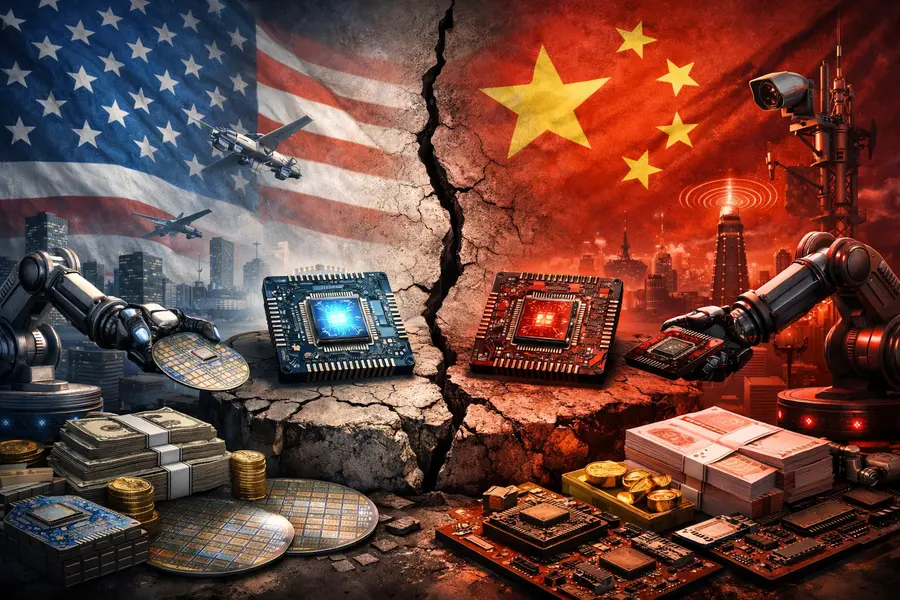
Stratfor Q3 2026 global outlook marks the US-China tech war as the defining geopolitical risk, accelerating AI chip decoupling and reshaping global supply chains and alliances.
- Stratfor's Q3 2026 forecast names technological competition between the US and China a primary driver of global instability, alongside stalled growth and the Ukraine stalemate.
- Washington's layered chip export controls have fractured the global semiconductor ecosystem, with China's domestic AI chip share projected at 50% of its home market by year-end.
- A Trump-Xi summit scheduled for September offers a narrow diplomatic window, but structural decoupling pressures are expected to persist regardless of outcome.
Lead
The contest for dominance in artificial intelligence and semiconductors has displaced traditional security flashpoints as the foremost driver of geopolitical risk heading into the third quarter of 2026, according to Stratfor's latest global outlook. The intelligence firm's Stratfor Q3 forecast identifies technological competition between the world's two largest economies as one of four structural forces — alongside low growth, financial fragility, and the war in Ukraine — most likely to generate market disruption and policy escalation between July and September.
The assessment arrives as Washington and Beijing each accelerate incompatible strategies: the United States tightening controls on advanced chip flows while preserving targeted commercial corridors, and China scaling domestic alternatives with unprecedented state investment. Neither trajectory shows signs of reversal.
What Happened
Stratfor's Q3 global outlook frames the US-China tech war not as a bilateral trade dispute but as a systemic contest over the infrastructure of the global economy. The forecast points to the convergence of several forces in the quarter ahead: the continuation of Washington's AI Export Program, Beijing's "AI Plus" industrial initiative, and the extension of the US-China trade truce — which preserves rare earth flows to the US while leaving chip controls intact.
In June 2026, the US Department of Commerce extended AI chip licensing requirements to subsidiaries of Chinese companies operating outside China, closing a loophole that had allowed Chinese cloud providers to route purchases through third-country affiliates. The move signals that Washington treats the US-China tech war as a global regime question, not a bilateral one.
The Semiconductor Divide
Export controls introduced in January 2026 established stringent total processing power thresholds for advanced chips destined for China, shifting licensing for NVIDIA's H200 and AMD's MI325X to case-by-case review. Even with a conditional carve-out permitting H200 sales — subject to a 50% volume cap relative to US domestic shipments, mandatory third-party testing, and end-use certification — Nvidia's China sales have stalled. Huawei and its Ascend chip line have filled much of the commercial gap.
China's DeepSeek confirmed in April that its V4 AI model was optimized for Huawei's Ascend architecture, a milestone illustrating how export controls are redirecting Chinese software development toward domestic hardware. TrendForce projects domestic vendors will account for 50% of China's AI chip market in 2026, rising sharply from a fraction of that figure three years prior.
On memory, ChangXin Memory Technologies is targeting HBM3-class production by year-end, trailing SK Hynix and Samsung by roughly two generations. Hua Hong Group, China's second-largest chipmaker, is readying 7nm capacity at its Huali facility in Shanghai, though SMIC remains capped at 7nm due to coordinated allied equipment restrictions. Despite these advances, analysts estimate the US holds a 21-to-49-times advantage over China in aggregate AI compute produced in 2026 — a gap that domestic investment alone cannot close in the near term.
Geopolitical Dimension
Stratfor's Q3 geopolitical risk assessment maps the tech competition onto a broader fragmentation of the rules-based economic order. The global chip ecosystem is bifurcating into two incompatible infrastructures — US-aligned architectures and China-aligned alternatives — a divide already forcing third-party nations across Southeast Asia, the Gulf, and Africa to choose sides in procurement and standards decisions.
Beijing has responded to chip restrictions with export controls on rare earths and critical minerals, leveraging its near-monopoly on processing capacity to generate asymmetric pressure. The US-China trade truce, extended through Q3, has suspended the sharpest escalation measures, but the underlying structure remains adversarial. Stratfor notes that Section 301 tariffs and tightened export controls are generating moderate hybrid escalation in the Indo-Pacific, including rising trade friction between China and Japan.
A summit between President Donald Trump and President Xi Jinping, scheduled for Washington in September, provides the quarter's primary diplomatic de-escalation window — but the scope is assessed as limited to managing, not resolving, core geopolitical risk in the technology domain.
What Comes Next
Political consensus in Washington around chip restrictions has fractured into a standoff among Congress, the White House, and the semiconductor industry, complicating policy coherence. NVIDIA has pressed publicly that permitting exports is strategically preferable to ceding the Chinese market to Huawei, a framing that reflects the difficulty of sustaining a maximalist control regime against commercial gravity.
China's domestication of AI infrastructure is set to intensify through the second half of 2026 regardless of the September summit's outcome. The "AI Plus" initiative represents a multi-year commitment to building sovereign compute capacity, reinforced by state capital, regulatory preferences for domestic procurement, and a rapidly expanding pool of engineers trained on domestic toolchains.
Outlook
Stratfor's Q3 global outlook leaves little ambiguity about the direction of travel: the US-China tech war has become a structural feature of the international system, not a policy dispute awaiting resolution. The bifurcation of global chip infrastructure, the export-control arms race, and the race to dominate AI deployment at scale collectively define the geopolitical risk landscape for institutional investors and policymakers entering the second half of 2026. A Trump-Xi summit may soften the tone at the margins, but the underlying contest for technological leadership is expected to persist and deepen through the decade.
Mentioned tickers: NVDA, AMD, ASML, TSM, MU, AMAT