Pomegra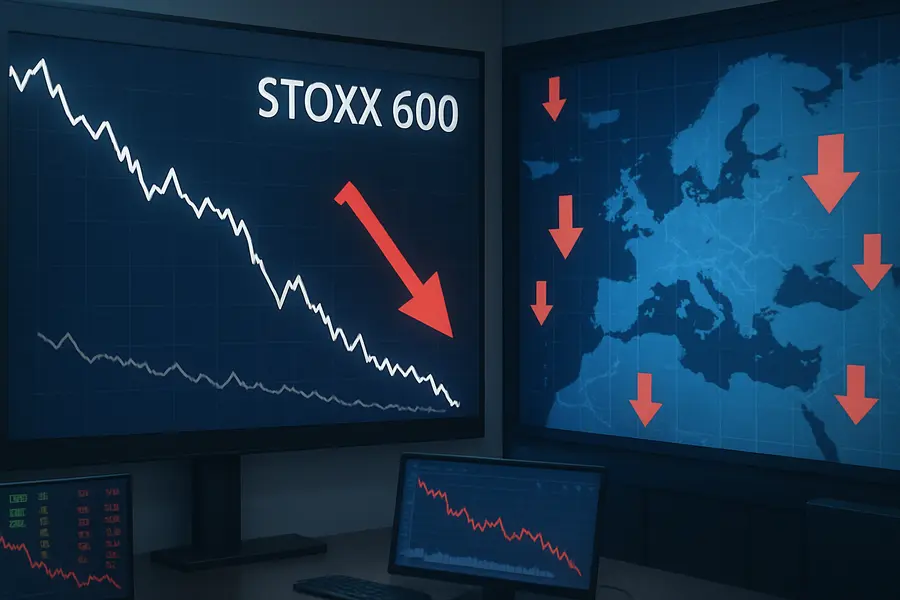
The STOXX Europe 600 slid as much as 1% at Tuesday's open, tracking an overnight global technology rout that sent South Korea's KOSPI crashing nearly 10% and unnerved markets from Tokyo to Hong Kong.
- The STOXX 600 Technology sub-index dropped 3.2%, with ASMI and STMicroelectronics each falling more than 6%.
- South Korea's KOSPI plunged 9.99% on Tuesday, triggering circuit breakers twice; Samsung and SK Hynix each shed more than 12%.
- Broadcom's decision to hold its $100 billion fiscal 2027 AI revenue target without a raise continues to deflate chip-sector sentiment globally.
Lead
European equities opened broadly lower on Tuesday, June 23, with the STOXX Europe 600 falling as much as 1% in the first hour of London trade, settling around 621.79 as the session progressed. The decline tracked a global technology sell-off that originated on Wall Street, where weakness in artificial intelligence-linked stocks dragged the Nasdaq Composite down 1.3% on Monday while the Dow Jones Industrial Average edged 0.3% higher — a split that reflected the narrowing of the broader market's pain to the high-growth technology names that had powered the previous rally.What Happened
The underlying catalyst for the week's technology decline surfaced in early June, when Broadcom reported fiscal second-quarter 2026 results that forced a sector-wide reassessment of AI hardware growth rates. AI networking revenue reached $4.1 billion, short of the $4.8 billion consensus, while Chief Executive Hock Tan maintained rather than raised the company's $100 billion fiscal 2027 AI semiconductor revenue forecast. In a market that had priced continuous upward revisions, a stable guidance number read as a warning sign. Broadcom stock fell 14% on the earnings session; Nvidia declined 6.2% and AMD shed 10.86%.
That recalibration compounded through the weeks that followed. By late June, what began as a single-company earnings disappointment had widened into a sustained rotation out of AI-linked equities. The Philadelphia Semiconductor Index had surged more than 50% over the preceding twelve months, accumulating the kind of crowded institutional positioning that is vulnerable to sharp reversal once momentum-driven buyers step back. By Monday's close, a fresh leg of selling on Wall Street had set the stage for a global cascade.
Asian Markets Absorb Sharpest Losses
The most acute overnight disruption came in South Korea. The KOSPI plunged 9.99% to close at 8,204 — a session severe enough to trigger circuit breakers twice, halting trading for twenty-minute intervals as sellers overwhelmed buyers. Samsung Electronics fell 12.31% to 310,000 won, and SK Hynix dropped 12.47% to 2.55 million won, twin collapses that reflected direct exposure to the AI chip supply chain as well as the rapid unwinding of momentum-driven positions built over months of record inflows into Korean equities. South Korea had been among the world's best-performing markets in 2026, leaving it acutely exposed to any reversal in global AI sentiment.
Japan's Nikkei 225 broke an eight-session winning streak, declining 3.55% to 69,788.38. Hong Kong's Hang Seng Index fell 1.82% to 23,336.28, while mainland China's CSI 300 retreated 2.77% to 4,919.39. No major Asia-Pacific index closed in positive territory.
European Chip Names Lead Regional Losses
Within Europe, technology and semiconductor stocks bore the sharpest pressure. The STOXX 600 Technology sub-index declined 3.2%, the worst-performing sector across the continent. Dutch semiconductor equipment maker ASM International fell more than 6%, as did chipmaker STMicroelectronics, making the two names the largest single-stock detractors on the broader STOXX Europe 600 during early trade. Basic resource stocks also retreated, shedding at least 2.5%.
Germany's DAX declined 1.10%, reflecting the country's heavier weighting toward industrial and technology exporters with chip-supply-chain exposure. France's CAC 40 fell a more moderate 0.55%, a divergence partly explained by the index's lower direct semiconductor weighting relative to its German counterpart.
Macro Backdrop Adds Pressure
The sell-off is unfolding against a policy backdrop that offers limited shelter. The Federal Reserve, under Chairman Kevin Warsh, raised its headline personal consumption expenditures inflation forecast to 3.6% for 2026 and its core PCE estimate to 3.3% at its most recent meeting, with nine of eighteen policymakers signaling that further rate increases remain on the table. A higher-for-longer rate environment compounds the pressure on high-multiple growth stocks at precisely the moment when AI revenue forecasts are showing signs of deceleration — removing two of the pillars that had sustained the sector's extended rally through early 2026.
European bond markets reflected the tension, with peripheral yield spreads edging wider as investors balanced the inflation signal from the Fed with the demand slowdown narrative emanating from the chip sector.Outlook
The STOXX Europe 600 Technology sub-index has retraced sharply from its 2026 peaks, and near-term direction will be determined by whether upcoming quarterly results from major chip producers can demonstrate that Broadcom's AI revenue shortfall was company-specific rather than a leading indicator of broader demand weakness. So long as the Federal Reserve's inflation projections anchor yields at elevated levels and global AI growth expectations continue to be revised downward, European equities — and technology stocks in particular — remain exposed to further selling. Any additional deterioration in overnight Asian or U.S. sessions would likely extend losses into the European open.
Mentioned tickers: .STOXX, ASM.AS, STM, DE:DAX, FCAU, FTSE, AVGO, NVDA, AMD, 005930.KS, 000660.KS, KS11, N225, HSI, CSI300