Pomegra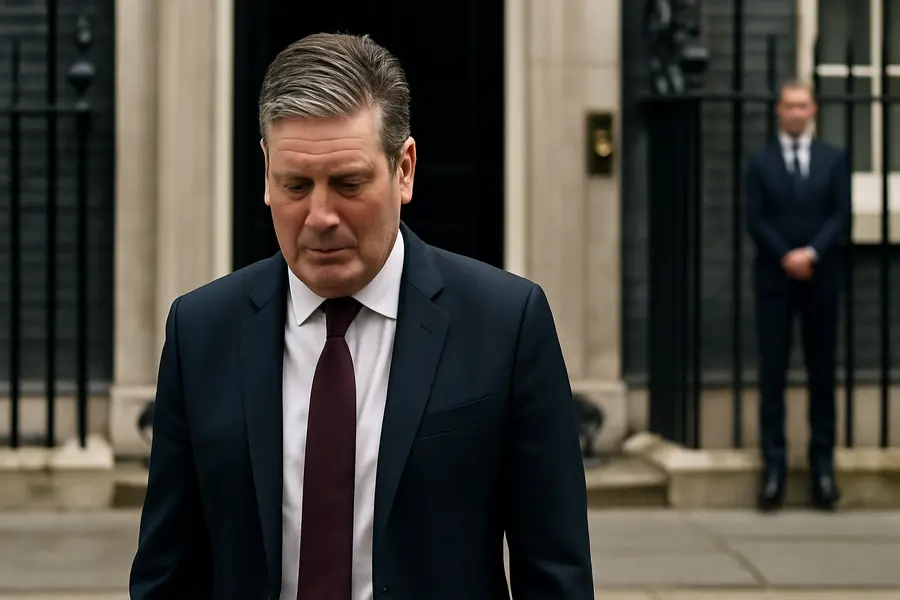
Keir Starmer steps down as UK Prime Minister on June 22, 2026, deepening British political instability and triggering a Labour leadership race expected to be won by Andy Burnham.
- Starmer quits after more than 95 Labour MPs demanded his resignation following heavy local election losses and the Makerfield by-election defeat.
- Sterling fell as much as 0.4% to $1.3181, brushing its 2026 low of $1.3159 set in March, before trimming losses to trade near $1.3202.
- Andy Burnham, former Greater Manchester mayor, is the leadership frontrunner; nominations open July 9 and close July 16 before the summer recess.
Lead
Keir Starmer announced his resignation as UK Prime Minister and Labour Party leader on Monday, June 22, 2026 — less than two years after delivering one of the party's largest ever general election victories. His departure, confirmed to King Charles III on Monday morning, means Britain will install its seventh head of government in a decade, extending a period of UK political instability that began with the 2016 Brexit referendum and has since consumed six administrations.What Happened
The immediate catalyst was Andy Burnham's commanding victory in the Makerfield by-election on June 18, 2026, where the former Greater Manchester mayor secured 54.8% of the vote, galvanizing Labour MPs who had grown restless under Starmer's leadership. Within days, more than 95 Labour parliamentarians had publicly called on Starmer to resign or set out a departure timeline.
The pressure had been building for months. Labour suffered significant losses in May 2026 local elections, and Starmer's poll ratings had contracted steadily. A separate controversy over the appointment of Peter Mandelson as British ambassador to Washington — clouded by questions over security vetting procedures and Mandelson's reported associations with the late sex offender Jeffrey Epstein — accelerated the breakdown of confidence among backbenchers. On June 11, the country's top two defense officials resigned, publicly accusing Starmer of insufficient commitment to the Defence Investment Plan.
Starmer confirmed he will remain in post until a successor is formally elected by the party. He told reporters he was stepping down "with good grace."
Market Reaction
Sterling moved lower on the news, sliding as much as 0.4% to $1.3181 in early London trading, approaching its 2026 low of $1.3159 reached in March. Losses were subsequently pared, with the pound quoted down 0.27% at $1.3202. Gilt markets steadied, with investors broadly awaiting policy signals from the incoming leader before repositioning. Analysts noted that uncertainty over the fiscal stance of Starmer's successor — particularly Burnham, who has offered limited detail on budgetary intentions — represents the primary near-term risk for UK assets.UK Political Instability: A Decade of Churn
Starmer's exit underscores the severity of UK political instability since the Brexit vote. Britain has now cycled through seven prime ministers — David Cameron, Theresa May, Boris Johnson, Liz Truss, Rishi Sunak, Starmer, and his yet-unnamed successor — in the span of a single decade. Truss's tenure in 2022 lasted just 45 days and triggered a gilt market crisis. The revolving door at Downing Street has complicated long-term policy commitments on defense, trade, infrastructure, and fiscal strategy, drawing concern from institutional investors and G7 partners alike.