 Pomegra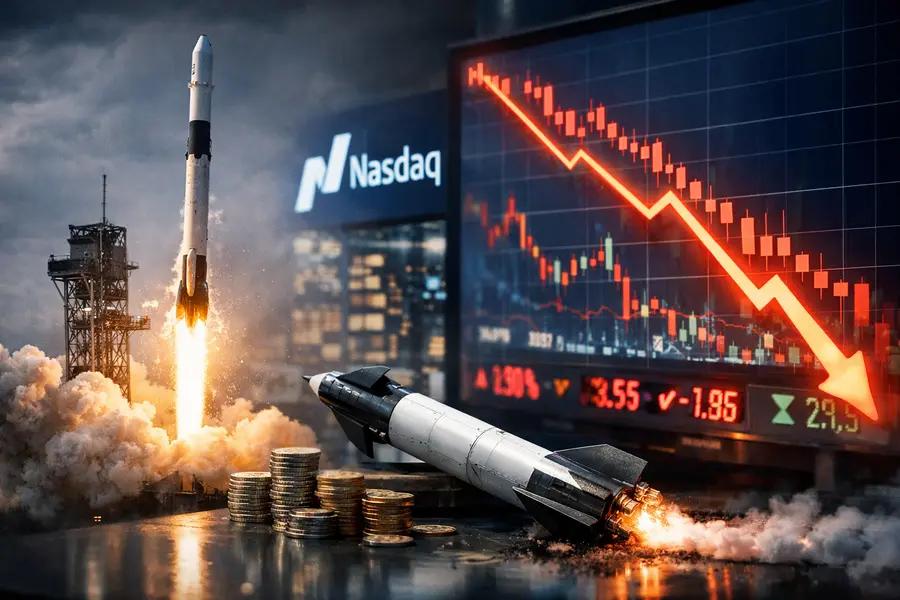
SpaceX stock fell to an all-time low of $145.20 on July 8, one day after its Nasdaq-100 debut, as $4.3 billion in passive index buying failed to reverse a deepening post-IPO correction.
- SPCX tumbled to $145.20 on July 8 — down 35.6% from its June 16 intraday peak of $225.64, underscoring intense SpaceX stock volatility.
- SpaceX entered the SPCX Nasdaq-100 on July 7 under a new Nasdaq "fast track" rule, just 15 trading days after its record $75 billion IPO.
- A float of only 3–5% of total shares outstanding has magnified every price swing since listing, fueling the severity of the SpaceX correction.
Lead
SpaceX (SPCX), which went public on June 12, 2026 in the largest initial public offering in history, recorded an all-time closing low of $145.20 on July 8 — one session after formally joining the Nasdaq-100 index. The move extended a correction that began just four days after the company's IPO debut and deepened despite an estimated $4.3 billion in mechanically required purchases by passive index trackers, including the $500 billion Invesco QQQ Trust (QQQ).What Happened
SpaceX priced its IPO at $135 per share on June 12, opened at $150, and scaled to an intraday high of $225.64 on June 16 — a 67% premium to the offering price in under a week. The surge reflected acute supply scarcity: the company floated roughly 3–5% of its outstanding shares, leaving institutional and retail demand chasing a thin pool of available stock.
The reversal was equally swift. By late June, SPCX had surrendered nearly 23% from that peak, settling around $153 as the initial momentum faded and wariness over a concurrent $25 billion SpaceX bond issuance weighed on sentiment.
On July 6, Nasdaq confirmed SpaceX's admission to the Nasdaq-100 effective July 7, invoking a fast-track eligibility rule permitting newly listed companies to qualify for index membership on their 15th trading day — bypassing the standard seasoning period.
Market Reaction
QQQ and its companion fund QQQM were required to acquire approximately $4.3 billion in SPCX shares before the July 7 open, funded by proportional reductions across existing constituents including Apple (AAPL), Nvidia (NVDA), Microsoft (MSFT), and Alphabet (GOOGL). Across the full family of Nasdaq-100 and Russell-linked vehicles, estimated forced buying reached as high as $27 billion.
The bulk of that purchasing was completed by the July 6 close. When trading opened on July 7, SPCX gained approximately 1%, closing at $158.77 — a subdued response that reflected a "buy the rumour, sell the news" dynamic. By July 8, the stock had retreated to $145.20, its lowest print since listing.
SpaceX stock volatility has been exceptional. The stock carries an implied volatility reading of 92, roughly 3.5 times that of QQQ itself — a function of the compressed float, high retail participation, and the absence of a multi-year options market for calibration.Strategic Context
SpaceX's Nasdaq-100 weighting at inclusion is materially smaller than its headline valuation implies. Nasdaq calculates index weights using float-adjusted market capitalization; with only 3–5% of shares in public hands, SPCX enters the benchmark at a fraction of the $1.75 trillion valuation assigned at IPO pricing. That structural constraint limits forced-buying volume while preserving the conditions for continued SpaceX stock volatility as the float gradually widens.
The pattern is not without precedent. High-profile Nasdaq-100 additions — including Palantir (PLTR) and Strategy (MSTR) — peaked at or before their respective inclusion dates, as index mechanics front-ran the event rather than sustained it. In each case, the mechanical buying merely absorbed selling that had built up around the announcement window.
Private Space Industry Investment Dimension
For the broader private space industry investment landscape, SpaceX's trajectory since listing carries structural significance. At its IPO valuation of $1.75 trillion, SpaceX commands a market capitalization larger than most legacy aerospace and defense conglomerates combined, based on projected 2025 revenue of $15.5 billion and Starlink's recently achieved unit profitability.
The listing drew sustained capital into space-adjacent equities, raising valuations across satellite communications, launch services, and in-orbit infrastructure providers. The subsequent SpaceX correction, however, has recalibrated those flows. Investors in thematic ETFs focused on private space industry investment are now navigating an environment where the sector's anchor stock remains more than a third below its post-IPO high, even as underlying fundamentals — Starlink subscriber growth, government launch contracts, and a pipeline of Starship commercial missions — remain intact.
The lockup expiration calendar poses the next material risk. When insider shares and pre-IPO institutional holdings become eligible for sale, the float will expand — a process that could take three to six months and that has historically produced additional pressure on newly public high-multiple technology companies.
What Comes Next
Options markets are pricing a move of approximately $20 in either direction over the next two weeks, reflecting lingering uncertainty about where price discovery stabilizes once the structural distortions from index entry clear. With implied volatility near 92 and a float too narrow to absorb large institutional repositioning smoothly, outsized daily moves in SPCX are likely to persist.
The space economy is projected to grow from roughly $630 billion in 2023 to $1.8 trillion by 2035 — a trajectory that underpins the investment thesis behind SpaceX's listing. Whether the current SpaceX correction represents a durable reset or a short-term dislocation will depend in part on how quickly the company can widen its publicly traded float and diversify its shareholder base beyond the momentum-driven capital that dominated early trading.