Pomegra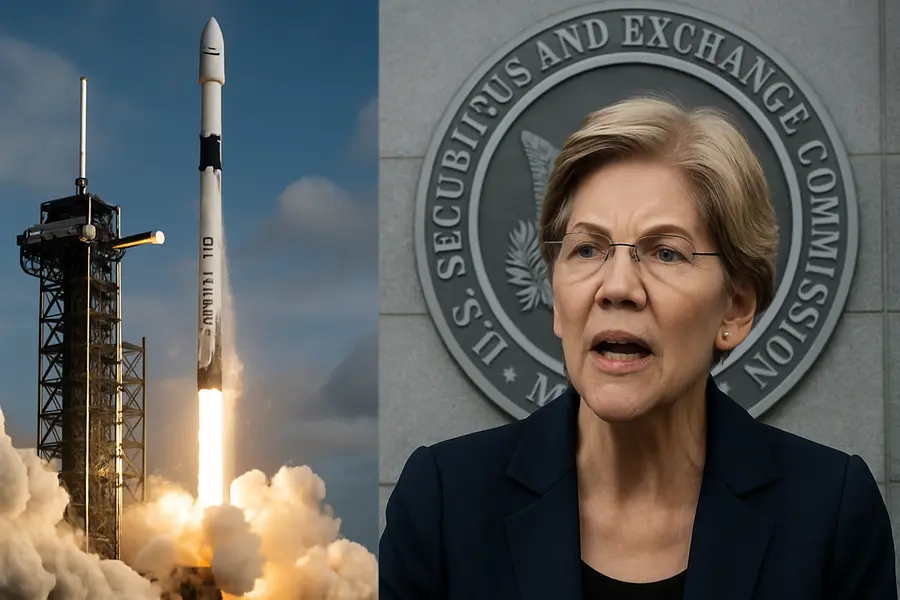
Sen. Elizabeth Warren calls on the SEC to halt SpaceX's record $75 billion Nasdaq IPO over governance, valuation, and investor protection concerns.
- Warren's 12-page letter cites Elon Musk's 82.4% post-IPO voting control as an unchecked governance risk for public shareholders.
- SpaceX targets $135/share on Nasdaq as SPCX on June 12, seeking a record $75 billion raise at a $1.75 trillion valuation.
- Warren raised separate concerns over Chinese investment exposure and SpaceX's role as a critical U.S. defense contractor.
Lead
Senator Elizabeth Warren on June 10, 2026, called on the Securities and Exchange Commission to delay SpaceX's imminent market debut, submitting a 12-page letter two days before the company's scheduled Nasdaq listing under the ticker SPCX. Warren cited unresolved governance deficiencies, potential valuation irregularities tied to SpaceX's acquisition of xAI, and inadequate investor protections in the offering documents — pressing regulators to intervene before trading begins.
What Happened
SpaceX, the rocket and satellite company controlled by Elon Musk, is targeting a $135-per-share IPO price, offering approximately 556.6 million Class A shares in what would be the largest initial public offering in U.S. stock market history. The company seeks to raise roughly $75 billion at an implied valuation of $1.75 trillion. Investor demand has exceeded $250 billion, leaving the deal between 3.5 and four times oversubscribed before final pricing.Warren's letter to the SEC contends that the offering contains material disclosure gaps surrounding SpaceX's acquisition of Musk-controlled xAI, raising the prospect of "inaccurate or misleading accounting or valuation." Because the transaction involved two entities under Musk's control, Warren argued it warrants independent regulatory review before public investors commit capital at scale.
Governance and Investor Protections
At the center of Warren's objections is SpaceX's dual-class share architecture. Following the IPO, Musk is set to retain approximately 82.4% of total voting power, with 93.6% of Class B super-voting shares required to remove him as chairman or CEO — rendering him effectively unremovable by public shareholders regardless of company performance.
Warren also objected to provisions she said further entrench Musk's authority: mandatory arbitration clauses that strip shareholders of standard court remedies, more restrictive-than-normal shareholder proposal rules, and SpaceX's incorporation under Texas corporate law, which affords shareholders fewer protections than Delaware's established legal framework.
In a separate follow-up to major stock exchanges, Warren questioned whether recent changes to index eligibility rules — changes that could automatically funnel capital from passive index funds into SpaceX without individual investor consent — were made in response to lobbying from Musk or SpaceX officials. The inquiry extends to whether OpenAI and Anthropic could benefit from the same modified criteria.
National Security Dimension
Warren flagged SpaceX's standing as one of the U.S. government's most critical defense contractors, arguing that a public listing could open a pathway for Chinese investment into a company with access to sensitive national security infrastructure. The letter called on the SEC to assess whether existing foreign-investment screening mechanisms are adequate given the offering's unprecedented scale and the company's dual commercial-military role.
Market Context
If priced as planned, SpaceX's offering would surpass Saudi Aramco's 2019 record raise of approximately $25.6 billion by a factor of nearly three, setting a new global benchmark. SpaceX reserved up to 30% of the offering for retail investors — an unusually large allocation for a deal typically dominated by institutional buyers. The company's Starlink satellite broadband division, operating roughly 10,000 satellites in low Earth orbit, provides substantial recurring revenue alongside the launch business and the recently integrated xAI unit.
Outlook
Neither SpaceX nor the SEC had issued a public response to Warren's letter as of the offering date. The letter carries no enforcement authority; the SEC retains sole discretion to delay or halt a listing. With the deal dramatically oversubscribed and pricing finalized, the probability of a last-minute regulatory halt is considered low. The episode nonetheless signals a broader political and regulatory environment increasingly attentive to concentrated-control structures in landmark technology listings — a dynamic that will likely intensify as other high-profile AI and space companies approach public markets.
Policy