 Pomegra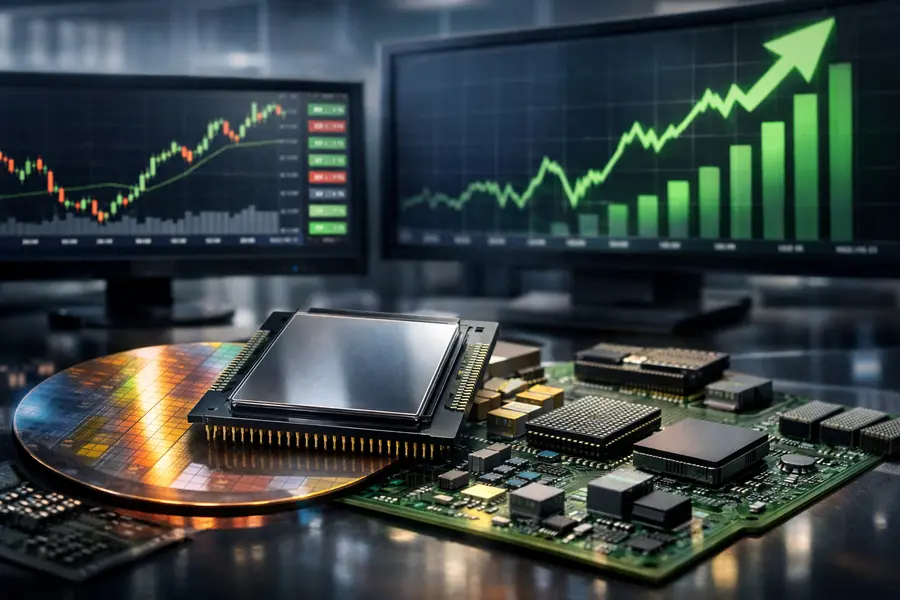
The S&P 500 rose 0.8% and the Nasdaq Composite gained 1.3% on July 10 as AI stock gains and a semiconductor stock rebound drove tech sector outperformance across Wall Street.
- The Nasdaq Composite gained 1.3% to 26,206.89 and the S&P 500 rose 0.8% to 7,543.64 on July 10, with tech the only major sector showing broad strength.
- SK Hynix raised $26.5 billion in the largest-ever U.S. listing by a foreign company, with its Nasdaq ADRs surging 13% on debut.
- Micron Technology committed $250 billion in U.S. semiconductor investments through 2035, while Meta announced its custom AI chip enters production in September.
Lead
U.S. equities closed higher on July 10, 2026, as a resumption of the artificial intelligence trade and a sharp recovery in semiconductor stocks offset weakness across most of the broader market. The Nasdaq Composite gained 336 points, or 1.3%, to 26,206.89, while the S&P 500 added 0.8% to close at 7,543.64. The Dow Jones Industrial Average rose a more modest 0.3% to 52,478.41. The CBOE Volatility Index fell 6.3% to 15.84, its lowest reading in weeks, signaling a pronounced easing of investor anxiety in the chip and AI complex.
Semiconductor Stock Rebound
The session's gains were narrowly concentrated. Nine of eleven S&P 500 sectors ended in negative territory, with Information Technology the decisive outperformer, rising 1.2%. The VanEck Semiconductor ETF climbed 2.5% as memory and data center chip names led the advance.
Micron Technology surged 4.5% after the company announced it would invest more than $250 billion in the United States through 2035 — an increase of roughly $50 billion above its prior pledge — and celebrated the first concrete pour at its Clay, New York fabrication facility, a milestone achieved more than a quarter ahead of the original construction schedule. The company also committed $5 billion to a new 300mm wafer manufacturing plant in Sherman, Texas, and made an additional $3 billion commitment to support GlobalWafers' Texas operations. SK Hynix provided the session's headline event. The South Korean memory maker's American depositary receipts, priced at $149 each under the ticker SKHYV, opened at $170 on the Nasdaq and closed up 13%, raising $26.5 billion in what stands as the largest U.S. listing ever completed by a foreign company. The landmark offering underscored the degree to which global capital is converging on high-bandwidth memory as the critical bottleneck in scaling AI infrastructure. SK Hynix Chairman Kwak Noh-jung told CNBC at the opening bell that "demand is enormous" and will remain so for the foreseeable future. Nvidia advanced 4% and Advanced Micro Devices gained 2%, extending a recovery that began mid-week. Broadcom and Intel ended modestly lower, shedding 0.3% and 2.4%, respectively, as investors continued to distinguish between companies most directly tied to AI accelerator demand and those with more mixed end-market exposure.Market breadth on the Nasdaq showed advances outpacing declines at a ratio of 1.65 to 1, while NYSE breadth was 1.5 to 1 in favor of gainers — a moderate reading that illustrated how concentrated the day's positive momentum remained in technology.
AI Stock Gains: Meta's Dual Catalyst
Meta Platforms added 4.7%, making it among the strongest individual performers in the S&P 500. The company announced that its custom AI chip, code-named Iris and developed through the Meta Training and Inference Accelerators program, would enter mass production in September, designed by Broadcom and manufactured by TSMC. Testing completed in six weeks revealed no major issues — a meaningful threshold for an internal chip program that faced persistent setbacks since its inception five years ago.Meta also released Muse Spark 1.1, an update to its flagship AI model offering coding, video captioning, and reasoning capabilities, entering public preview for developers with pricing positioned below competing offerings from OpenAI and Anthropic. The twin announcements from Meta illustrated the pivot underway across large-cap AI names: capital invested in infrastructure is beginning to translate into identifiable products and competitive positioning, a transition investors have been watching closely.
Strategic Context: Rebound From a Deep Selloff
The day's gains followed one of the sharpest sector drawdowns of the year. The PHLX Semiconductor Index dropped 10% on June 5 — its steepest single-day decline since March 2020 — erasing roughly $1.3 trillion in sector market value as concerns mounted over the pace of AI capital expenditure and the durability of enterprise demand. The rebound over the subsequent month has been uneven, and the July 10 session represented a consolidation of that recovery rather than a single dramatic reversal.
The macro backdrop provided additional support. Initial jobless claims for the prior week fell to 215,000, below consensus expectations, indicating continued labor market resilience. Crude oil prices declined, easing one source of cost and sentiment pressure, even as Middle East tensions remained an active risk factor monitored across commodity and fixed-income markets.
Micron's $250 billion domestic investment plan, made partly in response to the Trump administration's push for on-shore semiconductor production, reflects a structural shift in how the industry is allocating long-cycle capital. Combined with SK Hynix's U.S. market debut, the session illustrated how the AI semiconductor ecosystem is expanding well beyond graphics processing units into memory, storage, and custom inference hardware — broadening the investment surface area within the sector.
Outlook
The S&P 500 rise on July 10 confirmed that investor appetite for the AI and chip trade remains intact after a difficult June. The Nasdaq Composite gains were driven by a handful of high-conviction catalysts — SK Hynix's debut, Micron's investment commitment, and Meta's AI chip timeline — rather than broad market participation. Whether the semiconductor stock rebound sustains will depend heavily on how hyperscalers characterize AI capital expenditure in the earnings season beginning in mid-July. Any upward revision to data center spending guidance from major cloud operators would likely extend the recovery; any softening would renew scrutiny of chip demand assumptions that the market is once again pricing aggressively.
Mentioned tickers: SPY, QQQ, NVDA, AMD, AVGO, INTC, MU, SKHYV, META, SMH