Pomegra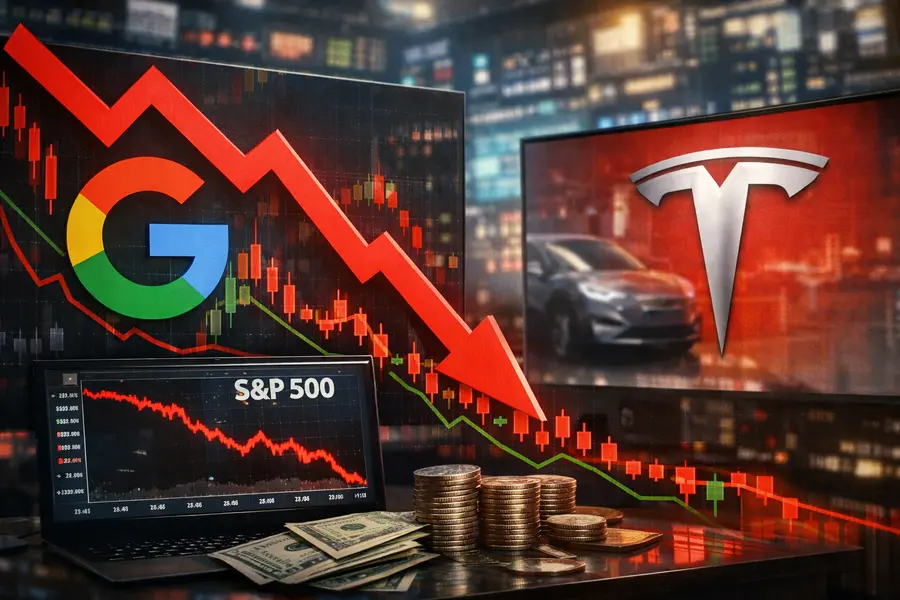
US stock futures fell Wednesday as rising Treasury yields and a Middle East escalation compounded a post-earnings selloff in Alphabet and Tesla, dragging tech stocks sharply lower.
- The S&P 500 dropped 1.44% and the Nasdaq fell 2.22% by mid-session as Alphabet and Tesla each lost more than 6% after reporting earnings.
- Alphabet beat revenue and cloud estimates but raised its 2026 capital spending forecast to as much as $205 billion, triggering a free-cash-flow deficit of $5.9 billion.
- Tesla posted record quarterly revenue of $28.24 billion yet missed earnings per share by 39%, with operating margin collapsing to 1.4% against a 5.4% consensus.
Lead
U.S. equity markets came under broad pressure on Wednesday, July 23, 2026, as the S&P 500 fell 1.44% and the Nasdaq Composite slid 2.22%, hurt by a confluence of rising borrowing costs, oil above $100 a barrel, and investor disappointment with the capital-spending trajectories of Alphabet and Tesla — two of the market's most closely watched technology names — following their Tuesday evening earnings releases.
What Happened
The 10-year Treasury yield rose to approximately 4.63%, a two-month high, keeping pressure on rate-sensitive growth assets. Oil topped $100 a barrel after President Donald Trump threatened further escalation of U.S. military activity in the Middle East, amplifying inflation concerns that had already been building on the back of slowing ADP private-sector hiring and a U.S. crude inventory build of 2.6 million barrels against a backdrop of emergency reserves at a 43-year low.
Against that macro backdrop, Wall Street's post-earnings verdict on two of the S&P 500's largest constituents set the tone for the session.
Alphabet Earnings Review
Alphabet (GOOGL, GOOG) reported second-quarter 2026 revenue of $119.8 billion, a 24.2% year-over-year increase that comfortably cleared the $116.93 billion analyst consensus. Google Cloud led the outperformance, rising 82% to $24.8 billion with operating income of $8.8 billion — up from $2.8 billion a year earlier — as enterprise demand for AI infrastructure and solutions accelerated. YouTube advertising revenue grew 13%, and the Gemini AI assistant reached 950 million monthly active users while processing 22 billion API tokens per minute; nearly 90% of Fortune 100 companies now use Gemini Enterprise.Operating profit climbed 30.4% to $40.8 billion, and reported earnings per share hit $9.11, a figure inflated by a $99 billion net gain on equity securities — including holdings in Anthropic and SpaceX — that skewed the headline profit comparison.
Despite the beat, GOOGL shares fell 7.76% to $315.36 in Wednesday trading. The catalyst was the company's revised capital expenditure outlook: Alphabet raised its 2026 spending forecast to as much as $205 billion, up from a prior estimate of $190 billion, reflecting intensifying investment in AI data centers and infrastructure. Free cash flow turned negative at -$5.9 billion for the quarter, reigniting concerns about fiscal discipline at a moment when the market is demanding returns on AI outlays.
Tesla Earnings Review
Tesla (TSLA) reported record quarterly revenue of $28.24 billion for the second quarter, a 26% year-over-year gain and ahead of the $26.4 billion analyst estimate. Vehicle deliveries reached 480,126 units, up 25% from a year earlier and roughly 74,000 above consensus. Energy storage deployments hit 13.5 GWh.The profitability picture disappointed sharply. Non-GAAP earnings per share came in at $0.33, a 39% miss against the $0.44 estimate and an 18% decline year-over-year. Operating margin collapsed to 1.4%, far below the 5.4% consensus. Operating expenses rose 47% to $4.35 billion. Automotive gross margin, at 16.9% (16.3% excluding regulatory credits), reflected intensifying competition and pricing pressure; regulatory credits themselves fell to $146 million from $439 million in the prior-year period. Free cash flow swung to a deficit of $1.09 billion from a $1.44 billion surplus in Q1 2026.
TSLA shares fell approximately 6% to around $350 in morning trade, touching a near three-month low.
Strategic Context: The AI Spending Divide
The twin selloffs in Alphabet and Tesla crystallize a central tension in tech earnings 2026: the market is simultaneously rewarding AI-driven revenue growth and punishing cash consumption. Alphabet's Cloud unit delivered operating income of $8.8 billion, nearly tripling year-over-year, yet the surge in capex absorbed all operational cash generation and more. Tesla's AI ambitions — reflected in soaring operating costs — are compressing margins while the core automotive business faces a more competitive global pricing environment.
Investors are increasingly drawing a distinction between AI investment that is translating into measurable revenue and investment that remains speculative, particularly when it coincides with deteriorating free cash flow and heightened macro uncertainty.
Market Reaction
The broader market absorbed the earnings and macro news poorly. The S&P 500 fell below its 50-day moving average, a technically significant level. Financials and energy held up better than technology, reflecting the dual support from higher rates and elevated oil prices. Treasury market activity suggested investors were rotating toward safety, compressing equity risk appetite further.