Pomegra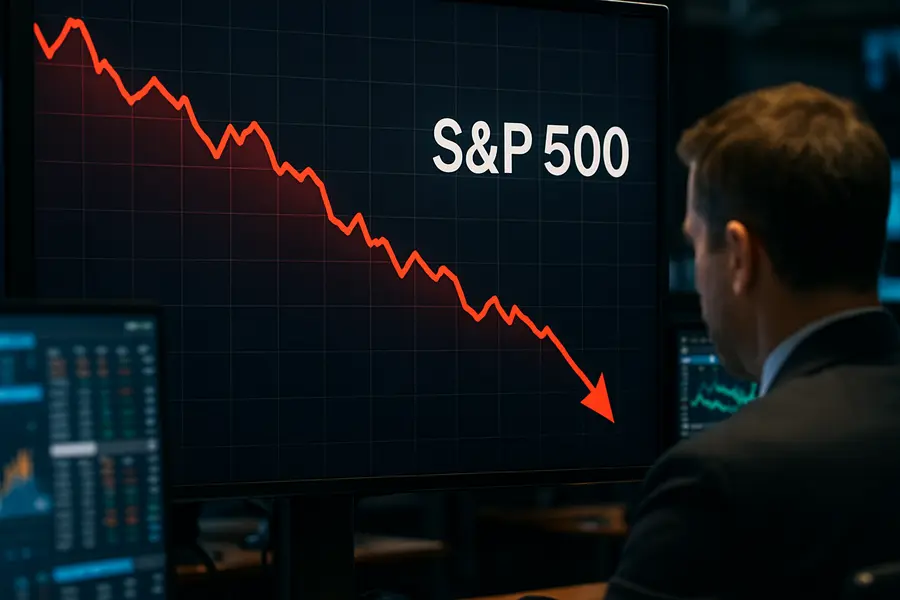
S&P 500 futures fell Friday while the index tracked toward a 1.9% weekly loss, as a global tech rout tied to AI infrastructure costs erased more than $1.3 trillion from semiconductor stocks.
- S&P 500 E-Mini futures (ESU26) fell 1.31% Friday morning; Nasdaq 100 futures dropped 2.60%, extending the week's technology-led decline.
- A global selloff in AI-linked semiconductor stocks wiped more than $1.3 trillion in market value this week, driven by Apple price hikes and OpenAI IPO delay reports.
- The Dow Jones Industrial Average gained 0.7% for the week as investors rotated into industrials, financials, and healthcare, bucking the broader decline.
Lead
September S&P 500 E-Mini futures (ESU26) fell 1.31% in Friday morning trading on June 26, 2026, leaving the index down 1.9% for the week and on course for its steepest stock market losing week since the tariff-driven turbulence of early 2025. Nasdaq 100 futures dropped 2.60%, extending a technology-sector retreat that has rippled across global equity markets since Monday and pulled South Korea's KOSPI into circuit-breaker territory for the second time this week.
What Happened
The week's losses crystallized around two developments that unnerved investors positioned for sustained AI-driven growth. Apple (AAPL) announced price increases on its MacBook and iPad product lines, citing higher semiconductor component costs, raising concerns that mounting chip expenses are beginning to compress margins across the technology supply chain. Separately, reports emerged that OpenAI may delay a planned initial public offering until 2027, rattling sentiment across AI-adjacent valuations broadly.
The Nasdaq Composite is on pace to close the week down 4.4%—its steepest weekly decline since April 2025—while the benchmark S&P 500 has shed approximately 1.9%. Semiconductor names bore the brunt of the correction, shedding more than $1.3 trillion in combined market capitalization during the week. Total losses across AI-linked equities approached $1.4 trillion on some measures.
Micron Technology (MU) provided a mid-week reprieve when the memory chipmaker reported that average selling prices for DRAM rose approximately 60% in its most recent quarter, and core data center revenue more than doubled sequentially to $11.5 billion—a 653% year-over-year increase. That result temporarily arrested the broader decline by affirming that structural demand for AI memory infrastructure remains intact, but renewed selling pressure resumed into Friday's session.Market Reaction
The damage extended well beyond Wall Street. South Korea's KOSPI plunged more than 8% on Friday, triggering a 20-minute circuit breaker as Samsung Electronics and SK Hynix dragged the index lower. Japan's Nikkei 225 fell more than 4%, while the MSCI Asia ex-Japan Index lost nearly 2.9%. SoftBank Group (9984.T) tumbled 13% at its intraday low as investors reassessed its heavy AI infrastructure exposure. Losses spread to Hong Kong's Hang Seng, down 1.6%, and China's CSI 300, off 2.4%.
In Europe, markets opened lower, tracking overnight weakness in Asia. The risk-off posture pushed capital toward government bonds, pulling benchmark yields modestly lower.
Not every corner of U.S. equities suffered. The Dow Jones Industrial Average gained 0.7% for the week as rotation into healthcare, financial, and industrial names provided a counterweight to the technology rout. Industrials led week-to-date gains with an advance of 2.19%, underscoring the divergence between high-multiple AI-exposed equities and economically sensitive cyclicals.
Strategic Context
The selloff reflects a recalibration of expectations built over two years of relentless AI spending. A May 2026 survey by KPMG of 204 U.S.-based executives found that only 26% said AI operating costs were fully visible within their organizations—a sign that firms have been committing to infrastructure buildouts without complete clarity on eventual returns.
AI infrastructure costs have become the central fault line for technology valuations this year. The core investment thesis that drove the sector's outperformance in 2024 and 2025—that AI adoption would simultaneously expand margins and accelerate revenue growth—is being stress-tested as hardware expenses escalate and enterprises demand measurable return on investment.Despite the week's turbulence, the broader earnings picture remains constructive. Wall Street now projects S&P 500 earnings growth of 25% for the full calendar year 2026, up from projections of less than 16% at the start of the year, suggesting the underlying profit cycle remains supportive even as technology leadership comes under pressure.
What Comes Next
The University of Michigan's final June consumer sentiment reading, due Friday, is the week's remaining scheduled data point and could offer incremental guidance on household confidence and inflation expectations entering the second half of 2026.
Beyond the near-term, investors are watching whether the rotation from high-multiple growth stocks into industrials, financials, and healthcare represents a durable leadership shift or a short-term repositioning. Second-quarter earnings season, beginning in earnest in mid-July, will be the first substantive test of whether AI capital expenditure is translating into measurable revenue acceleration for the companies most directly exposed to the buildout.
Outlook
S&P 500 futures today reflect a market absorbing the first serious repricing of AI-linked assets since early 2025. The index's 1.9% stock market losing week stands in sharp contrast to the Dow's modest gain, illustrating a sector rotation that could persist into earnings season. Whether Friday's session extends or arrests the week's losses may hinge on the Michigan sentiment reading and any further developments around the OpenAI IPO timeline or semiconductor supply chains. The structural underpinning of the market outlook 2026—a projected 25% full-year earnings growth rate for the S&P 500—remains intact, but the composition of market leadership is clearly shifting away from the AI infrastructure trade that defined 2025.
Mentioned tickers: SPY, QQQ, AAPL, MU, 9984.T, 005930.KS, 000660.KS