Pomegra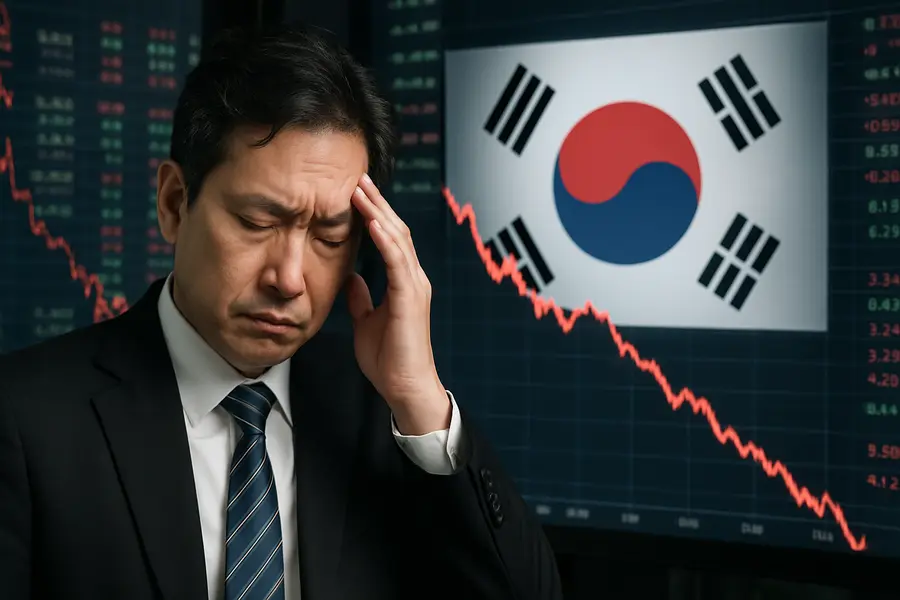
South Korea's Kospi index crash halted trade for 20 minutes on June 26 as a massive chip selloff drove Samsung and SK Hynix each down more than 10%, extending a punishing three-week semiconductor rout.
- The Kospi index fell as much as 9% on June 26, triggering a mandatory trading halt 2026 under Korea Exchange circuit-breaker rules.
- Samsung Electronics and SK Hynix both slid more than 10%, with foreign investors offloading 3 trillion won ($1.9 billion) in the morning session.
- Three converging catalysts drove the South Korea stocks selloff: MSCI's renewed Developed Markets exclusion, leveraged ETF regulatory warnings, and a hawkish Federal Reserve.
Lead
Seoul, June 26 — South Korea's Kospi index crashed as much as 9% on Thursday, triggering a mandatory 20-minute trading halt imposed by the Korea Exchange after the benchmark slipped past the threshold activating the bourse's circuit-breaker mechanism. Samsung Electronics and SK Hynix, the two semiconductor giants that together account for roughly half of the index's market capitalization, each plunged more than 10% at intraday lows. Foreign investors sold approximately 3 trillion won ($1.9 billion) of Kospi-listed shares in the morning session alone, one of the largest single-session outflows in recent history, confirming that the rout extends well beyond domestic selling pressure.
What Happened
The South Korea stocks decline on June 26 is the third significant leg down in a chip selloff news cycle that began in early June. The initial break came after Broadcom reported AI revenue guidance that fell short of elevated analyst expectations on June 3, sending global semiconductor benchmarks sharply lower and signaling that AI infrastructure spending had not accelerated as priced. The Philadelphia Semiconductor Index, the closest American proxy for global AI-chip sentiment, lost approximately 8% in that initial wave.
The Kospi index crash on June 26 extends losses that had already seen the benchmark shed nearly 10% in a single session on June 23 — South Korea's fifth-largest single-day decline on record — when the exchange also activated its 20-minute trading halt.
Triple Catalyst
Three distinct forces converged to produce the latest Kospi index crash. First, MSCI announced it would once again exclude South Korea from its Developed Markets watchlist, ending months of anticipation that had drawn substantial passive capital into Korean equities. The removal of that inflow catalyst prompted institutional rebalancing that amplified selling pressure across the board.
Second, domestic financial regulators issued formal warnings over leveraged single-stock exchange-traded funds linked to Samsung Electronics and SK Hynix — products approved only the previous month — citing systemic risk. The regulatory intervention triggered forced liquidations among retail investors who had used borrowed capital to build concentrated chip positions, creating a technical feedback loop that accelerated the broader chip selloff news cycle.
Third, the Federal Reserve's June 17 meeting — at which nine of 18 FOMC participants penciled in at least one additional rate increase in 2026 — had been slowly repricing global equity risk premiums all week. High-multiple growth stocks, including Korea's semiconductor leaders, are particularly sensitive to changes in the discount rate applied to forward earnings. The hawkish recalibration removed a key floor that had supported chip valuations through the first half of the year.
Market Reaction and Global Contagion
The chip selloff news spread rapidly across Asian markets. Japan's Nikkei 225 declined 3.55%, and SoftBank Group fell 15% in Tokyo trade on its exposure to semiconductor and AI holdings. Kioxia, the Japanese memory chip manufacturer, also logged double-digit losses.
In the United States, the Nasdaq Composite declined 2.21% and the S&P 500 lost 1.44% in sympathy, reflecting broad anxiety over AI-related valuations. The severity of the South Korea stocks rout underlines the degree to which Samsung and SK Hynix have become global proxies for AI infrastructure demand: weakness in Seoul now functions as a leading indicator for sentiment in U.S. technology markets. The South Korean won weakened alongside equities, reflecting an abrupt reversal in the risk-on positioning that had built up over the first half of 2026.
Strategic Context
South Korea's equity market carries structural concentration risk that amplifies headline moves. Samsung Electronics and SK Hynix together represent close to 45% of the Kospi's total market value. When both companies fall in double digits in a single session — as occurred on June 26 and again on June 23 — the index has limited natural shock absorbers elsewhere.
The trading halt 2026, while technically brief at 20 minutes, carries symbolic weight beyond its mechanical function: circuit-breaker activations historically coincide with inflection points in market confidence, prompting reassessment from both algorithmic systems and human portfolio managers.
Outlook
Whether the current South Korea stocks rout stabilizes depends on how quickly three unresolved uncertainties are addressed: the pace and scope of Federal Reserve tightening through the remainder of 2026; the speed of any corrective signals from AI hyperscalers on data-center capital expenditure plans; and whether domestic regulatory pressure on leveraged chip ETFs escalates or recedes. Until at least one of those variables shifts materially, Korean semiconductor stocks remain the most exposed single node in the global AI trade, and the Kospi index crash risk remains elevated heading into the third quarter.
Mentioned tickers: 005930.KS, 000660.KS, AVGO, 9984.T