Pomegra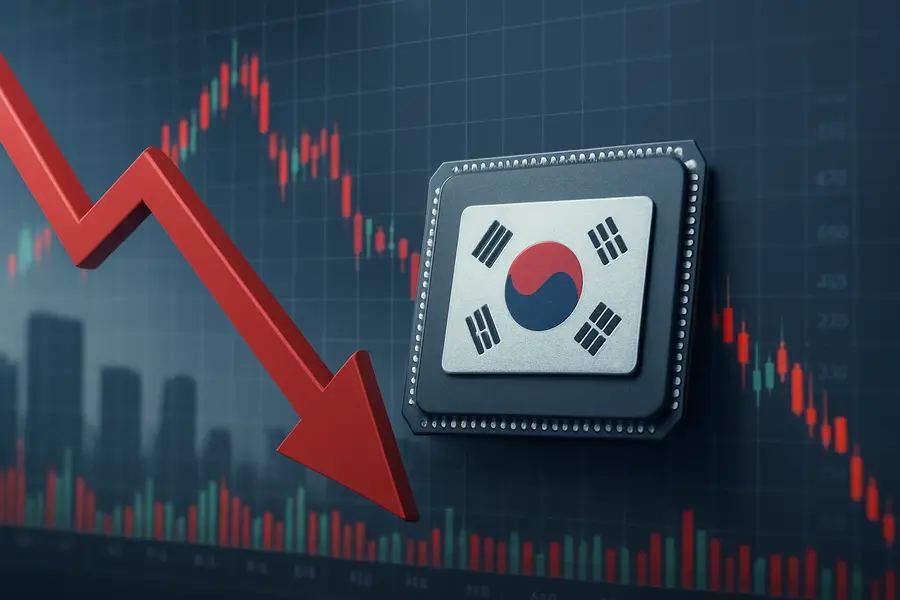
South Korea's Kospi falls 6.25% on July 2 as Samsung Electronics and SK Hynix bear the brunt of a broadening global semiconductor selloff triggered by Meta's cloud computing pivot.
- Samsung Electronics closed down 9.06% at 286,000 won; SK Hynix sank 14.57% to 2,187,000 won on July 2.
- Meta's plan to lease excess AI data center capacity to outside clients upended chip demand assumptions globally.
- South Korea's June semiconductor exports hit a record $44.8 billion, up 199.5% year-over-year — fundamentals remain intact.
Lead
Seoul — South Korean chipmakers absorbed a second consecutive day of severe selling pressure on Wednesday as the Kospi plunged 519.03 points, or 6.25%, to 7,784.38, erasing roughly $80 billion in market value. Samsung Electronics (005930.KS) closed at 286,000 won, a loss of 9.06%, while SK Hynix (000660.KS) sank 14.57% to 2,187,000 won — the steepest single-day drop for either name since the June 23 circuit-breaker event. Foreign investors offloaded an estimated $1.5 billion in Korean equities during the session, concentrated almost entirely in semiconductor positions.What Happened
The immediate catalyst was an overnight report that Meta Platforms (META) is constructing a business unit called Meta Compute to lease idle AI data-center capacity to third-party clients. The disclosure, which sent Meta's own shares up 8.8%, reframed years of assumed AI compute scarcity into an emerging supply surplus. Within hours, the Philadelphia Semiconductor Index fell 6.3%, Micron Technology (MU) shed 10.6%, and Applied Materials (AMAT) and Lam Research (LRCX) each dropped more than 9%.
Compounding the shock, separate reporting confirmed that OpenAI engineers have developed software optimizations capable of cutting AI inference costs by roughly half, further reducing the compute-per-output ratio that has underpinned surging memory demand. Together, the two developments rattled the foundational thesis behind the semiconductor supercycle: that insatiable AI training and inference workloads would sustain extraordinary demand for high-bandwidth memory and advanced logic chips through the end of the decade.
Market Structure Amplifies the Damage
The Kospi's outsized response to overseas developments reflects a structural concentration that has grown acute over the past year. Samsung and SK Hynix together now account for approximately half the benchmark index's total weighting, up from roughly a quarter at the start of 2025. Their joint 2026 rally had been responsible for roughly 70% of the Kospi's record-setting climb to above 9,300 points in early June. When both names give back double-digit percentages in a single session, arithmetic alone ensures the index cannot hold regardless of how the other 900-plus listed companies trade.
The dynamic has created a feedback loop. As foreign investors reduce broad emerging-market exposure, Korean equities receive disproportionate outflows because the largest and most liquid names — the ones easiest to exit — are precisely the semiconductor heavyweights that are also most sensitive to global AI sentiment. June 23 provided an earlier warning: the Kospi fell 9.99%, or 910.71 points, closing at 8,203.84 in its largest-ever point decline, triggering a 20-minute market-wide circuit breaker as Samsung and SK Hynix each lost more than 12%.
A Disconnect With Fundamentals
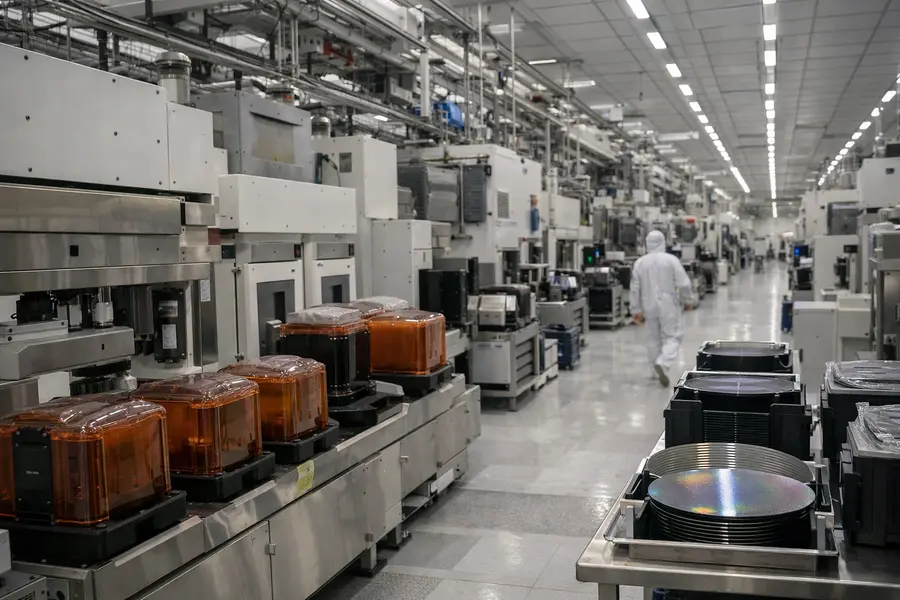
The severity of the price action stands in sharp contrast to operating reality. South Korea's semiconductor exports surged 199.5% year-over-year in June to a record $44.8 billion. DRAM export unit prices reached $82,260 per kilogram, up 576% year-over-year and 6% month-on-month through the first 20 days of June. May DRAM revenues were up 370% year-over-year; NAND revenues rose 207%.
HBM shipments, which SK Hynix pioneered with its HBM3E product, continue to command a substantial premium over standard memory. Order books at both companies remain full through the near term. Despite the current correction, SK Hynix shares are still more than 200% higher year-to-date, and Samsung, though recovering more slowly from earlier setbacks, has recovered substantially from its 2024–2025 lows.The tension between the stock narrative and the export data reflects what market participants are calling "peak-out" fears: a concern that chip revenue growth, while extraordinary, is already priced to perfection and that any evidence of demand normalization or efficiency compression in the AI stack will trigger a repricing of the entire semiconductor supply chain.
Strategic Context
The Meta Compute disclosure raises legitimate medium-term questions for chipmakers. If large-scale AI hyperscalers begin recycling excess capacity commercially — rather than continuing to expand aggressively — the pace of new capital expenditure commitments could slow more quickly than anticipated. That would reduce near-term orders for advanced memory, custom silicon, and the capital equipment needed to manufacture both.
Still, the operative word is pace. The aggregate AI infrastructure buildout is not reversing; it is still growing in absolute terms. Meta itself, even as it monetizes idle capacity, continues to announce fresh data center investment commitments. The question for South Korea chip stocks is not whether demand exists, but whether the explosive growth rate that justified valuations at Kospi highs above 9,000 can be sustained — or whether a more moderate growth path implies a structurally lower earnings multiple.
Samsung is additionally navigating a longer-term competitive challenge. Its HBM qualification timeline at leading AI chip designers has lagged SK Hynix's, and while a resolution is expected later in 2026, the delay has concentrated AI memory revenue disproportionately at SK Hynix. Samsung's foundry operations, competing with TSMC (TSM) in advanced logic, have made steady progress but remain a secondary revenue driver relative to its memory division.
Outlook
The Kospi's two-day rout has wiped out gains accumulated since mid-May, returning the benchmark to levels last seen before the spring AI-driven rally. The fundamental case for South Korean chipmakers — record exports, dominant HBM market position, accelerating AI infrastructure spending globally — has not materially changed in 48 hours. What has changed is the risk premium investors are willing to assign to a narrative that assumes compute scarcity is permanent. Tech volatility of this scale, driven by hyperscaler strategy shifts rather than demand destruction, typically resolves through consolidation rather than continued free-fall. How quickly South Korean equities stabilize will depend on whether U.S. semiconductor stocks find a floor and whether Samsung and SK Hynix's upcoming quarterly guidance reaffirms the strength visible in the export data.