Pomegra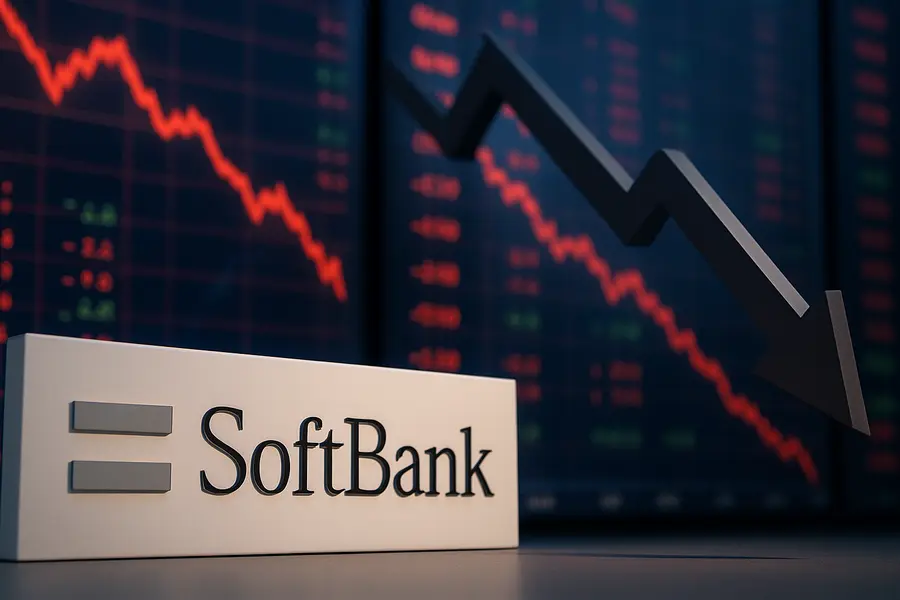
SoftBank stock price plunges as much as 13% on June 26 as OpenAI IPO delay fears converge with a broadening global tech selloff 2026, wiping billions from the Japanese conglomerate's market value.
- SoftBank shares fell as much as 13%, triggered by reports OpenAI may postpone its IPO from 2026 to 2027, deferring returns on a $60B+ stake.
- Japan's Nikkei 225 lost 3.9% and South Korea's KOSPI slid 5.7% as the tech selloff 2026 swept across Asia and into U.S. futures.
- Masayoshi Son's firm targets an 11–13% ownership stake in OpenAI; total exposure is set to reach roughly $65 billion by October.
Lead
SoftBank Group Corp. shares plunged as much as 13% in Tokyo on Friday, June 26, after reports emerged that OpenAI is weighing a delay of its blockbuster initial public offering from 2026 to 2027. The stock fell to approximately ¥6,200, its lowest level in months, as a widening global market rout dragged the Nikkei 225 down 3.9% and extended a losing run that has erased roughly 20% of SoftBank's market value in a single week — enough to strip the conglomerate of its status as Japan's most valuable listed company.What Happened
The catalyst arrived overnight from New York. Reports indicate that OpenAI's advisors have presented management with two paths: proceed with an IPO as soon as possible at a reduced valuation, or hold until 2027 to pursue a target approaching $1 trillion. The disclosure struck SoftBank with particular severity. The firm's cumulative investment in the ChatGPT maker now exceeds $60 billion, with an additional $5 billion of commitments scheduled to bring total exposure to roughly $65 billion by October. Masayoshi Son's firm is targeting an ownership stake of between 11% and 13%.
A delayed listing directly postpones the moment at which that concentrated capital can generate realized returns — a timeline now extending at minimum into 2027. For Son, who has publicly framed artificial general intelligence as the defining technological transition of the coming decades, the position represents his highest-conviction bet in years. SoftBank also controls Arm Holdings, the chip architecture company whose designs underpin the majority of AI-optimized silicon in global production, compounding the firm's exposure to any broad revaluation of the AI infrastructure trade.
Market Reaction
The selloff spread rapidly across Asian markets. South Korea's KOSPI fell 5.7%, shedding more than 508 points, while SK Hynix and Samsung Electronics each declined more than 12%, extending a punishing run for the region's semiconductor complex. Hong Kong's Hang Seng Index dropped 2.0%; China's CSI 300 shed 2.6%. The MSCI Asia ex-Japan Index fell nearly 2.8%.
In U.S. futures, the Nasdaq 100 slipped 0.8% and S&P 500 futures fell 0.4% as portfolio managers trimmed technology exposure ahead of quarter-end rebalancing. The Nasdaq Composite has now closed lower for four consecutive sessions — its longest losing streak in months.
The session tracked a difficult Wall Street handoff. Apple Inc. fell more than 6% overnight after raising hardware prices to offset surging chip costs, a disclosure that reinforced concern over the degree to which AI infrastructure spending is compressing margins across the supply chain.
Strategic Context
SoftBank's OpenAI exposure is a deliberate balance-sheet expression of Son's conviction that AI will restructure the global economy. In addition to direct equity, the firm arranged a $6 billion margin loan facility backed by OpenAI shares — a structure that amplifies both potential gains and downside risk in a volatile pricing environment.
An OpenAI IPO near a $1 trillion valuation would be transformative for SoftBank's net asset value, potentially unlocking tens of billions in mark-to-market appreciation and providing the capital velocity to fund the next phase of Son's AI infrastructure ambitions. A 12-month delay compresses that path and introduces valuation risk: the longer the IPO window stays shut, the more intensely markets will scrutinize whether AI monetization is materializing at the rate embedded in current private-market pricing.
Global Dimension
The tech selloff 2026 has been building since mid-June, driven by a convergence of pressures: stretched AI valuations following a record-breaking first half, reduced expectations for Federal Reserve rate cuts, and mounting evidence that AI capital expenditure is outpacing near-term revenue generation. South Korea's KOSPI had already retraced 10% from record highs by mid-week before Friday's additional losses. In Europe, the Stoxx 600 Technology index declined 3% in the prior session. Global market news has been dominated by the unwinding of the AI infrastructure trade, which has disproportionately punished the names most leveraged to the theme: SoftBank, Arm, SK Hynix, and the broader hyperscaler-adjacent semiconductor supply chain.
The selloff also raises structural questions about the durability of private AI company valuations and the capacity of public markets to absorb the wave of AI-related issuance that had been expected to define the second half of 2026.
Outlook
SoftBank's near-term trajectory remains tightly coupled to two variables: the OpenAI IPO timeline and the broader course of global market news around AI valuations. If OpenAI elects to wait until 2027 to pursue a trillion-dollar listing, SoftBank faces continued multiple compression until a concrete new schedule materializes. Masayoshi Son has navigated prior periods of mark-to-market pressure — most notably during the Vision Fund era — but the scale of the current concentrated position and the global scope of the tech selloff 2026 make the present episode among the most consequential tests of the firm's strategy in its modern history.
Mentioned tickers: 9984.T, AAPL, ARM, 005930.KS, 000660.KS