Pomegra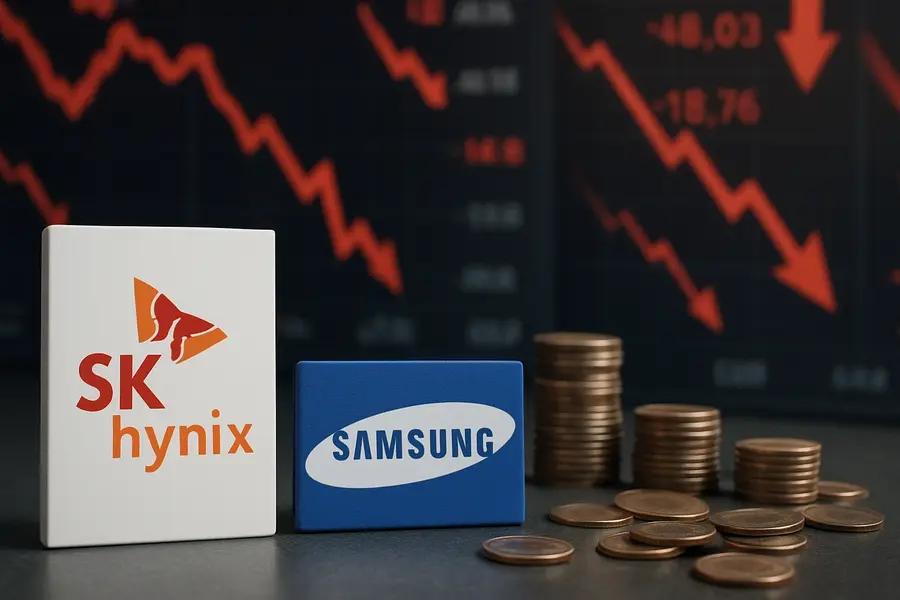
SK Hynix and Samsung each shed more than 4% on June 23, 2026, a day after SK Hynix displaced Samsung atop Korea's equity market for the first time since 2000.
- SK Hynix's market cap reached ₩2,082.5 trillion ($1.35 trillion) on June 22, edging past Samsung's ₩2,066.7 trillion — the first valuation reversal on the KOSPI in 26 years.
- Both chipmakers retreated sharply the following session as profit-taking, HBM supply strategy concerns, and overnight U.S. tech weakness converged.
- SK Hynix holds 61% of the global high-bandwidth memory market versus Samsung's 17%, the AI-era divergence that drove the valuation crossing.
Lead
Seoul, June 23 — Shares of SK Hynix Inc. and Samsung Electronics Co. each fell more than 4% on Tuesday, reversing the prior session's landmark milestone in which SK Hynix overtook Samsung as South Korea's most valuable listed company for the first time in 26 years. The Korea Composite Stock Price Index slid 4.6% from a record high, with foreign institutional investors turning net sellers for a second consecutive session after an extraordinary AI-driven rally had propelled both chipmakers to historic valuations.
What Happened
On Monday, June 22, SK Hynix closed up 5.6% in Seoul trading, lifting its market capitalisation to approximately ₩2,082.5 trillion — roughly $1.35 trillion — just ahead of Samsung Electronics' ₩2,066.7 trillion on a common-share basis. The crossing was the first time since 2000 that Samsung had yielded the top position on South Korea's benchmark equity index. Samsung disputes the ranking on a fully diluted basis: including preferred shares, its combined value stands near ₩2,252 trillion. The market-standard measure, however, weights common-share capitalisation for index purposes, and by that convention SK Hynix had claimed the summit.
The reversal lasted one session.
Market Reaction
SK Hynix and Samsung Electronics each shed more than 4% on Tuesday, driving a 4.6% decline in the KOSPI from its all-time closing high. The move was the index's worst single-session drop in more than a month. Elevated trading volumes accompanied the selloff as foreign institutional investors — the primary buyers through the index's year-to-date surge — pivoted to net sellers. The won weakened modestly against the dollar as capital flows reversed.Why It Fell
Three pressures converged.
Strategic Context
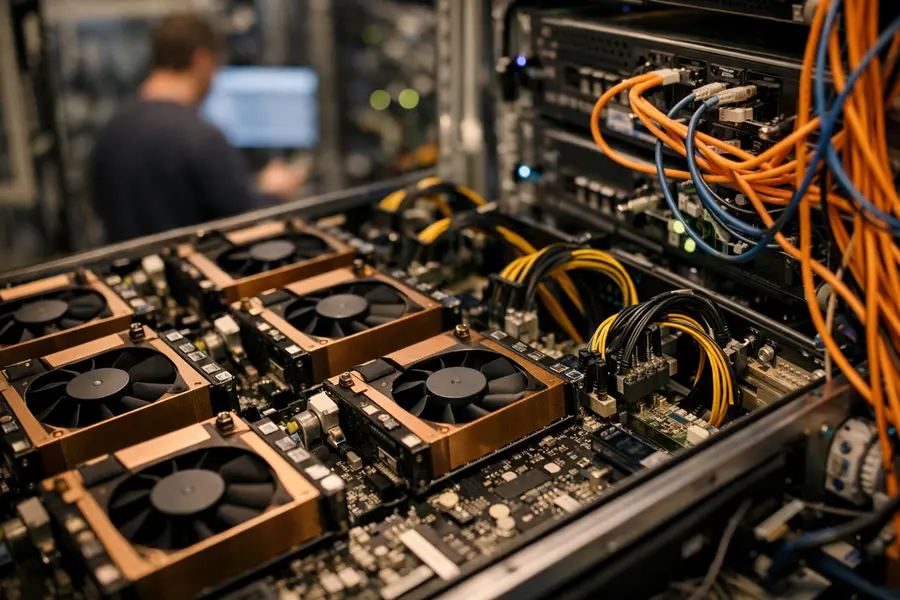
The valuation flip between SK Hynix and Samsung reflects a structural divergence in the two companies' positioning within the AI supply chain. Samsung retains a dominant share of conventional DRAM and NAND flash, and its foundry and logic chip businesses provide revenue diversification. SK Hynix has concentrated capital allocation almost entirely on HBM — the specialised stacked memory architecture that Nvidia and other AI chip designers require in volume.
The consequence is asymmetric market sensitivity. SK Hynix trades in tighter correlation with AI capital expenditure cycles, while Samsung has lagged on HBM because of yield challenges and certification delays that cost it market position in 2024 and 2025. That gap — 61% versus 17% in HBM market share — defines the valuation premium the market has assigned to SK Hynix.
The magnitude of the reversal also carries historical resonance: in 2003, shares of then-Hynix Semiconductor fell as low as ₩135 apiece as the company teetered on the edge of a distressed sale to Micron. Tuesday's pullback from a $1.35 trillion valuation underscores how thoroughly that chapter has been rewritten.
Outlook
Tuesday's correction is unlikely to resolve the structural question of which chipmaker merits a higher valuation. SK Hynix's HBM dominance remains intact, and Nvidia's accelerator roadmap requires increasing HBM capacity per device with each successive generation. Samsung's recovery in HBM is contingent on resolving yield issues and securing fresh certifications from hyperscale customers. Whether the pullback proves a brief pause in SK Hynix's ascent or the beginning of a more sustained rebalancing depends on whether AI infrastructure spending signals from U.S. cloud operators hold through the second half of 2026.
Mentioned tickers: 000660.KS, 005930.KS, HXSCL