Pomegra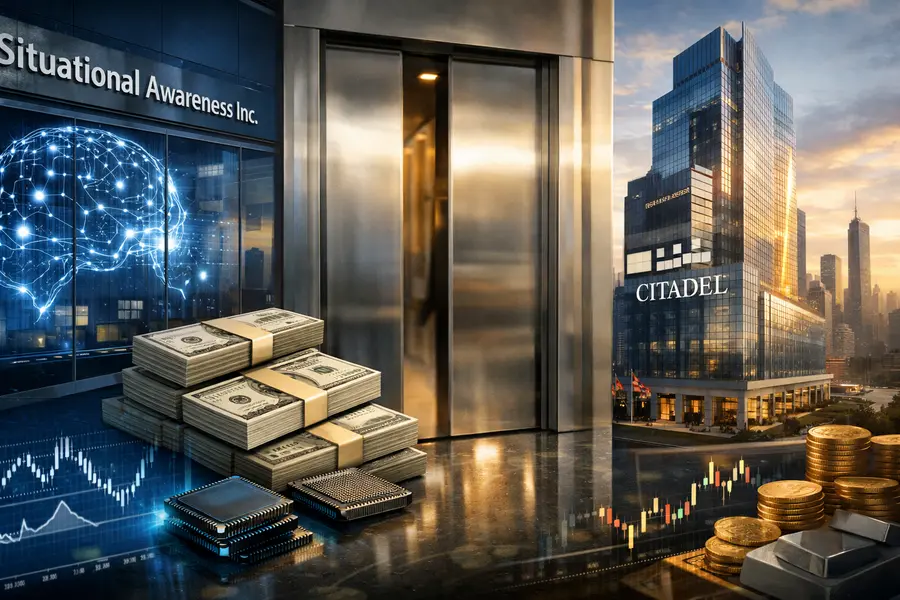
Situational Awareness LP sold its $16B public equity book to Citadel in a single block trade after 4x leverage turned a 439% gain into forced liquidation.
- Situational Awareness LP transferred its entire ~$16B public-equity book to Ken Griffin's Citadel in a single block trade on July 30, 2026.
- The fund's 4x leverage on AI infrastructure stocks — SK Hynix (SKHY), CoreWeave (CRWV), Nebius (NBIS) — fell 35–47% during July's rout, triggering cascading margin calls.
- A ~$5B Anthropic stake remains intact; the fund will continue operating as a private investment vehicle.
Lead
Situational Awareness LP, the AI-thesis hedge fund founded by former OpenAI researcher Leopold Aschenbrenner, transferred its entire public equity book — estimated at roughly $16 billion — to Ken Griffin's Citadel in a single block trade executed before U.S. markets opened on July 30, 2026. The transaction, among the largest single-day block trade transfers in recent hedge fund history, ended a run that had taken the vehicle from $225 million at inception in late 2024 to as much as $45 billion in peak assets, generating a 439% net return through June 30.
What Happened
The sale was not voluntary. Margin calls from three prime brokers — Goldman Sachs, JPMorgan Chase, and Bank of America — forced Situational Awareness to liquidate its entire public equities position in one transaction. Millennium Management also submitted a bid, but Citadel acquired the book. The structure reflects the logic of a block trade screen: rather than executing piecemeal in the open market, which would have moved prices sharply against the fund, Citadel absorbed the entire portfolio at a discount, assuming the market risk in a single negotiated transfer.
The AI Infrastructure Rout
The chain of events began on July 10, 2026, when SK Hynix completed a $28 billion U.S. listing on the Nasdaq under the ticker SKHY — among the largest IPOs in American market history. Situational Awareness had anchored the book with a roughly $7 billion cornerstone indication, making it one of the most visible participants in the offering. The listing coincided with a broader unwind of leveraged positions in South Korean equities. Within weeks, SKHY shares fell approximately 47% from their June peak, sending a cascade through the fund's long positions.
CoreWeave (CRWV) and Nebius Group (NBIS) — AI cloud infrastructure operators in which the fund held concentrated stakes — fell more than 35% during July. Micron Technology (MU) and SanDisk (SNDK) each declined between 27% and 42%. Bloom Energy (BE), held as an AI power-demand play, dropped alongside broader infrastructure names. The Philadelphia Semiconductor Index fell 28.6% from its June 22 peak over the same stretch. The Morgan Stanley Momentum TMT Index, a proxy for the concentrated positioning prevalent among AI-focused funds, shed 53.5%.Short positions compounded the losses. Situational Awareness had shorted software incumbents including Adobe (ADBE) on the thesis that generative AI would erode their revenue base. Software stocks rallied through July, turning those positions into a secondary drag.
The Leverage Trap
The structural failure was leverage. Situational Awareness had run approximately 4x gross exposure — borrowing roughly $400 for every $100 of fund equity — financed by Goldman, JPMorgan, and Bank of America. That leverage amplified returns spectacularly on the way up. When AI infrastructure stocks fell 35–47%, the equity cushion supporting the borrowed capital was rapidly consumed. Prime brokers moved to margin calls that the fund could not satisfy through gradual selling.
Hedge fund trading at that scale requires counterparties capable of absorbing positions without triggering further market dislocations. That constraint pointed directly to block trade execution with a single buyer large enough to warehouse risk. Citadel, with the infrastructure and balance sheet to hold and gradually unwind a $16 billion AI-weighted book, stepped in at a discount to prevailing bids.
Market Reaction
The forced sale produced an immediate irony. On July 30 — the same session in which the block trade cleared — the fund's former holdings rebounded sharply. SKHY rose approximately 17%. SNDK climbed around 24%. MU advanced roughly 18%. CRWV gained more than 21%. NBIS jumped over 27%. The rapid recovery indicated that concentrated, leverage-driven selling pressure — not a deterioration of the underlying AI demand thesis — had driven the bulk of July's decline. Citadel acquired a $16 billion AI book near its multi-month lows.
What Remains
Situational Awareness retains a stake in Anthropic valued at approximately $5 billion — a private holding immune to the prime-broker margin calls that forced the public-market exit. The fund's backers — including Stripe co-founders Patrick and John Collison, Nat Friedman, Daniel Gross, and Jane Street — remain committed. Going forward, the vehicle will operate as a private investment fund. Despite the liquidation, the fund is estimated to remain up approximately 80% from inception, a residual that reflects the magnitude of gains accumulated before July's drawdown.
Outlook
The collapse of Situational Awareness LP's public equity book marks the most prominent single casualty of the July 2026 AI infrastructure rout, and a precise illustration of how 4x leverage destroys a correct macro thesis during a sharp drawdown. The fund's original framework — that AI infrastructure would dominate the next phase of technology capital formation — was not disproved; its former holdings recovered materially within hours of the forced sale. What failed was the risk architecture beneath the thesis. With Citadel now holding the portfolio and AI infrastructure names recovering, the episode will be studied as the defining case study in how hedge fund trading dynamics, and specifically the block trade screen mechanism, interact with concentrated leveraged bets during forced liquidation events.
Mentioned tickers: SKHY, CRWV, NBIS, MU, SNDK, BE, ADBE