Pomegra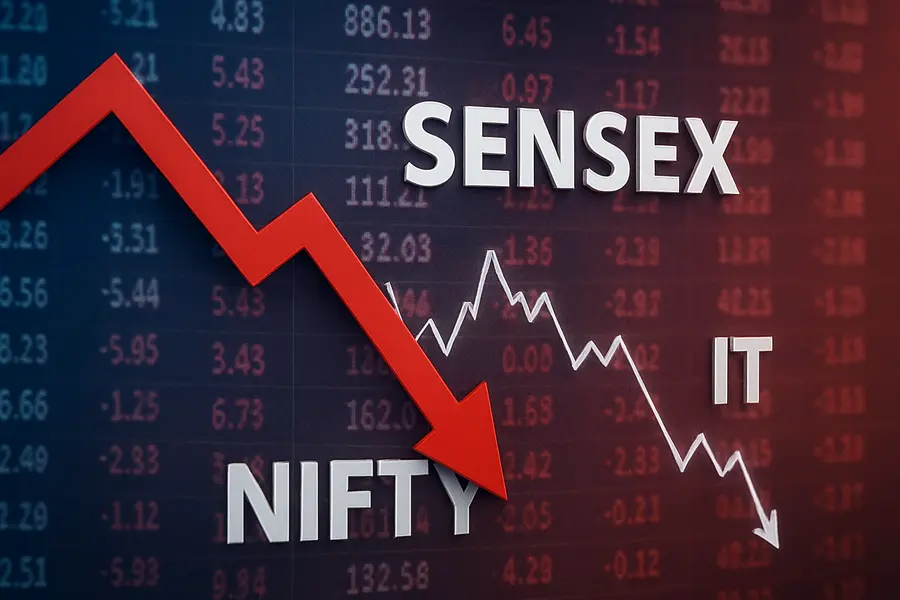
Indian equity benchmarks fell for a second consecutive session June 30, as a 2.7% plunge in the Nifty IT index overwhelmed sector gains, dragging the Sensex to 76,478.67 and Nifty to 23,865.75.
- Sensex fell 249.70 points (-0.33%) to 76,478.67; Nifty 50 slipped 80.50 points (-0.34%) to 23,865.75 on June 30.
- The Nifty IT index declined 2.7% for its second consecutive session, with Infosys, TCS, and Wipro the biggest index drags.
- Indian IT stocks have shed 29% year-to-date; the sector's weight in Nifty 50 has dropped below 7.6%, the lowest recorded since 2002.
Lead
Mumbai, June 30, 2026 — Indian equity markets fell for a second straight session as the Nifty IT index slumped 2.7%, pulling the BSE Sensex down 249.70 points, or 0.33%, to close at 76,478.67, while the Nifty 50 shed 80.50 points, or 0.34%, to settle at 23,865.75. The two-day retreat has extended what has become one of the most prolonged tech stock selloffs in India's modern market history and raised fresh questions about the sector's trajectory heading into the Q1 FY27 earnings season.
What Happened
The session's losses were concentrated almost entirely in technology. Infosys fell 3.5%, Tata Consultancy Services declined 3.2%, and Wipro slid 2.9%, making the three heavyweights the top drags on the benchmark. HCL Technologies dropped 2.8% and Tech Mahindra shed 2%. The combined selling was sufficient to push the broader index into the red despite modest gains in financial and consumer-staples stocks.
Monday's close follows a sharper decline on June 29, when the Sensex fell 372.10 points, or 0.48%, to 76,728.37, and the Nifty finished at 23,946.25, down 109.75 points or 0.46%. That session was rattled by Iran's accusation that the United States had violated the fragile June 17 ceasefire agreement, which revived fears of a broader Middle East escalation and weighed on risk appetite across Asian markets.
The IT Stock Selloff in Context
The IT stock losses today are the latest chapter in a sustained selloff that has reshaped the composition of India's flagship index. The Nifty IT index has lost 29% this calendar year — nearly three times the pace of the Nifty 50's 9% decline — and the combined weight of the five major IT companies in the Nifty 50 has fallen below 7.6%, the lowest level recorded since at least 2002.
The sector's slide accelerated sharply in mid-June when Accenture trimmed its fiscal 2026 revenue growth forecast to 3%–4% from 4%–5%, citing broad-based client caution and a $100 million revenue drag from the Middle East. Accenture's stock fell nearly 18% in a single session, its steepest single-day decline on record, and its guidance carries particular weight as an early-cycle demand signal for the entire global IT services industry. Indian markets reacted in kind: the Nifty IT index fell 6% in one session, with Infosys crashing 8.19% to Rs. 1,034 and TCS declining 6.52% to Rs. 2,060 on the day of the announcement.
Why IT Stocks Are Under Pressure
Two structural forces are compounding the demand-side weakness. First, elevated U.S. interest rates — with the Federal Reserve signaling rates will remain higher for longer — raise the cost of capital for enterprise technology buyers and historically prompt delays in discretionary IT spending. Total IT budget growth ran roughly flat in 2026 even as AI prioritization within those budgets increased, according to market analysis. That reallocation is the second pressure point: rapid adoption of generative AI tools is beginning to erode the traditional outsourcing model that underpins the revenue base of India's largest software exporters.
Investors approaching the Q1 FY27 earnings season — results from TCS, Infosys, HCL Technologies, and Wipro are expected in mid-July — are focused on management commentary around deal closures, large-deal momentum, discretionary order books, and the pace at which AI-related revenues are materializing to offset legacy contract pressure.
Market Reaction
Outside IT stock losses, Monday's session showed a bifurcated market. Financial, energy, and fast-moving consumer goods stocks provided partial support, capping the Sensex's decline at roughly a third of a percent. Selling in auto stocks — another export-sensitive segment — added a secondary drag alongside IT. Sensex Nifty live updates throughout Monday tracked a steady drift lower from the open, with no meaningful intraday recovery. Volume on the BSE was broadly in line with the 30-day average, indicating the move reflected repositioning rather than panic-driven liquidation.
The geopolitical backdrop added another layer of uncertainty. Iran's accusation of a U.S. ceasefire violation renewed fears of crude oil supply disruption, nudging Brent crude higher and squeezing import-dependent emerging market equities, including India.
Outlook
The near-term trajectory for Indian stock market news will be shaped by two catalysts. Incoming U.S. macroeconomic data — including Friday's nonfarm payrolls report — could shift Federal Reserve rate expectations and either accelerate or ease pressure on export-oriented IT sector valuations. Beyond that, mid-July earnings guidance from India's IT majors will serve as the definitive signal. Any indication of demand stabilization or large-deal acceleration holds the potential to arrest the sector's slide. A continuation of cautious management outlooks, however, risks extending the worst annual run for Indian IT in more than two decades. The Indian stock market enters the second half of 2026 with its largest sector substantially offside — a condition that has historically resolved either through earnings validation or a deeper structural de-rating.
Mentioned tickers: SENSEX, NIFTY50, INFY, TCS, WIPRO, HCLTECH, TECHM, ACN