Pomegra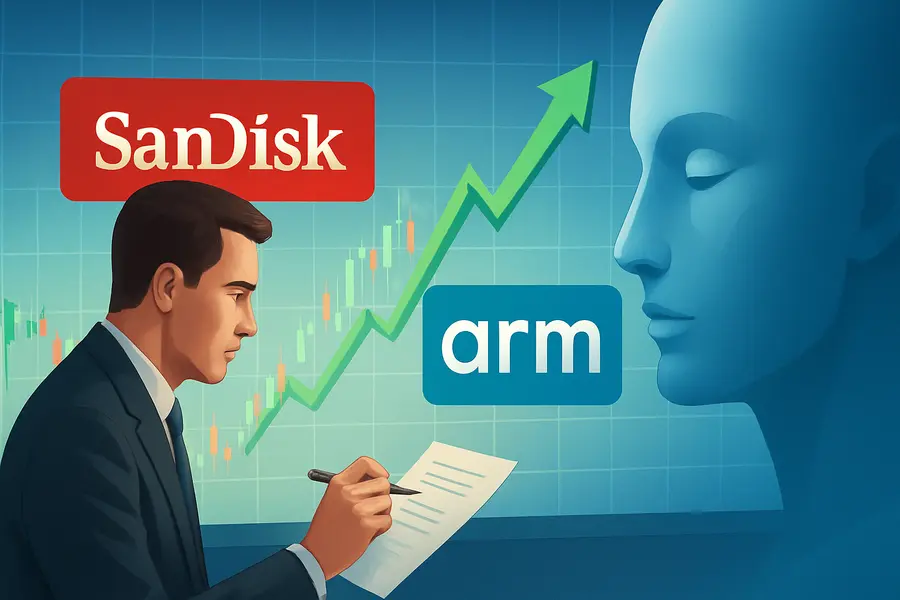
Lead
Wall Street moved aggressively on two of the semiconductor sector's highest-profile names in the first week of July 2026. SanDisk Corporation (SNDK) received a sweeping target lift from Bernstein — from $1,700 to $3,000 — while Bank of America Securities reaffirmed its Buy rating and set a $2,500 objective on July 1. Arm Holdings plc (ARM), which reported record fiscal-year results in May, continues to accumulate upgrades on the strength of its AGI CPU platform, with Mizuho posting the Street's most aggressive target at $500 and a Buy-skewed consensus now covering 36 analysts.
- Bernstein raised its SanDisk price target to $3,000 from $1,700; Bank of America reiterated Buy at $2,500 on July 1, 2026.
- ARM Holdings posted record FY2026 revenue of $4.92 billion, up 23% year-over-year, with its AGI CPU drawing over $2 billion in early customer commitments.
- ARM stock has advanced roughly 80% year-to-date; SanDisk stock has climbed from approximately $37 in early 2025 to above $2,000 by mid-2026.
What Happened
For SanDisk stock, the Bernstein upgrade stands as the most significant single-session catalyst in the current cycle. The firm's analyst team, led by Mark Newman, cited the company's fully sold-out 2026 production capacity and an accelerating enterprise SSD pricing cycle as drivers for the near-doubling of the price objective. Bank of America's $2,500 target implies roughly 40% upside from SanDisk's July 1 close and echoes an earlier Barclays raise to $2,300 on May 27 and Susquehanna's Street-high $3,250 set on May 29.
On the ARM price target front, revised assumptions around agentic AI workloads have reshuffled consensus materially since early 2026. Mizuho lifted its target to $500 on June 4 following Computex disclosures that Oracle and ByteDance had joined the company's AGI CPU platform. Bank of America followed on June 11 with a $335 objective. The consensus across 28 analysts now sits near $295, though the stock's year-to-date advance has left mean targets trailing market price by roughly 38%, according to available Street data.
Market Reaction
SanDisk shares swung between $1,693 and $2,113 during the July 3 session, reflecting both the magnitude of the recent re-rating and elevated volatility consistent with a stock that has risen from single digits to four figures in roughly 18 months. The spread between the current consensus target near $1,864 and the Bernstein bull case at $3,000 indicates that the analyst community is still calibrating how much of the NAND upcycle is already priced in. ARM stock has gained approximately 80% in 2026, extending a multi-year rally rooted in royalty revenue growth and AI licensing momentum. The gap between ARM's trading price and the Street's mean target reflects genuine disagreement about how quickly the AGI CPU ramp will contribute to royalties — a variable that will likely dominate analyst models through fiscal 2027 and 2028.Strategic Context
SanDisk's investment case rests on a structural shift in enterprise storage demand. Artificial intelligence training and inference workloads require dense, high-throughput NAND flash at a scale that is filling fab capacity well in advance of production. The company has reported 251% year-over-year revenue growth, disclosed that 2026 capacity is fully committed, and indicated that 2027 bookings are tracking strongly, with contracts totaling at least $42 billion. The parallel introduction of BiCS10 — its 10th-generation 1Tb TLC 3D NAND — demonstrates continued technology investment designed to maintain per-gigabyte cost leadership as the cycle matures. ARM occupies a different part of the AI supply chain. Its business model — licensing processor architectures and collecting royalties on every chip shipped — gives it structural leverage across smartphones, data centers, and custom silicon simultaneously. The company generated $4.92 billion in fiscal 2026 revenue, with royalty revenue of $2.613 billion and licensing and other revenue of $2.307 billion. The AGI CPU, a data center processor co-developed with Meta and already committed to by OpenAI, Cloudflare, SAP, and SK Telecom, addresses agentic AI workloads directly. CEO Rene Haas disclosed on the May earnings call that demand for the platform had exceeded $2 billion across fiscal 2027 and 2028 — more than double the $1 billion figure cited at the product launch just six weeks earlier. The company sees a $100-billion-plus addressable market in data center CPUs by 2030, predicated on the estimate that agentic AI deployments will require more than four times current CPU capacity per gigawatt of compute.AI and Technology Angle
The SanDisk ARM pairing in this analyst cycle illustrates how AI infrastructure spend is widening across the semiconductor stack. GPU-centric investment theses dominated 2023 and 2024; 2025 and 2026 have drawn capital toward memory and CPU architecture, the two components required to move and process data at AI scale. NAND flash is the persistent storage substrate for model weights and inference outputs; ARM-based CPUs handle orchestration, edge inference, and an increasing share of server workloads that are too latency-sensitive or cost-constrained for GPU clusters.
Analyst upgrades across both names reflect a maturing view that the current AI buildout is demand-driven rather than speculative inventory accumulation — a distinction that underpins the bull case for sustained pricing and capacity utilization.
Outlook
SanDisk enters the second half of 2026 with a sold-out order book, next-generation NAND in sampling, and a target range spanning $1,864 at consensus to $3,250 at the high end. The primary risk is a sharper-than-expected decline in enterprise SSD pricing should hyperscaler capex moderate or competing capacity comes online sooner than current booking visibility implies. ARM faces a different set of variables. First production revenue from the AGI CPU is not expected until Q4 fiscal 2027, meaning near-term results will continue to reflect the existing royalty model. With analyst tech ratings for ARM skewing 35% Strong Buy and 48% Buy across the current coverage universe, the Street is pricing in a successful ramp — but the 38% gap between consensus target and market price signals that valuation discipline is keeping a portion of the analyst community at a cautious distance.Both names remain central to institutional positioning in the AI infrastructure trade heading into the second half of the year.