Pomegra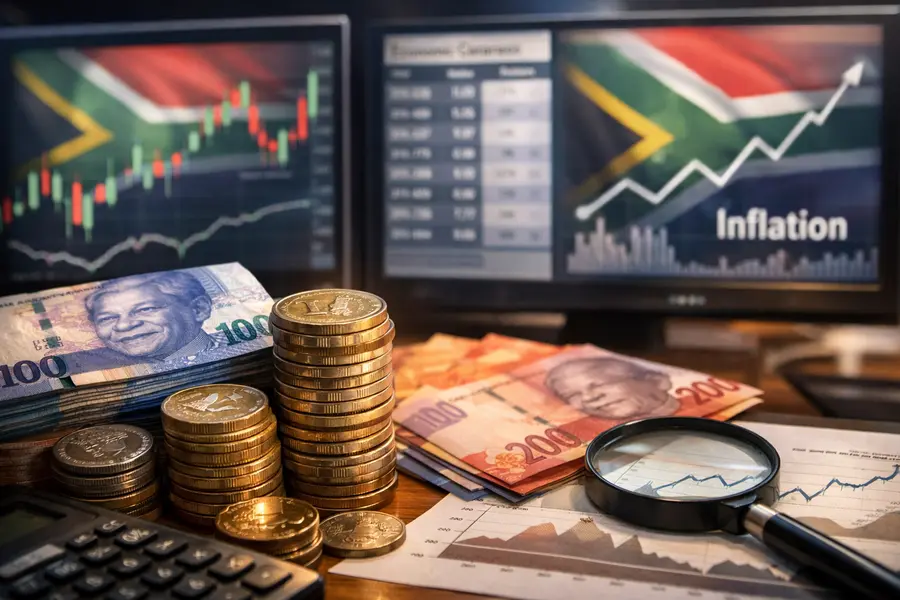
The South African rand held near 16.40 per dollar ahead of June inflation figures, supported by firm gold prices, before annual consumer price growth accelerated to a two-year high of 5.0%, sharpening debate over the central bank's next rate move.
- The rand traded at 16.3975 per dollar on July 22, down 0.42% on the session, holding within the week's 16.2853–16.566 range.
- June CPI rose to 5.0% year-on-year from 4.5% in May, the highest reading since June 2024's 5.1%, driven by a 34.3% annual surge in fuel prices.
- The hotter-than-expected print keeps the South African Reserve Bank (SARB) rate decision firmly in focus, with the repo rate currently at 7.00%.
Lead
The South African rand traded steadily at around 16.40 against the dollar in morning trade on July 22, 2026, as investors positioned cautiously ahead of the release of June consumer price data by Statistics South Africa (Stats SA). Buoyant gold prices provided a modest underpin for the emerging market currency. When the numbers landed, they delivered an upside surprise: annual CPI accelerated to 5.0% from 4.5% in May, lifted sharply by transport and fuel costs, sending the rand into tightly range-bound trade as markets assessed implications for monetary policy.
What Happened
Stats SA confirmed that the consumer price index rose 0.7% month-on-month in June and 5.0% on an annual basis, the steepest pace recorded in two years. The outturn exceeded market consensus and marks the most significant inflationary acceleration since the 5.1% reading in June 2024.
Transport was the dominant driver, with its annual rate jumping to 12.7% from 9.4% in May. Fuel prices surged 34.3% over the 12 months to June, with diesel climbing 50.8% and petrol rising 31.7%. The pass-through from elevated energy costs into broader categories remains a key concern for policymakers, given fuel's weight in both household budgets and production costs.
The latest print arrives against a backdrop of earlier price pressure signals. Producer price inflation reached 7.8% year-on-year in May, pointing to upstream cost pressures still working their way through supply chains. A 1.8% decline in the composite leading business cycle indicator meanwhile flags softening forward momentum, complicating any straightforward hawkish policy response.
ZAR USD Exchange Rate and Market Reaction
The ZAR USD exchange rate reflected measured positioning. The rand traded at 16.3975 per dollar on July 22, off a weekly high of 16.566 touched on July 19 — when uncertainty around the SARB decision and rising oil prices had briefly pushed the pair above 16.50 — but firmer than the 16.2853 low recorded on July 15.
On a broader horizon, the rand's resilience is notable. The South African rand has appreciated 0.79% over the past month and is up 6.54% against the dollar over the trailing 12 months, reflecting a combination of improving domestic fiscal credibility, a still-attractive carry relative to developed-market peers, and a weaker broad dollar.
Gold, South Africa's most valuable export commodity, provided a supportive backdrop. Higher bullion prices bolster the country's trade balance and tend to lend short-term support to the rand, a dynamic that helped insulate the emerging market currency from more pronounced pre-data selling.
Strategic Context: SARB and the Inflation Mandate
The June CPI reading places South Africa inflation at 5.0%, within the SARB's formal target band of 3%–6% but near the upper bound. Governor Lesetja Kganyago has repeatedly flagged inflation credibility as a non-negotiable priority, signalling that the central bank retains flexibility to tighten if price pressures prove persistent.
In a significant institutional move, the SARB has committed to lowering its operational inflation target from 4.5% to 3.0%, a shift that markets have treated as credible — 10-year inflation expectations derived from inflation-linked bonds have fallen from around 6% to approximately 4%. This anchor matters for the ZAR: a credible central bank typically attracts capital into local-currency assets, supporting the exchange rate.
Market pricing currently assumes the repo rate holds at 7.00% through most of 2026, with consensus favouring a single 25-basis-point cut in the fourth quarter contingent on inflation returning sustainably toward the midpoint of the target range. The June CPI overshoot makes any near-term easing more difficult to justify without additional evidence of disinflation in subsequent months.
Geopolitical and Emerging Market Dimension
The rand does not trade in isolation. Emerging market currencies broadly have navigated a demanding environment in 2026, contending with a Federal Reserve that has maintained a hawkish tone and a global growth outlook that remains uneven. The dollar's residual strength has compressed the room for EM central banks to ease without triggering currency depreciation and imported inflation — a constraint the SARB is acutely aware of.
For South Africa specifically, persistent domestic structural challenges — including elevated youth unemployment, energy supply constraints, and subdued private investment — weigh on the economy's medium-term trajectory even as near-term inflation accelerates. The composite leading indicator decline underscores that demand-driven inflationary momentum is limited; the June CPI spike is primarily a supply-side energy story rather than a signal of overheating.
Outlook
The June South Africa inflation data at 5.0% represents the near-term ceiling of the rand's macro challenge: elevated but still within the SARB's mandate, driven by a fuel-price surge that may not persist if global oil markets stabilise. The South African rand is likely to remain reactive to the SARB's rate guidance, global risk sentiment, commodity prices — particularly gold — and the trajectory of the dollar.
For the ZAR USD exchange rate, a continuation of the current 16.30–16.55 band is plausible in the near term, with direction increasingly determined by whether subsequent CPI readings confirm the June acceleration or reveal a temporary spike. A SARB that opts to hold and signal vigilance rather than act immediately may be sufficient to keep the emerging market currency broadly supported, provided global risk appetite does not deteriorate materially.