Pomegra
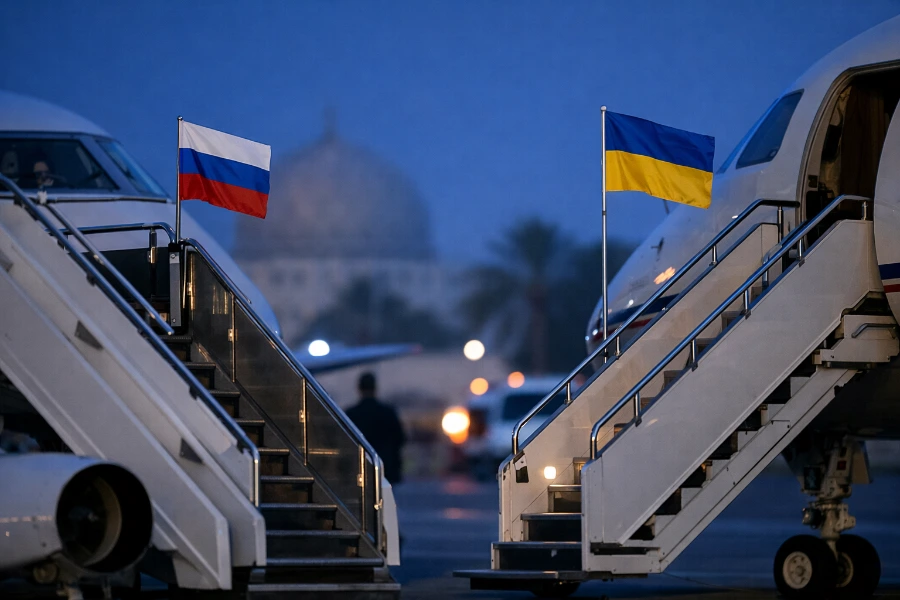
Russian and Ukrainian officials held nearly four hours of U.S.-brokered talks in Abu Dhabi, their first since February, as the White House voiced cautious optimism.
- Delegations from Russia and Ukraine met with U.S. mediators in Abu Dhabi on Nov. 10, with a second day set for Nov. 11.
- The first session lasted nearly four hours, and the agenda centers on security guarantees, NATO and territory.
- Brent crude sits near $104 a barrel, and the MOEX Russia index slipped about 0.6% on the day.
Lead
Russian and Ukrainian officials opened two days of U.S.-brokered negotiations in Abu Dhabi on Tuesday. It is the first meeting with American mediators present since February. The White House described itself as "cautiously optimistic" as the session ended after nearly four hours. Secretary of State Marco Rubio called the exchange "very productive" and gave no details. Markets responded modestly: the MOEX Russia index fell to about 2,456 points, down roughly 0.6% from a close of 2,473.14 on Nov. 9.
What Happened in Abu Dhabi?
The talks restarted a diplomatic track that produced no breakthrough in three earlier rounds this year. U.S. envoys Steve Witkoff and Jared Kushner led the mediation. Gen. Alexus Grynkewich, NATO's supreme allied commander, also attended on the American side.
Ukraine's delegation was headed by Rustem Umerov, with Kyrylo Budanov, Sergiy Kyslytsya and Davyd Arakhamia. Russia's team was led by Vladimir Medinsky, a Kremlin aide and chief negotiator. It also included Deputy Foreign Ministers Sergei Ryabkov and Mikhail Galuzin, and senior military officials Igor Kostyukov and Yuri Zhigarlovsky. Observers from the United Kingdom, France, Germany, Italy, NATO and the European Commission were present.
Ukrainian President Volodymyr Zelenskiy described the first session as constructive and substantive, saying it covered humanitarian and security questions. Kushner said the goal was a new framework capable of securing peace for decades.
Why Is the White House Cautiously Optimistic?
The White House is optimistic because Moscow agreed to return to the table and to put collective security at the top of the agenda. Russian Foreign Minister Sergei Lavrov welcomed that approach. President Donald Trump has pointed to a "very strong inclination" on both sides to end the war and has spoken of a broader "big agreement" extending beyond Ukraine.
The caution reflects the substance of the gap between the parties. Moscow demands that Ukraine cede all of the eastern Donbas region, including areas it has not captured, abandon NATO aspirations and accept limits on its military. Kyiv rejects territorial concessions and restrictions on Western partnerships. It wants a ceasefire to come before any territorial discussion, and it has offered to accept Russian de facto control of occupied land without formal recognition. German Chancellor Friedrich Merz said he held no overly high expectations.
Fighting continues in parallel. Overnight strikes involved 162 Russian drones and missiles and 155 Ukrainian drones. The front line runs about 750 miles and has been largely deadlocked.
How Are Oil and Russian Markets Reacting?
Reaction has been muted so far. Brent crude settled at $103.60 a barrel on Nov. 3, a nearly four-week low, and U.S. West Texas Intermediate settled at $96.09. Traders were weighing prospects for peace in Ukraine against supply risks from the separate conflict involving Iran. The latest crude oil price levels leave room for a further drop if a settlement ever eased pressure on Russian exports, since sanctions on Russian energy have helped support global prices. Russia is the world's third-largest crude producer.
The MOEX Russia index had risen 0.38% on Nov. 9 before the decline. Domestic investors have traded peace headlines repeatedly. The index rallied on news of a U.S. peace plan in November 2025. It then slid to its lowest level since October in June 2026 as hopes for a deal faded. The ruble remains one of the world's stronger currencies despite the strain of war and sanctions, though it softened ahead of the talks.
Geopolitical Dimension
The venue matters. The United Arab Emirates has positioned itself as a neutral convener, and Abu Dhabi has already hosted prisoner-exchange diplomacy and earlier U.S.-Russia contacts. The presence of European and NATO observers addresses a long-standing Ukrainian concern that any settlement be negotiated with the continent's security architecture in view, rather than over Europe's head.
The war is now in its fifth year. Casualties number in the hundreds of thousands, and the Russian economy is under strain from sanctions, high rates and war spending. Ukraine has cited recent battlefield gains and Russian losses as improving its bargaining position.
What Comes Next?
The talks continue Nov. 11, and Witkoff and Kushner may travel on to Moscow and Kyiv to meet Vladimir Putin and Zelenskiy directly. Territory is widely seen as a matter for leader-level negotiation, so any progress on the Donbas question would require those direct meetings. A ceasefire framework tied to security guarantees is the most plausible near-term outcome. A full settlement within the next three to twelve months would need movement on territory and NATO status from both sides.
Outlook
The Abu Dhabi round restores a diplomatic channel that had been idle for nine months and gives the White House grounds for measured optimism. The core disputes over Donbas, NATO and military limits are unchanged. Energy markets and Russian equities will track the outcome of the second day and any follow-up visits to Moscow and Kyiv.
Mentioned tickers: none