Pomegra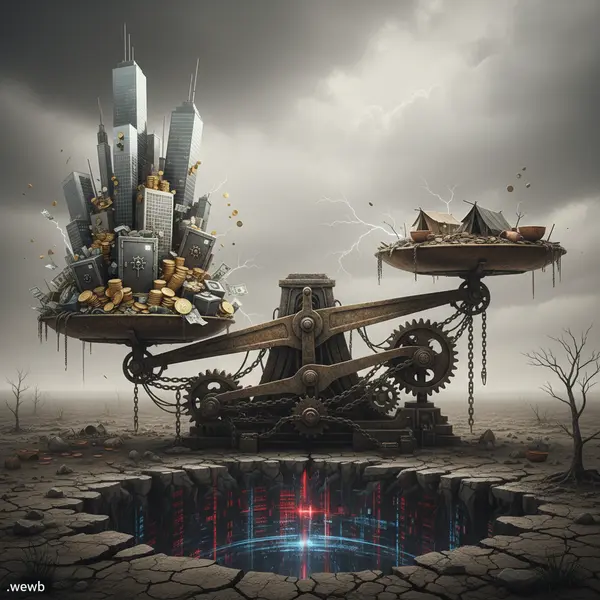
The World Inequality Report 2026 confirms a global financial architecture that channels wealth upward, leaving the bottom half of humanity with just 2% of total global assets as billionaire fortunes hit record highs.
- The top 0.001% — fewer than 60,000 individuals — holds three times more wealth than the poorest four billion people combined.
- Billionaire wealth reached $18.3 trillion in 2025, up 16% in a single year and 81% above 2020 levels, with more than 3,000 billionaires worldwide for the first time.
- A "reverse Robin Hood" dynamic in personal finance sees lower-income households subsidize financial products that benefit only the wealthy and financially sophisticated.
Lead
The World Inequality Lab's third annual World Inequality Report, released in 2026, documents a global financial system under which the top 10% of the world population controls 75% of all wealth while the poorest 50% collectively hold just 2%. A net financial transfer equivalent to 1% of global GDP — three times total global development aid — flows annually from lower-income nations to richer ones, embedded in persistent excess yields and interest-payment structures that define the current international financial architecture.
What the Data Show
The concentration of assets at the apex of the global distribution has reached a scale that renders conventional income statistics insufficient. The top 0.001% — a cohort numbering fewer than 60,000 individuals — now owns three times more wealth than the bottom half of humanity combined, roughly four billion people. The 12 wealthiest billionaires alone possess more assets than the world's poorest 50%.
Oxfam's January 2026 report, Resisting the Rule of the Rich, provides granular color. Billionaire wealth reached $18.3 trillion in 2025, the highest level ever recorded — up 16% in a single year, three times the pace of the preceding five-year average, and 81% above 2020 levels. The global billionaire count has surpassed 3,000 for the first time. In October 2025, Elon Musk became the first individual to cross the $500 billion threshold in personal fortune.
The $2.5 trillion single-year gain in billionaire assets would, Oxfam calculates, be sufficient to eradicate extreme poverty globally 26 times over.
A Rigged System by Design
The structural dimension of the rigged system extends well beyond top-line wealth statistics into the mechanics of everyday financial products. Economists John Y. Campbell of Harvard University and Tarun Ramadorai of Imperial College London detail in their 2025 book, Fixed: Why Personal Finance Is Broken and How to Make It Work for Everyone, a reverse Robin Hood dynamic embedded in retail financial markets.
Lower-income consumers routinely incur preventable costs — revolving credit card interest and late fees, failure to refinance mortgages when rates fall, premature lapsing of life insurance policies — that generate revenue for financial product providers. A portion of that revenue is returned to the market in the form of lower headline prices, but only consumers with financial sophistication and sufficient capital to sidestep the traps benefit. The less financially literate effectively cross-subsidize the more financially literate.
"It sits very uncomfortably when you realize that you're not just a participant but are actually in some ways complicit in this bizarre system that has created essentially this robbing-the-poor-to-pay-the-rich thing," Ramadorai has said of the structure.
Political Power and Democratic Risk
The wealth gap is generating growing concern among international governance bodies about democratic stability. Oxfam estimates that billionaires are 4,000 times more likely to hold political office than ordinary citizens — a ratio the January 2026 report characterizes as a structural threat to representative government rather than a peripheral economic disparity.
Economic inequality in 2026 is compounding across multiple dimensions simultaneously. The World Inequality Report finds that the wealthiest 10% of the global population are responsible for 77% of emissions associated with private capital ownership, while the poorest 50% generate just 3% — yet bear disproportionate exposure to climate-linked economic shocks. On gender, women earn approximately 32% of what men earn per working hour when unpaid domestic labor is factored in, versus 61% in purely market-wage comparisons.Policy Gap
The United Nations released an assessment ahead of 2026 IMF and World Bank meetings warning that key structural financial reforms aimed at narrowing the gap between rich and poor nations remain unfulfilled. Identified failures include persistent excess yields on capital deployed in lower-income countries, insufficient reform of the international tax architecture to capture offshore and inherited wealth, and the absence of effective multilateral mechanisms to redirect capital toward productive development.
Oxfam has specifically highlighted the IMF's limited attention to wealth taxation in its guidance to member states — a structural tilt toward asset holders that the organization argues perpetuates the economic inequality trend.
The World Inequality Report recommends a coordinated policy package including progressive wealth taxes, gender-equal compensation frameworks, and deep reform of the international financial architecture. Without such intervention, the report projects that the structural dynamics driving the wealth gap will persist and intensify through the remainder of the decade.
Outlook
The convergence of findings from the World Inequality Lab, Oxfam, and academic economists in 2026 presents a consistent diagnosis: from retail personal finance to cross-border capital flows, the global financial architecture compounds advantage at the top and deepens disadvantage at the bottom. The $2.5 trillion single-year billionaire wealth gain, the 1%-of-GDP annual south-to-north financial transfer, and the reverse Robin Hood mechanics of consumer finance collectively describe a rigged system that self-reinforces in the absence of coordinated structural intervention. Whether policymakers at the IMF, World Bank, and G20 level translate the diagnostic consensus into durable reform remains the central open question of the inequality debate heading into 2027.
Mentioned tickers: None