Pomegra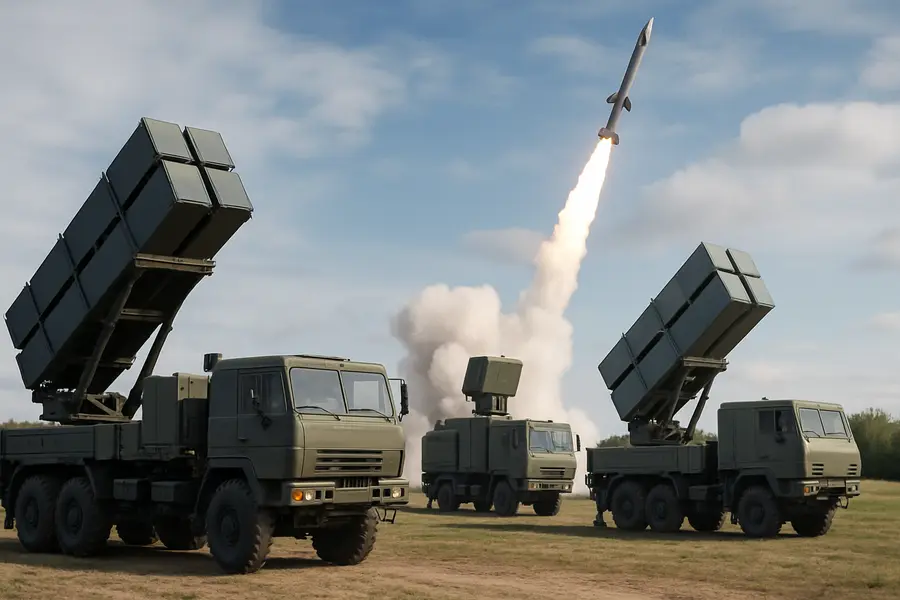
Rheinmetall and South Korea's LIG Nex1 form a majority-held joint venture to deliver layered air-defense solutions across European and NATO markets, unveiled at Eurosatory 2026 in Paris.
- Rheinmetall takes the majority stake in a new JV with LIG Defense & Aerospace, targeting European and NATO air-defense procurement.
- The deal pairs LIG's combat-proven L-SAM and MSAM-II missile systems with Rheinmetall's Skyranger VSHORAD to cover all engagement layers.
- LIG D&A posted €2.5 billion in 2025 revenue; its MSAM-II scored a live combat intercept of Iranian ballistic missiles in April 2026.
Lead
Rheinmetall and South Korea's LIG Defense & Aerospace (LIG D&A) — a defense subsidiary of LIG Nex1 — announced a majority-held joint venture on June 15 at the Eurosatory 2026 exhibition in Paris, targeting the complete spectrum of European ground-based air-defense requirements. The German armaments group holds the majority stake in the new entity, which will localize, further develop, and market LIG D&A's battle-tested Korean missile systems across Europe while co-developing the next generation of short-range interceptors for the air defense market.What Happened
The partnership unites two complementary portfolios across all air-defense layers. LIG D&A contributes its medium-range air defense system (MSAM-II / Cheongung II) and long-range interceptor (L-SAM), both operationally proven in South Korean service. Rheinmetall adds its Skyranger family of very short-range air defense (VSHORAD) platforms, already contracted to the German Bundeswehr and integrated into the German-led European Sky Shield Initiative (ESSI). The joint venture is jointly tasked with developing new missiles for the short-range air defense (SHORAD) segment — a layer where NATO members have identified urgent operational gaps since Russia's full-scale invasion of Ukraine.
The strategic logic prioritizes speed over indigenization. European governments are seeking near-ready solutions rather than decades-long domestic development cycles. LIG D&A's MSAM-II supplied the venture with a critical credential in April 2026 when it intercepted Iranian ballistic missiles in live combat — a demonstration of performance that no purely developmental system in the European market can match.
Strategic Context
LIG Nex1 and its defense subsidiary have grown into a first-tier global exporter of air defense technology over the past decade. The company completed a $3.2 billion missile-defense contract with Saudi Arabia and advanced a $2.6 billion M-SAM II deal with Iraq, while establishing a European office in Munich expressly to support NATO-aligned cooperation and in-region research and development. LIG D&A reported €2.5 billion in annual revenue in 2025 with approximately 6,000 employees, building missiles, sonar systems, and unmanned surface vehicles. Rheinmetall, which posted roughly €10 billion in 2025 turnover and carries a market capitalization of approximately €56 billion, has simultaneously been scaling its own air-defense output. A framework contract for 500 to 600 Skyranger 30 systems, valued between €6 billion and €8 billion, is in advanced negotiation with the Bundeswehr, with annual production capacity being expanded to 200 units. The joint venture with LIG D&A extends Rheinmetall's reach from ultra-short-range cannon engagements into theater-altitude ballistic intercepts — a full-spectrum offering neither company could build alone.Geopolitical Dimension
The deal reflects two structural forces reshaping the global defense industry. First, European governments are accelerating investment in layered air defense, a capability that received inadequate funding for three decades. The ESSI, now counting more than 20 participating nations, explicitly encourages integration of allied systems — including non-European hardware — to close coverage gaps from drone-range engagements out to theater altitudes.
Second, South Korea has cemented its position as an exporter of high-value military systems, moving well beyond artillery and armored vehicles into the sophisticated domain of air defense technology. The Rheinmetall LIG Nex1 arrangement provides Korea's missile ecosystem with the localization architecture and distribution network required to compete for European government contracts that increasingly mandate sovereign or partner-nation production content.
The combination of Rheinmetall's established relationships within NATO and the ESSI framework with LIG Nex1's proven interceptor portfolio and cost-effective production record positions the venture as a credible, near-term competitor for national procurement programs across multiple European member states.
Market Reaction
Rheinmetall shares (RHM) fell approximately 4 percent on June 15 as investor concerns over the Franco-German Main Ground Combat System (MGCS) tank program — where CEO Armin Papperger signaled France may significantly reduce budget commitments — and a broader defense industry sector rotation overshadowed the new air-defense deal's announcement. The stock has shed nearly a quarter of its value year-to-date in 2026, despite continued revenue growth.Outlook
The joint venture's near-term mandate is to adapt LIG D&A's MSAM-II and L-SAM for European regulatory and industrial requirements while simultaneously delivering new SHORAD interceptors to fill a gap NATO allies have marked as operationally critical. With Rheinmetall's established footprint across European defense ministries and LIG Nex1's combat-validated missile technology, the partnership is positioned to pursue procurement programs across multiple NATO member states as European defense budgets continue their structural expansion.
Mentioned tickers: RHM, 079550.KSGeopolitics