Pomegra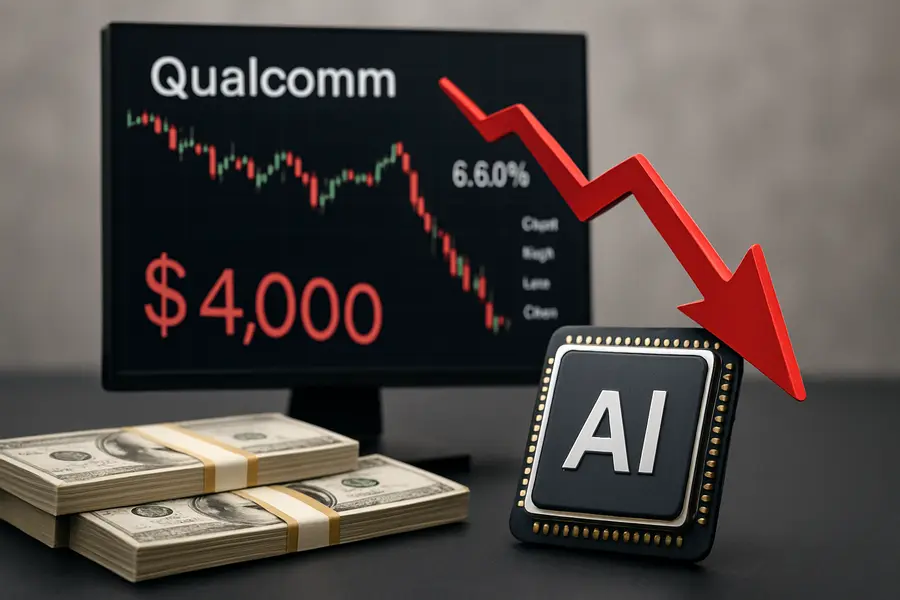
Qualcomm shares dropped roughly 6% after Bloomberg reported the chipmaker is in advanced talks to acquire AI infrastructure firm Modular Inc. for approximately $4 billion, compounding a broader technology sector selloff.
- Qualcomm is nearing a $4 billion acquisition of AI software firm Modular Inc., Bloomberg reported June 22, with a formal announcement potentially weeks away.
- QCOM fell approximately 6%, closing at $204.13 on Tuesday and erasing nearly $19 billion in market capitalization during a broader tech selloff.
- Modular's MAX inference engine and Mojo programming language would anchor Qualcomm's push into data center AI infrastructure.
Lead
Qualcomm Inc. is in advanced talks to acquire Modular Inc., an artificial intelligence infrastructure software company, in a deal valued at approximately $4 billion, Bloomberg reported on June 22. QCOM shares fell roughly 6%, closing at $204.13 on Tuesday and shedding nearly $19 billion in market capitalization as the deal report landed during a broad technology sector selloff.What Happened
The proposed $4 billion valuation represents a significant markup from the $1.6 billion at which Modular last raised private capital roughly nine months ago—a 2.5-times step-up in under a year. A formal agreement has not been signed, and terms remain subject to change. A deal announcement could come within weeks if discussions hold.
Market Reaction
QCOM shares declined as much as 8% intraday before closing at $204.13, down 8.01% on the session. The magnitude of the move reflected both the acquisition headline and simultaneous selling pressure across the semiconductor and technology sectors. Qualcomm had already given back nearly 2% in the prior session, amplifying the two-day drawdown for shareholders.
Strategic Context
The Modular M&A discussion is the second major AI deal Qualcomm has disclosed in rapid succession. Earlier in June, Bloomberg reported that the San Diego chipmaker was in separate advanced talks to acquire AI chip hardware startup Tenstorrent in a transaction valued between $8 billion and $10 billion. Together, the two acquisitions would deliver both a custom accelerator architecture and a full-stack AI software layer—positioning Qualcomm to pursue data center infrastructure budgets currently concentrated at Nvidia.
Qualcomm's dealmaking accelerated across late 2025 and early 2026. The company acquired RISC-V server chip designer Ventana Micro Systems in December 2025, completed a $2.4 billion purchase of high-speed interconnect supplier Alphawave Semi, and secured a favorable outcome in its lawsuit against Arm—freeing it to pursue an independent chip architecture.
AI and Technology Angle
Modular Inc. was co-founded in 2022 by Chris Lattner—the engineer behind the LLVM compiler infrastructure, Clang, and Apple's Swift programming language, and a former Tesla Autopilot executive—alongside Tim Davis, a veteran of Google and Apple. The company's two core products are MAX, an AI inference serving framework engineered to run efficiently across diverse chip architectures, and Mojo, a programming language combining Python-like syntax with performance approaching C and CUDA.Mojo reached its 1.0.0 beta milestone in May 2026. For Qualcomm, acquiring Modular would provide a developer-facing software platform capable of attracting AI engineers who currently default to Nvidia's proprietary CUDA ecosystem—an entrenched advantage that hardware competitors have struggled to erode through chip design alone.
What Comes Next
Regulatory review of semiconductor consolidation has extended timelines across the industry, and Qualcomm may be managing two significant transactions simultaneously. Investor attention will focus on deal pricing discipline, integration roadmaps, and any update from Qualcomm on its investor-day guidance following the dual acquisition disclosures.
Outlook
Qualcomm is executing a deliberate pivot away from handset chip dependence—assembling a stack spanning processors, interconnects, inference serving, and developer tooling designed to compete in the data center AI market. Whether these acquisitions translate into durable market share against entrenched competitors remains the central question for QCOM investors heading into the second half of 2026.