 Pomegra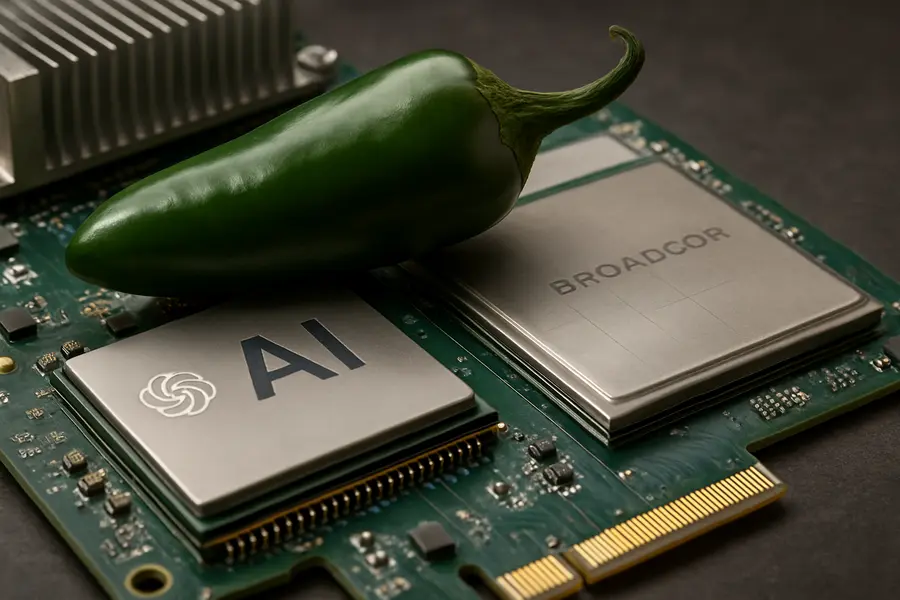
OpenAI and Broadcom (AVGO) unveiled Jalapeño, the AI company's first custom silicon, targeting roughly 50% inference cost savings over leading AI GPUs as part of a multi-generation compute partnership.
- Jalapeño went from initial design to manufacturing tape-out in nine months — widely described as among the fastest ASIC development cycles for advanced high-performance semiconductors on record.
- Early testing shows approximately 50% inference cost reduction versus current-generation GPU alternatives; Broadcom (AVGO) shares rose roughly 3% on the announcement.
- The partnership targets deployment of 10 gigawatts of OpenAI-designed accelerators, with initial rollout before end-2026 and a full production ramp across 2027 and 2028.
Lead
OpenAI and Broadcom (NASDAQ: AVGO) on Tuesday jointly unveiled Jalapeño, OpenAI's first purpose-built AI accelerator chip, at a joint announcement that positions the ChatGPT maker as the latest hyperscaler-tier company to pursue custom silicon as a hedge against dependence on Nvidia (NVDA). Developed in nine months — roughly half the typical ASIC timeline — and manufactured by TSMC, the reticle-sized chip is purpose-architected for large language model inference and is projected to deliver cost savings of approximately 50% per inference token versus the current generation of AI graphics processing units.What Happened
Jalapeño is a custom application-specific integrated circuit designed by OpenAI's hardware engineering team and brought to production through Broadcom's silicon implementation expertise and TSMC's fabrication capabilities. The announcement marks the first tangible product from a strategic collaboration the two companies formalized earlier, under which they committed to co-developing a multi-generation compute platform targeting gigawatt-scale AI infrastructure.
The chip is optimized exclusively for inference — the compute-intensive process of running a trained AI model to generate responses for end-users across ChatGPT and OpenAI's enterprise API. Training, which requires different hardware characteristics, is not in Jalapeño's initial scope.
OpenAI disclosed that its own AI models were used to accelerate portions of the chip's design and optimization process, a feedback loop the company described as a demonstration of its broader thesis that AI will increasingly compress engineering timelines across industries.
Market Reaction
Broadcom shares (AVGO) gained approximately 3% in Wednesday morning trading following the announcement, extending a run of positive momentum tied to the company's expanding ASIC pipeline for hyperscaler clients. The move reflects investor recognition that Jalapeño is, in structural terms, a significant design-win for Broadcom's custom silicon business — a segment the company has identified as a multi-year revenue driver. Nvidia (NVDA), whose Blackwell GPU architecture currently dominates AI inference infrastructure, saw muted immediate reaction. Broadcom CEO Hock Tan told reporters that early-stage performance benchmarks for Jalapeño are on par with Nvidia's Blackwell chips and Google's Tensor Processing Units on targeted inference workloads, while delivering the cost advantage.Strategic Context
The OpenAI–Broadcom partnership is structured as a multi-generation platform, not a single product engagement. The companies have announced a joint commitment to deploy 10 gigawatts of OpenAI-designed AI accelerators, with Microsoft (MSFT) and other infrastructure partners expected to underpin the data center buildout beginning in 2026. The ambition puts OpenAI in a cohort alongside Google, Amazon, Meta, and Microsoft itself — all of which have developed or are developing proprietary AI accelerators to reduce per-token compute costs and lessen exposure to GPU supply constraints.
For Broadcom (AVGO), the deal reinforces its position as the preferred ASIC partner for large-scale AI deployments, a role it has cultivated through engagements with multiple major cloud providers. Custom silicon work carries higher margins and longer customer lock-in than commodity networking hardware.
AI and Technology Angle
Jalapeño's nine-month design-to-tape-out cycle is notable in an industry where comparable ASIC programs typically require 18 to 24 months. OpenAI credited three converging factors: close software-hardware co-development between its engineers and Broadcom's implementation teams, Broadcom's existing advanced-node tooling, and the application of OpenAI's own generative models to compress parts of the design iteration process. The last point — AI accelerating the development of AI hardware — is likely to attract scrutiny as a proof-of-concept for autonomous engineering workflows.
The chip's reticle-sized form factor signals that OpenAI is targeting maximum die area within TSMC's process constraints, prioritizing raw throughput for inference workloads that benefit from dense on-chip memory and high parallelism.
Outlook
Initial deployment of Jalapeño is targeted before the end of 2026, with full production ramp across 2027 and 2028 as gigawatt-scale data center capacity comes online with Microsoft and other partners. The partnership's 10-gigawatt deployment target frames Jalapeño as the first in a planned succession of co-designed accelerators, meaning Broadcom's design-win from OpenAI is structured for multi-year revenue contribution. How aggressively Nvidia responds — through pricing, roadmap acceleration, or deepened partnerships — will shape the competitive calculus for AI infrastructure procurement over the next two to three years.
Mentioned tickers: AVGO, NVDA, MSFT, GOOGL