Pomegra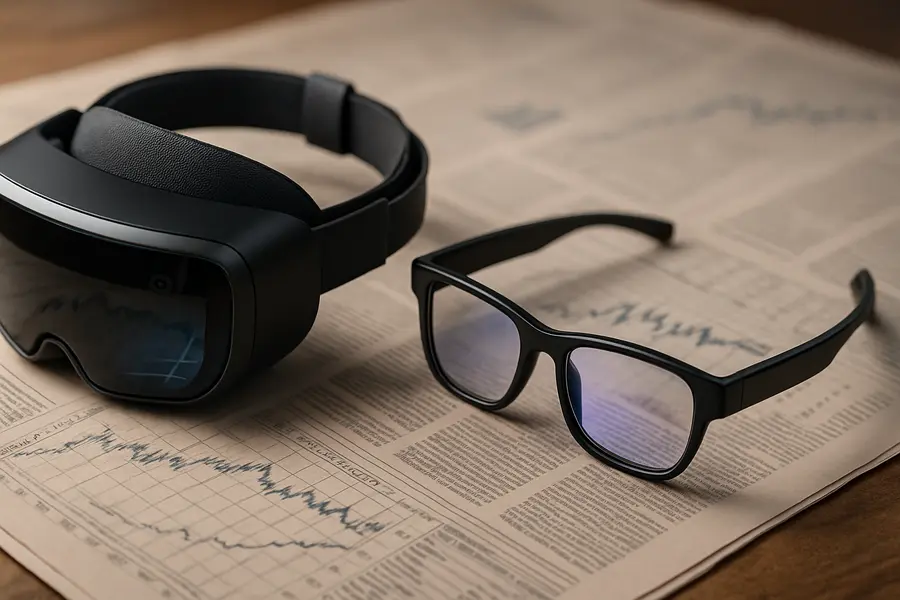
Omdia forecasts the global XR headwear market will rebound to 6.5 million units in 2027 as lightweight AR glasses displace bulky VR headsets as the industry's dominant form factor.
- XR headwear shipments will contract 12% to 6.2 million units in 2026 before recovering 4.8% to 6.5 million in 2027.
- Tethered AR glasses led by RayNeo and Xreal will grow 19% to 900,000 units in 2026 and reach 3.8 million by 2030.
- Standalone VR and MR headsets enter a fifth consecutive year of decline in 2026, falling 15% to 4.7 million units.
Lead
The global XR headwear market is undergoing a structural realignment. Research firm Omdia projects total shipments will fall 12% to 6.2 million units in 2026 — a trough shaped by weakening demand for standalone headsets — before recovering to 6.5 million in 2027. Critically, that recovery will not be driven by headsets. It will be driven by glasses. The forecast, published June 16, 2026, marks a defining inflection point in the years-long contest between AR glasses vs VR headsets for control of the next major computing platform.
What Happened
Omdia's latest device forecast breaks the XR headwear category into four segments, and the divergence in trajectory across them underscores how thoroughly the market's center of gravity has shifted.
Tethered XR glasses — lightweight display units that connect to a companion smartphone or PC — are the standout performers. Led by Chinese vendors RayNeo and Xreal, the segment is on course for 900,000 shipments in 2026, a 19% year-over-year increase. Omdia projects that momentum will compound through the decade, bringing tethered glasses shipments to 3.8 million units by 2030. Standalone XR glasses remain a smaller, largely enterprise and developer-focused segment at 93,000 units in 2026. However, Omdia expects rapid expansion as spatial computing capabilities mature and hardware costs fall.On the headset side, the picture is starkly different. Standalone XR headsets — the category that includes the Meta Quest lineup and Apple Vision Pro — are forecast to ship 4.7 million units in 2026, a 15% decline that extends what will be a fifth consecutive year of contraction since the pandemic-induced peak of 2021–2022. Tethered headsets face an even steeper drop of 34%, to approximately 500,000 units.
Why Headsets Are Losing Ground
Omdia Senior Principal Analyst George Jijiashvili points to a fundamental mismatch between headset design and everyday consumer life. "Bulky XR headsets struggle to demonstrate everyday utility for mainstream consumers," the firm's analysis concludes, with weight, social acceptability, and session length cited as persistent friction points. Following three years of rapid growth, AI glasses have begun normalizing face-worn computing at a price point and form factor that headsets cannot match.
AI and Technology Angle
The glasses surge is inseparable from the rapid integration of on-device and cloud AI. Devices like the Ray-Ban Meta glasses function as ambient AI companions — fielding queries, translating audio, and surfacing contextual information — without requiring users to strap on a headset. This positions AI glasses as the near-term gateway to spatial computing for the mass market, rather than the full mixed reality experiences that headsets offer.
Google has moved aggressively to capture this moment. Its Android XR platform — announced at Google I/O 2026 — will power a new generation of display-enabled smart glasses from multiple hardware partners, with audio-first variants targeting a fall 2026 launch. Apple, whose Vision Pro has not seen a successor enter active development, is separately reported to be targeting a smart glasses launch as early as late 2027, with feature parity against Meta's Ray-Ban lineup and deep Siri integration as the likely entry point.Omdia expects these platform commitments from the largest tech industry players to accelerate the ecosystem — driving down bill-of-materials costs for tethered glasses and pulling enterprise and developer adoption of standalone glasses forward.
Strategic Context
The XR headwear market pivot carries significant implications for display supply chains, semiconductor vendors, and software platform economics. Micro LED and waveguide display suppliers — already seeing micro LED revenue doubling to $105 million in 2026 — stand to benefit as glasses form factors demand advanced, compact optics at scale. A Omdia-linked forecast projects the micro LED display market will reach $6.8 billion as AR glasses adoption broadens.
For standalone headsets, the outlook is not terminal but is contingent on a price breakthrough. Omdia forecasts a partial headset recovery to 5 million units by 2028, predicated on Apple releasing a more accessible, lower-cost Vision product that could re-energize the premium end of the market and prompt a broader competitive response.
Outlook
The XR headwear market is entering 2027 as a fundamentally different industry than it was at the 2022 peak. The tech industry trends driving this shift — AI commoditization, form-factor preference, and platform consolidation around Android XR — are structural rather than cyclical. Tethered AR glasses, with double-digit annual growth and a clear path to 3.8 million units by 2030, represent the market's near-term growth engine. Standalone headsets will remain relevant for enterprise, gaming, and premium spatial computing use cases, but mass-market ambitions for that category now depend on hardware innovation that has yet to arrive at a consumer-accessible price point. The glasses era has begun.
Mentioned tickers: META, AAPL, GOOGLTechnology