Pomegra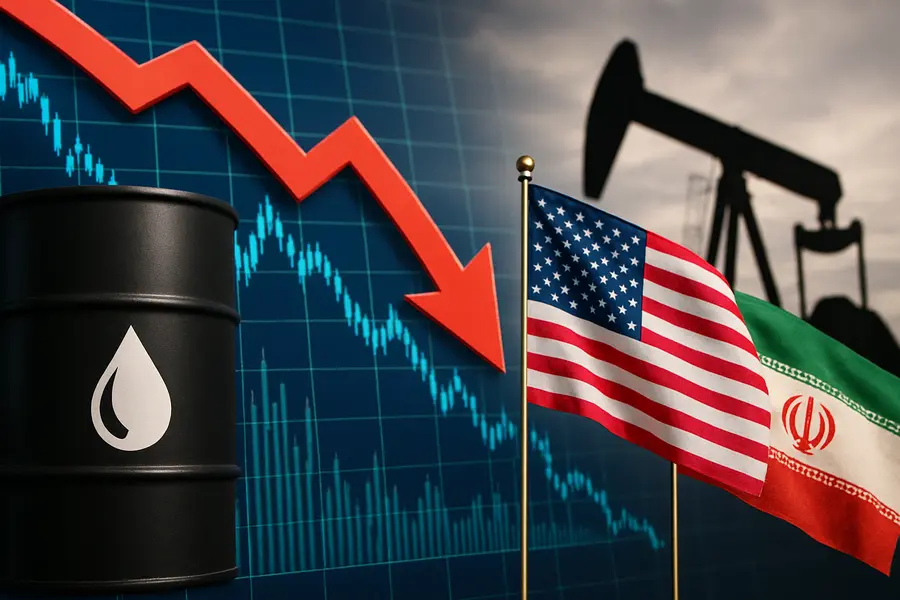
Markets are shrugging off residual flashpoints in the Persian Gulf, sending Brent crude down nearly 2% as a U.S.-Iran peace framework and improving Strait of Hormuz shipping conditions reshape the energy market outlook.
- Brent crude fell close to $70/barrel this week, extending a third consecutive weekly decline as U.S.-Iran ceasefire talks advanced.
- The June 18 U.S.-Iran memorandum of understanding reopening the Strait of Hormuz—through which roughly 20% of global oil and LNG flows—has anchored the oil price drop.
- Despite fresh incidents including a cargo ship struck off the Omani coast and renewed Trump threats, the crude oil forecast remains bearish through year-end.
Lead
Brent crude fell toward $70 a barrel on Thursday, extending a fourth straight session of losses and erasing nearly all the price premium accumulated since the outbreak of the 2026 U.S.-Iran conflict, as improving prospects for a durable peace deal and the resumption of shipping through the Strait of Hormuz recalibrated the global energy market. The oil price drop of roughly 2% in Asian trading marked the sharpest single-session decline in weeks, even as isolated incidents in Gulf waters continued to test market nerves.What Happened
Brent crude was quoted near $74.70 a barrel as of June 25, down from $75.57 the prior session and well below the near-term peaks that followed the war's outbreak earlier in the year. WTI tracked broadly lower in parallel. The day's move extended what is shaping up as a third consecutive week of declines, a sustained pullback that stands in sharp contrast to the commodity's wartime spike.The immediate trigger for Thursday's slide was a surge of crude offers from Middle Eastern exporters and West African producers taking advantage of reopened transit corridors, with buyers facing an unusually wide array of supply options. More tankers transited the Strait of Hormuz with tracking signals switched on—a visible signal of returning confidence—and shipping insurers began reassessing war-risk premiums that had been elevated since hostilities began.
The Geopolitical Dimension
The proximate cause of the oil price drop is the U.S.-Iran peace framework signed June 18–19 in Geneva, brokered in part by Pakistani Prime Minister Shehbaz Sharif. Under the memorandum of understanding, both sides committed to a 60-day cessation of military operations and agreed to lift their respective maritime blockades. For the energy market, the most consequential clause was Iran's pledge to "instantly reopen" the Strait of Hormuz and the U.S. agreement to "immediately" lift its naval blockade of Iranian ports.
The Strait of Hormuz handles approximately one-fifth of global oil and liquefied natural gas trade. Its partial closure since the war's outset had been a primary driver of elevated crude prices. The removal of that choke-point risk is now the single largest structural shift in the crude oil forecast.
On June 22, the two sides agreed in Switzerland to a "roadmap" toward a final settlement that would address Iran's nuclear program—the underlying flashpoint of the conflict. Iran is expected to receive access to billions of dollars in frozen assets and phased sanctions relief in exchange for verifiable nuclear concessions.
Fresh Tensions Persist—Markets Are Unmoved
Despite the US-Iran tensions formally easing, fresh incidents have punctuated this week's trading. An unidentified projectile struck a cargo vessel off the Omani coast on June 25, briefly pushing Brent back above $81 a barrel before traders reversed the move. Earlier in the week, President Trump warned via social media that the U.S. could "go right back to dropping bombs" on Iran if Tehran did not "behave," language that rattled currency markets but had a diminishing effect on crude.
The market's ability to look past these flare-ups reflects a fundamental repricing of risk. In the early days of the conflict, similar rhetoric sent Brent surging several dollars per barrel within hours. That sensitivity has eroded as the peace architecture gains credibility and supply chains begin to normalize. A dedicated communication channel established between Washington and Tehran to manage Strait of Hormuz incidents has reduced the probability that a single episode escalates into a broader disruption.
Market Reaction and Energy Market Supply Dynamics
The structural supply picture has shifted materially. Buyers who had been rationing crude amid the Hormuz closure are now receiving a surge of offers. Middle Eastern producers, eager to rebuild revenue streams after months of constrained exports, have moved aggressively to recapture market share, contributing directly to the energy market oversupply dynamic.
OPEC faces its own internal pressures in this environment. Iraq has threatened to exit the cartel unless its production quota is raised, a posture reflecting broader frustration among members who see the post-war demand environment as an opportunity. Meanwhile, U.S. shale producers, which had pulled back on rig activity during peak-disruption uncertainty, are beginning to signal a return to growth mode as the crude oil forecast stabilizes.Global oil demand is projected to fall by approximately 1.1 million barrels per day over the course of 2026 compared to 2025 levels, according to the U.S. Energy Information Administration (EIA). That demand softness, layered onto recovering supply, reinforces the bearish directional bias in the oil price drop narrative.
Crude Oil Forecast Through Year-End
The EIA's June Short-Term Energy Outlook projected Brent averaging around $105/barrel for June and July under assumptions of continued Hormuz disruption. With those assumptions now outdated following the peace framework, the effective forward curve has shifted decisively lower. The agency's updated modeling, which assumes Hormuz traffic gradually resumes through the third quarter, points to Brent falling toward an average of $89 a barrel by the fourth quarter of 2026.
Market participants are pricing in a faster normalization. Crude oil futures for delivery later in the year have collapsed more aggressively than the prompt contract, a structure that reflects expectations of a supply glut if Iranian and regional production returns to pre-war volumes on an accelerated timeline.
Outlook
The oil price drop is no longer a function of a single day's peace-process headline—it has become embedded in the energy market's fundamental supply-demand balance. The U.S.-Iran framework, while not final, has sufficiently altered the Hormuz shipping calculus to redirect bearish momentum. Residual US-Iran tensions, including sporadic Gulf incidents and diplomatic friction over the nuclear file, retain the capacity to trigger short-term spikes, but the threshold for a sustained reversal of the current crude oil forecast has risen considerably. Unless the ceasefire collapses outright, Brent crude is likely to continue its gradual descent through the second half of 2026, with OPEC unity and the pace of Iranian production restart serving as the key variables to watch.
Mentioned tickers: USO, BNO, XLE, XOM, CVX, COP, OXY