Pomegra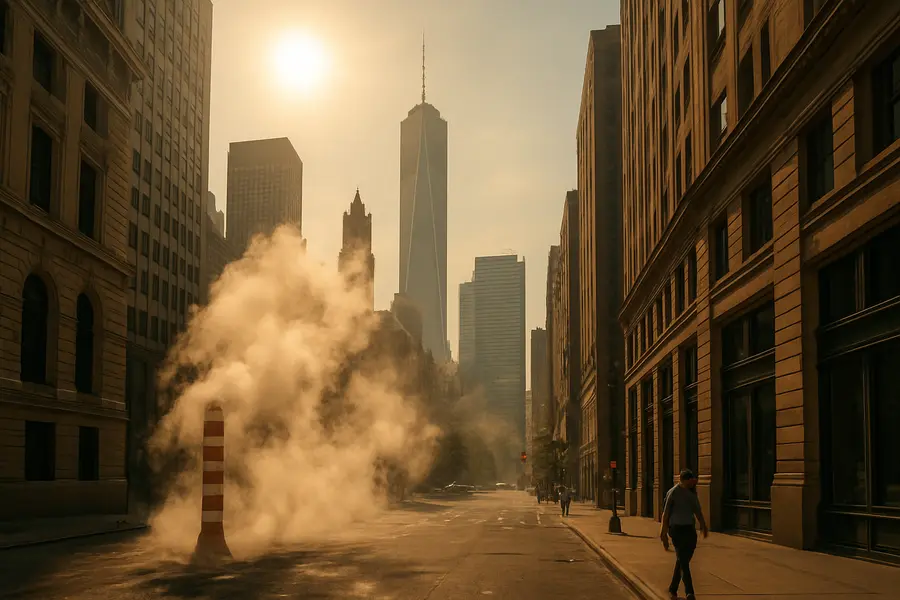
A historic heat dome has pushed New York City temperatures to 100°F, triggering emergency health protocols, widespread power disruptions, and urgent warnings for workers in lower Manhattan's densely built Financial District.
- Central Park reached 100°F on July 3, tying a record last set in 1966; feels-like temperatures approached 115°F citywide.
- Con Edison cut power to roughly 9,800 Southwest Queens customers and reduced voltage across parts of Manhattan and the Bronx under peak demand strain.
- More than 500 New Yorkers die prematurely from heat each summer; city officials expanded emergency cooling measures through the July 4th weekend.
Lead
New York City is enduring one of the most intense heat events in recent memory, with a multi-day heat wave pushing temperatures to triple digits and driving public health officials to issue Emergency Health Alert No. 17 for the first time this year. The NYC heat wave, centered on a high-pressure dome stretching from Washington to Boston, arrived at its worst on July 3, turning the Financial District's concrete canyons into a crucible with conditions that climate researchers link to accelerating urban heat island effects and a broader shift in NYC climate baselines.
What Happened
The National Weather Service placed an extreme heat warning in effect through the July 4th holiday weekend for the entire five boroughs and surrounding tri-state region. Central Park recorded a high of 100°F Thursday, the first triple-digit reading in 14 years and a tie for the all-time July record set in 1966. AccuWeather's heat index calculations placed the "real feel" temperature at or above 109°F in shaded areas, with direct sunlight on paved surfaces in lower Manhattan pushing exposure risk significantly higher.
The Financial District, one of the most densely developed zones in the western hemisphere, offers minimal canopy cover and limited pedestrian shade between office towers. Outdoor workers — construction crews, deliveristas, street vendors, and maintenance staff — faced sustained exposure during the hottest hours with little structural relief.
Health Warning and City Response
The NYC Department of Health and Mental Hygiene issued its heat alert classifying extreme heat as the deadliest of all weather emergencies. Official data shows more than 500 New Yorkers die prematurely each summer from heat-related causes, a toll that falls disproportionately on older adults, low-income residents, and communities of color. Black New Yorkers face twice the heat-mortality risk of white New Yorkers, a disparity officials attribute to structural inequities in housing quality and access to air conditioning.
Mayor Zohran Mamdani authorized an expansion of the city's emergency heat posture, deploying 21 COOL vans equipped with nurses and paramedics to conduct wellness checks on homebound older adults, distribute water and electrolytes, and transport vulnerable residents to cooling centers. Street outreach teams intensified Code Red canvassing between noon and 8 p.m. on all heat warning days, with particular focus on unsheltered populations. The city simultaneously conducted outreach to more than 75,000 businesses to enforce worker protection standards.
The New York State Department of Labor mandated paid rest breaks, shade access, and free drinking water for outdoor workers once the heat index crosses 80°F, with more frequent breaks required above 90°F — thresholds exceeded continuously this week.
Power Grid Strain
Con Edison shut off service entirely to approximately 9,800 residential and commercial customers in Southwest Queens after equipment failures triggered by record demand loads. The utility simultaneously reduced voltage across parts of the Bronx and lower Manhattan — including corridors adjacent to the Financial District — to protect transmission infrastructure during repairs. As of Thursday evening, more than 17,000 customers across the New York metro area had lost power. Con Edison asked all customers to limit air conditioner use and reduce consumption of energy-intensive appliances during peak afternoon hours.NYC Climate Context
The severity of this event reflects a documented long-term trend. Average summer temperatures in New York City have risen approximately 2.5°F over the past century, and the frequency of days above 90°F has more than doubled since the 1950s. The urban heat island effect — intensified by asphalt, reduced tree cover, and waste heat from buildings and vehicles — makes the Financial District and surrounding downtown neighborhoods measurably hotter than suburban and coastal areas during peak events.
Outlook
The heat warning remains in effect through the July 4th weekend, though temperatures are forecast to moderate into the mid-90s by Saturday before a frontal system brings relief early next week. Power restoration timelines remain tied to grid repair progress. City officials have signaled that cooling center capacity and mobile medical response will remain at elevated levels through Sunday. The event adds urgency to ongoing municipal debates over urban tree canopy expansion, building energy codes, and mandatory cooling provisions in older residential stock — policy areas that intersect directly with the long-term resilience of the NYC climate and the economic productivity of its densest commercial corridors.
Mentioned tickers: ED