Pomegra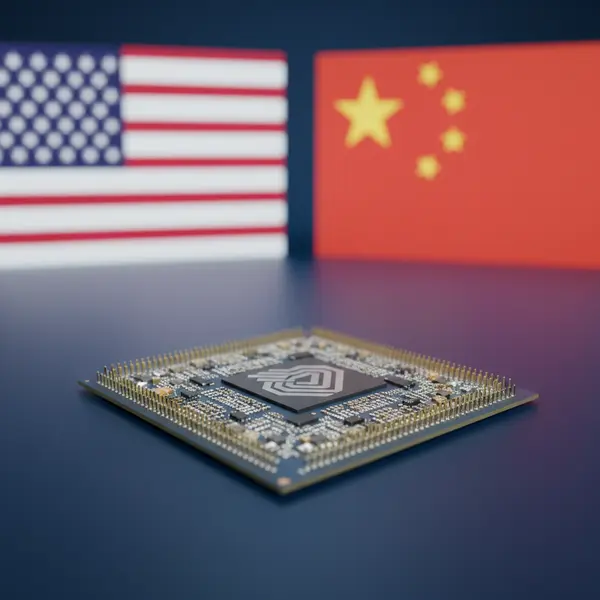
The U.S. Commerce Department has granted export licenses to approximately 10 Chinese firms permitting the purchase of Nvidia's H200 AI accelerator chip — the company's second-most powerful processor — yet not a single chip has been delivered to China as of May 14, 2026. The stalled deal has become a focal point of President Donald Trump's two-day state visit to Beijing, where Nvidia CEO Jensen Huang is accompanying the presidential delegation in an urgent bid to unlock the market.
- Washington cleared ~10 Chinese firms — including Alibaba, Tencent, ByteDance, and JD.com — to purchase up to 75,000 H200 chips each.
- Despite U.S. export approvals dating back to January 2026, zero H200 deliveries have reached China due to Beijing's own resistance.
- Nvidia CEO Jensen Huang boarded Air Force One in Alaska to join President Trump's two-day Xi Jinping summit in Beijing on May 14, 2026.
Huang Boards Air Force One in Alaska
Huang, who was not initially listed on the White House's official China delegation, joined the trip at the last minute after a direct invitation from President Trump. He was spotted boarding Air Force One during a refuelling stop in Anchorage, Alaska, en route to Beijing. A company spokesperson confirmed Huang is "attending the summit at the invitation of President Trump to support America and the administration's goals."
Trump told reporters and posted on Truth Social that his "very first request" to President Xi Jinping would be to "open up" China so that American business leaders "can work their magic." The summit is the first visit by a U.S. president to China in nearly a decade, and more than a dozen U.S. executives have joined the delegation, largely from companies seeking to resolve bilateral commercial disputes.
Approved Buyers, Frozen Deals
The approved list of H200 chip buyers includes Alibaba, Tencent, ByteDance, and JD.com, with distributors Lenovo and Foxconn also cleared to facilitate sales. Under current U.S. export licensing terms, each approved Chinese customer may purchase up to 75,000 H200 units, either directly from Nvidia or through authorized intermediaries. Lenovo confirmed in a statement that it "is one of several companies approved to sell H200 in China as part of Nvidia's export license."
Yet the approvals have produced no actual commerce. Chinese tech companies pulled back from finalizing orders after guidance from Beijing, with pressure from the State Council mounting to block or tightly vet purchases. Two recently issued supply chain security regulations triggered a government-wide push to identify and eliminate potential foreign dependencies in critical technology infrastructure — a directive that encompasses the H200 acquisition pipeline.
Commerce Secretary Howard Lutnick confirmed the stalemate at a Senate Appropriations subcommittee hearing in late April, stating that "the Chinese central government has not let them, as of yet, buy the chips, because they're trying to keep their investment focused on their own domestic industry."
Beijing's Strategic Hesitation
China's reluctance is rooted in a deliberate industrial policy calculus. While domestic AI chip capabilities still lag Nvidia's hardware by a meaningful margin, Beijing has increasingly directed its tech sector toward homegrown alternatives. Firms like DeepSeek have prominently promoted their reliance on chips developed by Huawei, reinforcing a strategic pivot away from U.S. silicon that Beijing views as essential to long-term technological sovereignty.
The pivot is cutting deeply into Nvidia's China position. Before U.S. export controls began tightening, Nvidia commanded roughly 95% of China's advanced AI chip market, and China accounted for approximately 13% of Nvidia's total revenue. Huang has previously estimated that China's AI accelerator market alone would be worth $50 billion in 2026. The company now acknowledges its share of AI accelerators in China has effectively fallen to zero.
Thorny Compliance Architecture
Beyond Beijing's reluctance, the transaction itself faces a complex web of compliance requirements on the U.S. side. Rules issued by the Bureau of Industry and Security (BIS) in January 2026 require Chinese buyers to demonstrate installation of "sufficient security procedures" and provide assurances the chips will not be redirected for military use. Nvidia must also certify that sufficient inventory remains available within the United States.
An additional complication arises from a revenue-sharing arrangement negotiated by President Trump, under which the U.S. government would receive 25% of revenue from H200 chip sales to China — a structure requiring the chips to physically transit U.S. territory before onward shipment to China. The arrangement has prompted unease in Beijing over potential tampering or the insertion of vulnerabilities into the hardware, even as U.S. officials characterize the routing requirement as a workaround to legal constraints rather than a surveillance mechanism.
Congressional Pushback Persists
The deal continues to attract bipartisan scrutiny. Senator Chris Coons (D-Del.), a member of the Senate Foreign Relations Committee, sent a formal letter to Commerce Secretary Lutnick in May demanding a detailed accounting of how many H200 chips have received export licenses, how many have been shipped, and how many additional licenses the department plans to issue.
Coons characterized his position bluntly: "Allowing any companies in China to purchase these products presents a serious risk to our national security and economic leadership." National security analysts in Washington have echoed that view, arguing that any expansion of Nvidia's Chinese footprint directly narrows the U.S. lead in AI development. "Any deal that allows Nvidia to sell more chips to China means fewer Nvidia chips for U.S. firms, and a smaller U.S. lead in AI over China," said Chris McGuire, senior fellow for China and emerging technologies at the Council on Foreign Relations.
Summit as Potential Turning Point
With both governments facing their most significant direct engagement in years, the Trump-Xi summit in Beijing carries extraordinary weight for the global semiconductor trade. Beyond AI chips, the two-day agenda includes U.S. arms sales to Taiwan, the ongoing Iran conflict, rare earth export controls, and potential Boeing aircraft and energy purchases by China to narrow the persistent trade deficit that has long been a core Trump grievance.
Trade negotiator Scott Bessent completed three hours of preparatory talks with Chinese Vice Premier He Lifeng at South Korea's Incheon airport before the delegation arrived in Beijing, with Chinese state media describing the discussions as "candid, in-depth and constructive."
Whether Trump and Huang can convert goodwill into completed transactions remains the defining question hanging over the summit. The $50 billion market opportunity Nvidia has publicly identified in China sits dormant — approved in Washington, blocked in Beijing, and now squarely on the table between the world's two largest economies.
Mentioned tickers: NVDA, BABA, JD, LNVGY, FXCOF