Pomegra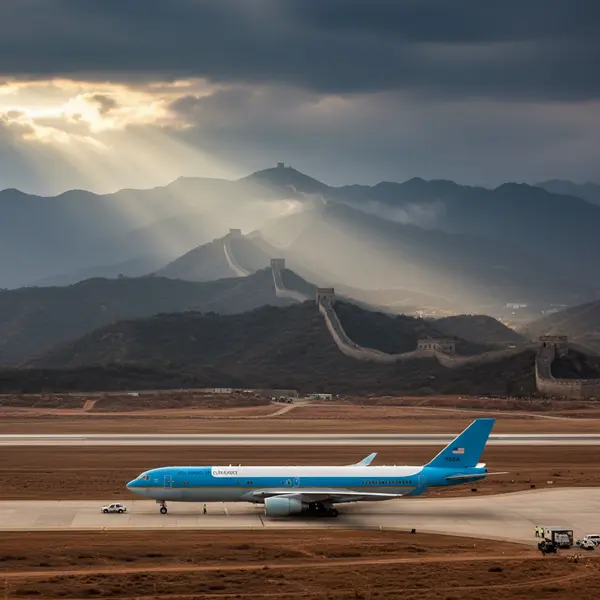
President Donald Trump touched down at Beijing Capital International Airport on Wednesday, May 13, 2026, accompanied by a delegation of 17 top American executives — including Nvidia CEO Jensen Huang and Tesla and SpaceX CEO Elon Musk — in what marks the first visit by a sitting U.S. president to China in nearly a decade. The two-day summit with President Xi Jinping, scheduled for May 14–15, is set to cover a sweeping agenda spanning advanced semiconductor exports, trade tariffs, the ongoing Iran conflict, and the future of US-China AI cooperation.
- Nvidia CEO Jensen Huang joined Trump's China trip as a last-minute addition, raising expectations for a breakthrough on stalled H200 AI chip sales to China.
- Elon Musk, whose Tesla maintains significant manufacturing operations in China, was among 17 U.S. executives traveling aboard Air Force One to Beijing.
- Trump told Truth Social he would make "opening up" China to American business his "very first request" to President Xi Jinping.
A Last-Minute Boarding for Jensen Huang
Nvidia's Jensen Huang was a notably late addition to the presidential entourage. Trump personally invited Huang to join the trip, and the NVDA chief was spotted boarding Air Force One during a refuelling stop in Alaska, en route to Beijing. The inclusion of Huang immediately raised market expectations that the long-stalled negotiations over Nvidia's H200 AI chips — blocked from sale in China under existing export control restrictions — could gain new momentum. Nvidia has been unable to secure regulatory clearance to sell its most powerful datacenter chips in China, one of the world's largest AI markets. The company's stock climbed on the news of Huang's participation, reflecting broad optimism that the summit could unlock a significant new revenue channel for the semiconductor giant.
Musk Returns to China on a Diplomatic Stage
Elon Musk's presence on the trip carries particular strategic weight. Tesla (TSLA) operates a major Gigafactory in Shanghai, and China remains the company's second-largest market by volume. However, Tesla has been losing ground to Chinese domestic rivals, with BYD surpassing the American automaker in battery EV unit sales globally for the first time in 2025. Musk's direct participation in the diplomatic mission signals a renewed push to defend and expand Tesla's market position amid fierce Chinese EV competition. Musk previously led Trump's Department of Government Efficiency before departing the role in spring 2025, and the Beijing trip marks his return to the center of high-level U.S.-China economic diplomacy.
A 17-CEO Delegation Targeting China Market Access
The full executive delegation represents the broadest cross-section of American corporate power assembled for a diplomatic China mission in years. Alongside Huang and Musk, the delegation includes Apple (AAPL) CEO Tim Cook — who is in the final months of a 15-year tenure as CEO, set to hand leadership to hardware chief John Ternus on September 1 — as well as Boeing CEO Kelly Ortberg, Goldman Sachs Chairman David Solomon, Blackstone's Stephen Schwarzman, Blackrock's Larry Fink, Citigroup CEO Jane Fraser, Mastercard CEO Michael Miebach, Visa CEO Ryan McInerney, Qualcomm CEO Cristiano Amon, Micron CEO Sanjay Mehrotra, GE Aerospace CEO H. Lawrence Culp, and Meta's Dina Powell McCormick, among others. The composition of the delegation reflects US corporate China exposure across semiconductors, finance, aerospace, consumer technology, and electric vehicles — all sectors directly affected by bilateral trade tensions.
Trade Truce and Tariff Talks in the Balance
Behind the scenes, Treasury Secretary Scott Bessent held approximately three hours of preparatory trade negotiations with Chinese Vice Premier He Lifeng at Incheon airport in South Korea on Wednesday, ahead of Trump's arrival in Beijing. The talks were described by China's official Xinhua news agency as "candid, in-depth and constructive." Both sides are working to maintain and potentially extend the fragile trade truce struck in October 2025, under which Trump suspended triple-digit tariffs on Chinese goods in exchange for Beijing backing away from restrictions on rare earth exports — critical materials used in electric vehicles, defense systems, and semiconductors. Further discussions are expected to cover potential tariff reductions on up to $30 billion in imports, expanded forums for mutual trade and investment, and structured dialogue on AI governance issues. Washington is also seeking to advance sales of Boeing commercial aircraft, U.S. agricultural goods, and energy to China to reduce the bilateral trade deficit.
Xi Summit Agenda: From AI to Iran and Taiwan
Trump was greeted in Beijing with a lavish ceremonial welcome — military honor guard formations, dozens of students waving American and Chinese flags, and chants of "welcome, warm welcome" in Mandarin at the base of the Air Force One steps. The two leaders are scheduled for a formal reception at the Great Hall of the People, a visit to the 600-year-old Temple of Heaven complex, and a state banquet. Beyond trade and advanced technology access, the summit agenda includes sensitive geopolitical topics: Trump is expected to press Xi on convincing Tehran to accept a deal to end the ongoing Iran war, which has stoked inflation at home and threatens Republican control of Congress in November's midterm elections. China reiterated its strong opposition to U.S. arms sales to Taiwan on Wednesday, with the fate of a pending $14 billion military package still unresolved.
Market Backdrop and Stakes
Trump enters the summit from a position of relative domestic pressure. Courts have constrained his administration's ability to levy tariffs unilaterally, and the Iran war has pushed U.S. consumer price inflation to 3.8% in April 2026. Xi, by contrast, faces fewer comparable economic or political time constraints, giving Beijing measured leverage in any negotiation. Geopolitical analysts note that Washington's urgency to demonstrate tangible results — whether in chip export approvals, Boeing aircraft deals, or a formal tariff framework — is higher than China's, as the administration seeks visible economic wins ahead of the midterms. The two-day summit is widely regarded as the most consequential U.S.-China diplomatic encounter since the bilateral tariff war reshaped global supply chains in 2025.
With a delegation representing trillions of dollars in combined market capitalization landing in Beijing alongside the President, the 2026 Trump-Xi summit sets the stage for potential breakthroughs on AI chip exports, EV market access, and the broader architecture of US-China technology trade — or for a new phase of managed rivalry if talks fall short of corporate expectations.
Mentioned tickers: NVDA, TSLA, AAPL, BA, GS, BLK, C, MA, V, QCOM, MU, GE