Pomegra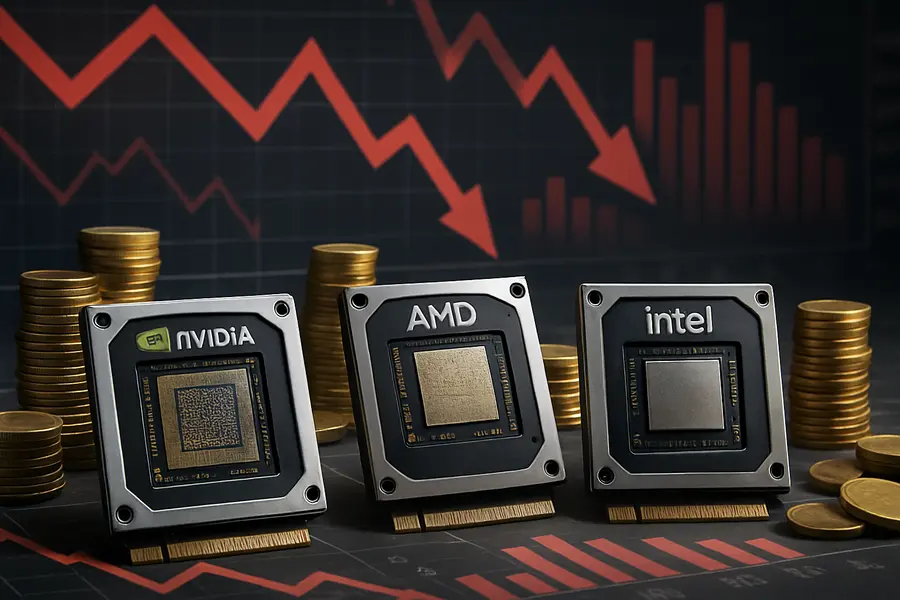
The Philadelphia Semiconductor Index shed 10% on June 5 — its worst session since March 2020 — as Broadcom's cautious AI chip guidance erased $1.3 trillion in global chip sector market value in a single day.
- Broadcom's Q3 AI chip guidance of $16 billion missed the $17.2 billion analyst consensus, igniting a sector-wide selloff across Nvidia, AMD, Intel, and Micron
- The PHLX Semiconductor Index recorded its steepest single-day loss since March 2020, erasing roughly $1.3 trillion in combined market capitalization
- Nvidia stock fell 6.2%, temporarily losing its $5 trillion valuation milestone, while Intel dropped 11.28% and AMD shed 10.86%
Lead
The global semiconductor sector suffered one of its most severe single-session routs in years on June 5, 2026, as a guidance shortfall from Broadcom (AVGO) ignited a cascading selloff that hammered every major chip name from Nvidia (NVDA) to Intel (INTC). The Philadelphia Semiconductor Index plunged 10% — its worst one-day performance since the early months of the pandemic in March 2020 — erasing an estimated $1.3 trillion in market value across the sector and abruptly interrupting an AI-driven rally that had powered chip equities to record levels throughout the prior eighteen months.
What Happened
The catalyst was not a catastrophic quarter. Broadcom posted fiscal second-quarter 2026 revenue of $22.19 billion against a $22.13 billion consensus estimate and non-GAAP earnings per share of $2.44 versus the $2.39 forecast — numbers that, in isolation, cleared the bar. AI semiconductor revenue reached $10.8 billion in the quarter, up 143% year over year. The problem emerged in the forward guidance: Broadcom projected Q3 AI chip sales of $16 billion, a figure that fell $1.2 billion short of the $17.2 billion that analysts had modeled. Equally significant, the company declined to raise its full-year 2026 AI semiconductor revenue forecast, signaling a deceleration in the pace of hyperscaler ordering that the market had not priced in.
The reaction was immediate and broad. Broadcom shares dropped 14.7% at the open on June 5, setting the tone for the entire sector. Micron Technology (MU) fell as much as 13.25% as concerns about a deepening memory chip glut compounded the AI guidance disappointment. AMD slid 10.86% to close at $466.38. Intel led large-cap declines, falling 11.28% to $99.17, reflecting its dual exposure to both the enterprise PC cycle and data-center spending uncertainty. Nvidia stock retreated 6.2%, the most measured decline among major names given the company's recent blowout earnings — but still sufficient to temporarily push its market capitalization below the $5 trillion threshold it had only recently breached.
Market Reaction
The semiconductor selloff did not stop at the sector perimeter. The Nasdaq Composite had already declined more than 4% on June 4, weighed down by escalating Middle East tensions and renewed inflation concerns, giving investors little cushion heading into Broadcom's print. The combination of macro headwinds and a high-profile guidance miss proved corrosive: the sell-the-news dynamic that had lurked beneath richly valued AI chip stocks for months finally materialized with force.
Volume across chip names ran well above their 30-day averages, suggesting the move was not a thin-market aberration but a genuine re-pricing. Marvell Technology shed 3.24% in early trading, and Arm Holdings (ARM) also declined sharply, reflecting broad pressure on the AI infrastructure supply chain rather than name-specific issues.
Strategic Context
The selloff arrived against a backdrop of extraordinary fundamental strength in AI chip demand. Nvidia's fiscal first-quarter FY2027 results, reported on May 20, showed revenue of $81.6 billion — up 85% year over year — with Data Center revenue reaching $75.2 billion, a 92% year-over-year gain. Management guided the current quarter to $91 billion in revenue at a 75% non-GAAP gross margin, figures that would have been inconceivable two years ago. By June 10, Nvidia stock had retreated to approximately $200.42 — roughly 26% below its 52-week high of $236.26 — despite remaining up 39% over the prior twelve months.
The gap between those two realities — explosive underlying growth on one hand and a sharp correction on the other — reflects a valuation dynamic that had made the AI chip trade increasingly vulnerable to any hint of deceleration. Investor expectations had been calibrated to sequential acceleration, not merely strong absolute numbers. When Broadcom's Q3 guidance implied a flatter trajectory for AI chip orders, the market treated it as evidence that the data-center buildout, while still expanding, was entering a more measured phase.
AI and Technology Angle
The broader question the selloff raised is whether hyperscaler capital expenditure on AI infrastructure — which has driven the semiconductor boom since late 2023 — is approaching a near-term plateau. The largest cloud providers collectively committed hundreds of billions of dollars to AI infrastructure in 2025 and 2026, absorbing nearly every chip Nvidia and its peers could produce. Broadcom's guidance, combined with earlier signals from memory markets and a projected softening in global smartphone demand, suggested that at least some of that spending is being paced rather than accelerated.
For AMD, the selloff exposed continued uncertainty about its AI accelerator market share gains. The company has made progress competing in AI training and inference workloads, but investor confidence in the pace of that ramp proved fragile when sector sentiment deteriorated. Intel's steep decline reflected its more complex position: the company is simultaneously managing a foundry buildout, an AI PC product cycle, and ongoing data-center server CPU competition, leaving it with less margin for error in a risk-off environment.
What Comes Next
A partial recovery began on June 8, as the Nasdaq Composite gained 1.71% and semiconductor stocks led the rebound, with investors treating the prior session's decline as an overreaction to guidance noise rather than a structural break in AI demand. Whether that recovery holds depends largely on the trajectory of hyperscaler AI capital expenditure announcements over the coming months and Nvidia's ability to continue converting record backlog into revenue.
Outlook
The June 5 semiconductor selloff illustrates the fragility of premium valuations in a sector where the gap between strong fundamentals and priced-in perfection had become unusually wide. Nvidia stock and its peers retain the support of a genuine, multi-year infrastructure buildout — but the episode establishes that any deviation from sequential acceleration carries an outsized downside. Near-term sector direction will hinge on Q3 hyperscaler spending disclosures and whether Broadcom's conservative guidance proves conservative or prescient.