Pomegra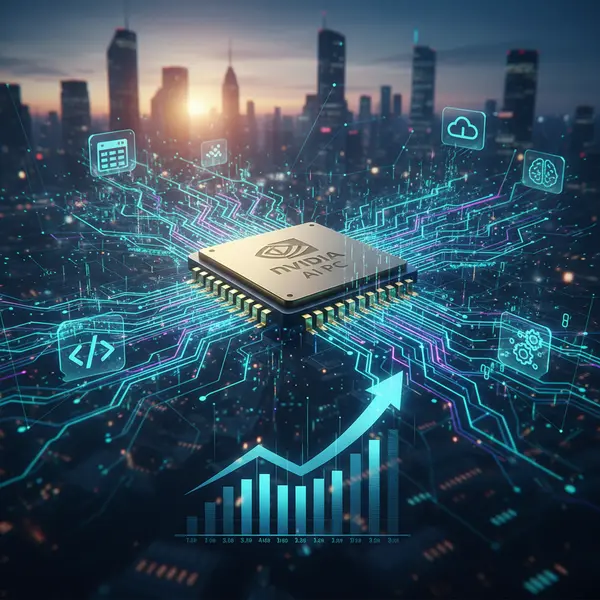
Nvidia's RTX Spark AI PC chip announced at Computex 2026 sparks a tech rally, lifting ServiceNow 8.4% and Arm Holdings 14.7% on rising agentic AI demand.
- Nvidia unveiled the RTX Spark superchip at Computex 2026 on June 1, a 1-petaflop AI hardware platform for Windows PCs launching fall 2026.
- ServiceNow surged 8.4% and Arm Holdings climbed 14.7% after Jensen Huang argued agentic AI expands, rather than cannibalizes, enterprise software demand.
- Intel fell more than 3% and Qualcomm retreated as Nvidia's Arm-based AI PC chip opens a direct competitive front in the consumer processor market.
Lead
Nvidia (NVDA) shares rose 3.8%, touching an intraday high of $222.17, on Monday after CEO Jensen Huang unveiled the company's first personal-computer processor at Computex 2026 in Taipei — a move that immediately upended the consumer chip landscape and ignited a broad tech rally across software, semiconductor, and enterprise-infrastructure stocks.What Happened
Speaking at the Taipei Music Center on June 1, Huang introduced the RTX Spark superchip, framing it as "a reinvention of the computer — as big a deal as the reinvention of the phone into what we now know as the smartphone." The announcement marks Nvidia's formal entry into the Nvidia AI PC segment after years of dominance in data-center AI hardware.
The RTX Spark — formally designated the N1X — is an Arm-based system-on-chip co-developed with Taiwan's MediaTek and manufactured on TSMC's 3-nanometer process. It pairs a 20-core Arm CPU, consisting of 10 Cortex-X925 performance cores and 10 Cortex-A725 efficiency cores clocked at up to 4.1 GHz, with a Blackwell-architecture GPU carrying 6,144 CUDA cores — the same count as a discrete desktop RTX 5070. The two dies are linked via Nvidia's NVLink C2C interconnect at 300 GB/s, feeding up to 128 GB of unified LPDDR5X memory and delivering one petaflop of AI compute.
RTX Spark-powered devices from Microsoft, Dell, HP, Asus, Lenovo, and MSI will reach consumers in fall 2026, with Microsoft's Surface Laptop Ultra confirmed as a launch device. More than 30 laptop designs and 10 desktop configurations are slated for the initial wave.
Market Reaction
The Nvidia news extended a tech rally that had been building throughout May. Arm Holdings (ARM) surged 14.7%, with investors quickly identifying the architecture licensor — whose IP underlies the N1X CPU developed alongside MediaTek — as a primary beneficiary of the initiative. ServiceNow (NOW) led the enterprise software sector, rising 8.4% in regular trading after briefly reaching 14.4% in premarket activity. IBM added 8.1%, Salesforce climbed 6.5%, Atlassian gained 6.6%, and HubSpot rose 6%. Hewlett Packard (HPQ) advanced 5.8%.
The iShares Expanded Tech-Software Sector ETF (IGV) gained 4.5% in premarket trading and held approximately 3.5% higher at the close. Despite remaining down roughly 4% for 2026, IGV has now advanced approximately 17% over the past month. ServiceNow's 30-day gain stands near 36%; IBM has added approximately 28% over the same period.
Intel slid more than 3% and Qualcomm retreated as markets repriced competitive risk across the consumer PC processor landscape.
Strategic Context
Huang's message was as much about software as silicon. Arguing that agentic AI — systems in which autonomous agents execute complex multi-step workflows — means "there are going to be many agents doing work, using more tools than ever," the CEO explicitly reframed the prevailing fear that AI would commoditize or replace enterprise software platforms. That narrative shift powered the day's software gains as decisively as the AI hardware specifications themselves.
By embedding a full Blackwell GPU, the complete CUDA software stack, and Nvidia's AI inference runtime inside a consumer-class laptop, Nvidia is positioning the Nvidia AI PC as a native execution environment for agentic workloads — not merely a thin client for cloud-based inference. The platform ships alongside a published three-generation roadmap: Rubin (featuring LPDDR6 memory) and Rosa Feynman follow the current Spark generation.
The platform also brings Nvidia's data-center AI software ecosystem — including CUDA libraries, TensorRT, and NIM microservices — to the PC market for the first time, creating a developer surface that Intel and Qualcomm cannot immediately replicate.
Competitive Dimension
Nvidia's entry opens a direct front against Intel's Core Ultra series, AMD's Ryzen AI chips, Qualcomm's Snapdragon X Elite, and Apple's M-series in a consumer AI PC market that research firms project will scale significantly through 2027. Nvidia holds an estimated 80–85% share of data-center AI accelerators by revenue; Tuesday's announcement signals an intent to extend that software-ecosystem moat to endpoint devices where rivals currently set the competitive terms.
Qualcomm had previously positioned its Snapdragon platform as the definitive Windows-on-Arm solution. Nvidia's arrival with a CUDA-native architecture backed by the world's largest AI software community represents a structural disruption to that positioning rather than an incremental competitive adjustment.
Outlook
The RTX Spark announcement consolidates Nvidia's presence across data-center, automotive, robotics, and consumer AI hardware in a single keynote cycle — a coverage breadth no direct competitor currently matches. With an Arm roadmap already published, OEM partners spanning the full market from premium ultrabooks to workstation desktops, and a software ecosystem that enterprise developers already rely on at scale, the structural tailwind embedded in Nvidia news flow is unlikely to reverse course in the near term. The more immediate question for equity markets is whether the software sector's 17% monthly gain prices in a meaningful acceleration of agentic AI deployments or primarily reflects relief that AI infrastructure spend will not eliminate software vendors as intermediaries. Fall device availability, developer adoption velocity, and initial sell-through data will provide the first concrete signals.
Mentioned tickers: NVDA, ARM, NOW, IBM, HPQ, CRM, TEAM, HUBS, INTC, QCOM, AMD, AAPL