Pomegra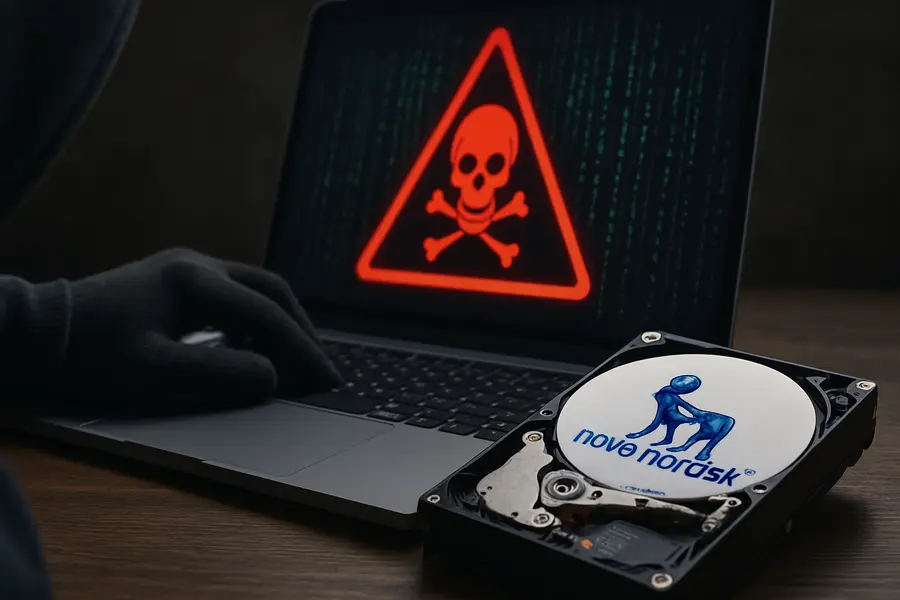
Cybercrime group FulcrumSec stole 1.3TB from Novo Nordisk and is shopping stolen data after the pharma giant rejected a $25M ransom demand in June 2026.
- FulcrumSec exploited exposed Azure and GitHub credentials to persist inside Novo Nordisk's systems for over two months beginning in March 2026.
- The 1.3TB haul includes 24 proprietary AI models, clinical trial data on roughly 11,500 patients, drug pipeline details, and manufacturing facility files.
- After Novo Nordisk declined a $25M ransom, the group published 264GB publicly and is now soliciting private buyers for the remaining trove.
Lead
Novo Nordisk A/S, the Danish maker of Ozempic and Wegovy, confirmed on June 11, 2026 that an unauthorized third party had copied data from a limited number of internal IT systems — the same day cybercrime group FulcrumSec announced it had spent more than two months inside the company's infrastructure, walked out with 1.3 terabytes of proprietary files, demanded a $25 million ransom, and — upon rejection — began leaking and selling the data. The Novo Nordisk hack and FulcrumSec breach together represent one of the most consequential intrusions in pharmaceutical industry history.What Happened
FulcrumSec claims it first accessed Novo Nordisk's environment in March through two credential exposures: an Azure container registry password embedded in a client-side JavaScript bundle, and a GitHub personal access token with read/write permissions across hundreds of private code repositories. The repositories allegedly contained additional API tokens, database credentials, and service account passwords, which enabled lateral movement across corporate systems.
Over roughly ten weeks of persistent access, the group assembled a cache of more than 700,000 files. The haul spans 24 internal AI models — approximately 1.1TB of the total, including a nanobody discovery engine, a patent-drafting large language model, and a clinical omics model — alongside clinical trial records for approximately 11,500 pseudonymized patients, source code, proprietary data on marketed and pipeline drug compounds, healthcare-professional registration data, and operational technology files linked to manufacturing facilities.
On June 1, FulcrumSec shared correspondence with Novo Nordisk outlining its demands. The pharmaceutical company declined. On June 15, the group published 264GB of the stolen data to its dark web site and announced it was "exploring private sales" of specific research datasets to third parties, including competitive intelligence on unreleased drug candidates.
Market Reaction
NVO shares initially absorbed the disclosure with limited damage. The stock was trading near $66 at the time of the June 11 announcement, supported in part by the same-day U.K. regulatory clearance of a daily GLP-1 weight-loss pill, which pushed shares up as much as 3% before settling. Over the prior 30 days, NVO had already declined 5.2%, and the stock remains down roughly 14.9% year to date, reflecting pre-existing commercial pressures — including GLP-1 supply constraints and pricing concerns — that frame the breach within a broader period of investor uncertainty.Strategic Context
The commercial stakes of the stolen intellectual property are difficult to overstate. Novo Nordisk has invested billions of dollars developing proprietary AI infrastructure for drug discovery, and the models alleged to be included in the FulcrumSec trove sit at the core of its competitive pipeline. A nanobody discovery engine and a clinical omics model, if authentic, represent years of research investment that could materially shorten development timelines for any acquirer — whether a rival pharmaceutical company, a contract research organization, or a state-linked actor.
Manufacturing data carries a separate risk. Details on processing facility operations and drug formulations could enable competitors to replicate manufacturing processes at scale, particularly as global demand for GLP-1 therapies remains far ahead of supply.
The FulcrumSec Profile
FulcrumSec emerged in late 2025 and operates as a cloud-focused extortion collective, specializing in cloud infrastructure hosted on AWS and Microsoft Azure. The group now claims 21 victims across sectors including life sciences, professional services, and engineering — with the Arup Group among recently reported targets. Its operating model centers on credential harvesting from improperly secured developer environments, persistent access over extended periods, and public pressure campaigns that include naming individual executives.
The Novo Nordisk breach is the group's highest-profile target to date and reflects a deliberate pivot toward pharmaceutical intellectual property, where data has both immediate extortion value and potential long-term commercial value to private buyers.
Regulatory Dimension
Under the EU General Data Protection Regulation, pseudonymized health data remains personal data. The unauthorized external copy of clinical trial records triggers mandatory supervisory authority notification under Article 33, with a 72-hour reporting window. Because the dataset contains special-category health data, the Danish Data Protection Authority is expected to scrutinize both the breach itself and Novo Nordisk's credential management practices. Under NIS2, executive management may face direct personal liability if investigators determine that systemic security negligence contributed to the exposure.
Novo Nordisk said it is notifying affected individuals and is cooperating with authorities. The company described the patient data as pseudonymized — meaning no direct personal identifiers link individual patients to specific trial information — though legal experts note that pseudonymization does not eliminate GDPR obligations.
Outlook
The immediate exposure is threefold: reputational damage to a company whose clinical credibility underpins drug regulatory submissions worldwide; competitive risk if stolen AI and pipeline data reaches adversarial buyers; and regulatory cost from data-protection enforcement proceedings likely to run into 2027. The private-sale phase of the FulcrumSec breach introduces a new variable — law enforcement seizure of the data remains possible, but the window during which it circulates in closed markets may already be open. For the broader pharmaceutical sector, the intrusion serves as a direct precedent: cloud credentials embedded in developer toolchains represent a systemic attack surface that has now been exploited against one of the world's most valuable drug pipelines.
Mentioned tickers: NVO