Pomegra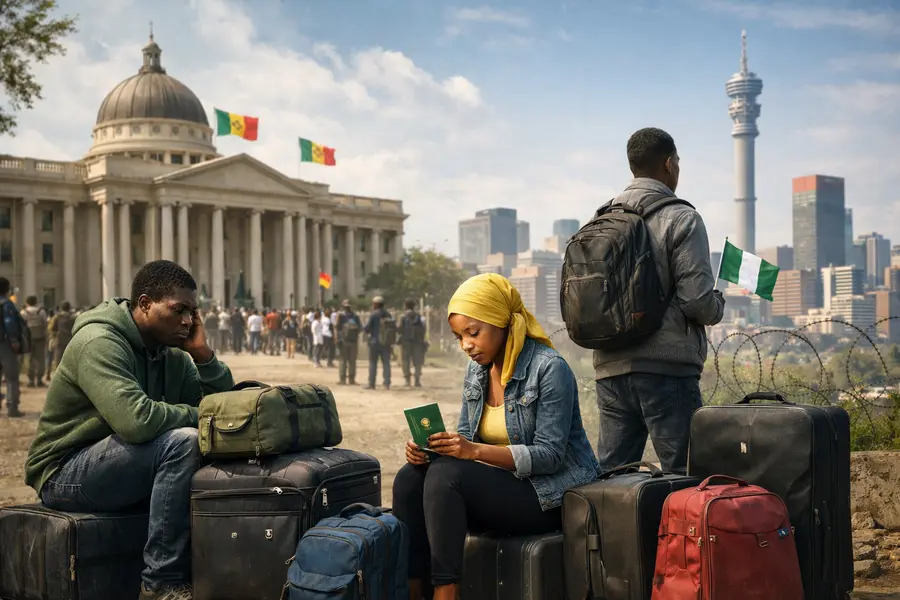
More than 700 Nigerian nationals remain stranded in South Africa amid surging xenophobic violence, as West Africa's political landscape shifts following Senegal parliament's passage of landmark constitutional reforms.
- Over 700 Nigerians remain stranded in South Africa; Abuja has evacuated nearly 900 citizens across multiple emergency flights since June.
- Senegal's National Assembly passed sweeping constitutional reforms on June 29 curtailing presidential authority, with President Faye sending the bill to a referendum.
- The parallel crises highlight deepening strains in African geopolitics, migration governance, and intra-continental power dynamics heading into the second half of 2026.
Lead
More than 700 Nigerian nationals are stranded in South Africa as of early July 2026, sheltering from renewed xenophobic attacks orchestrated by vigilante networks that imposed a June 30 deadline for undocumented foreign nationals to leave the country. Simultaneously, thousands of kilometres to the northwest, Senegal's National Assembly concluded a contentious legislative session on June 29, passing constitutional amendments that fundamentally reorder the balance of executive and legislative power — a vote that descended into physical confrontation on the chamber floor and triggered an opposition walkout.
What Happened: Nigerians Stranded in South Africa
Groups including Operation Dudula and March and March set a June 30 expulsion deadline for undocumented migrants, driving a fresh wave of displacement that has put thousands of Nigerians — registered community members, traders, and students — at risk across Gauteng, the Western Cape, and KwaZulu-Natal.
Nigeria's Federal Government launched an emergency repatriation programme, deploying Air Peace and ValueJet aircraft under a fully government-funded evacuation effort. Three successive flights have returned approximately 900 citizens: an initial 268-person airlift on June 11, a second flight of 269 returnees on June 30, and a third batch of 271 passengers on July 3. President Bola Tinubu ordered the operation to continue until every Nigerian who voluntarily registered and cleared screening was brought home.
With over 15,000 Nigerians initially registered for assistance and evacuation logistics strained, more than 700 remain in-country as of this writing. The Nigerian Ministry of Foreign Affairs has separately announced it will seek compensation from Pretoria for properties and businesses abandoned by citizens forced to flee, raising the diplomatic temperature between Abuja and Johannesburg.
What Happened: Senegal Parliament Passes Constitutional Reform
Senegal's National Assembly voted on June 29 to adopt a sweeping constitutional amendment package proposed by the ruling Pastef parliamentary bloc. The legislation creates a new Constitutional Court, bars a sitting president from leading a political party, restricts presidential authority to sign binding acts in the window between an election and a new inauguration, and mandates that the government brief parliament on all natural-resource exploitation agreements.
The session was turbulent. Speaker Ousmane Sonko — dismissed as prime minister by President Bassirou Diomaye Faye on May 22 and elected Assembly speaker four days later — ordered security officers to physically remove a legislator during debate. Opposition lawmakers responded with a mass walkout before the vote proceeded. Scenes of the confrontation circulated across the continent within hours.
President Faye, rather than promulgate the reform outright, announced it will be submitted to a national referendum, handing the final decision to Senegalese voters and diffusing, at least temporarily, the standoff between the executive and a legislature now firmly in the hands of his former ally.
Geopolitical Dimension
The two stories converge on a single structural challenge: Africa's migration governance framework remains critically underdeveloped relative to the scale of intra-continental mobility. South Africa hosts an estimated 2.9 million foreign nationals, with Nigerians representing one of the largest documented communities. Economic anxiety, unemployment running above 32 percent nationally, and political opportunism have repeatedly translated into cyclical violence against migrant entrepreneurs and workers — a dynamic that has tested the African Union's non-discrimination commitments without triggering enforceable consequences.
Senegal's political convulsion, meanwhile, reflects a broader generational tension playing out across the Sahel and West Africa between reformist movements that won electoral mandates on anti-establishment platforms and the institutional constraints — constitutional, judicial, military — those movements now find themselves navigating. The Faye-Sonko rupture, once a model of post-insurgency democratic consolidation, has become a cautionary data point for regional observers monitoring governance fragility.
What Comes Next: Migration 2026
Nigeria's government has signalled it will maintain evacuation flights until its registered citizens are accounted for, but the diplomatic relationship with South Africa faces a longer repair process. Compensation negotiations over abandoned Nigerian-owned property — encompassing retail, logistics, and informal market stakes worth hundreds of millions of naira — will test bilateral institutions that have historically been slow to resolve such disputes.
In Senegal, a referendum date has yet to be set. The outcome will determine whether the country's parliament secures its expanded oversight role permanently or whether the reform becomes a bargaining chip in further negotiations between Faye and Sonko's competing factions. Regional partners and multilateral lenders are watching closely: governance stability in Dakar directly affects investment frameworks tied to Senegal's nascent offshore gas and oil sector, where major production is scheduled to ramp across 2026 and 2027.
Outlook
The Nigerians stranded in South Africa and the conclusion of Senegal parliament's landmark session are, on the surface, distinct events. Together, they signal that Africa geopolitics in 2026 is being shaped by two reinforcing pressures: the politicisation of migration as an economic grievance in middle-income economies and the institutional stress testing of democratic frameworks installed by reform-era governments. Both pressures are likely to intensify before year-end, as South Africa moves toward its next municipal budget cycle and Senegal approaches a referendum campaign that will further test the durability of its young coalition government.
Mentioned tickers: AIRPZ