Pomegra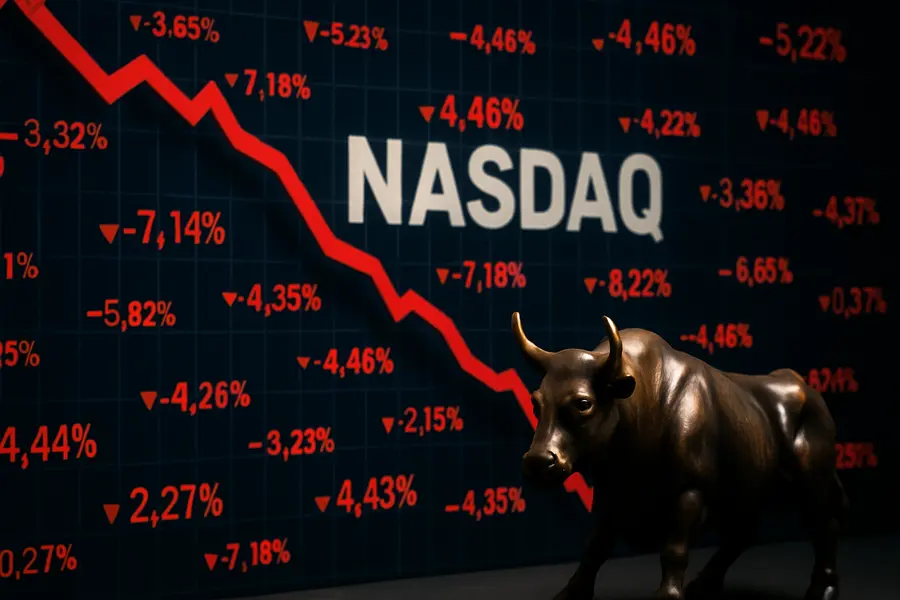
The Nasdaq fell 1.25% Friday, extending a six-day tech stock crash that has rattled Wall Street and pulled the index more than 6.5% below its early-June peak.
- The Nasdaq fell 1.25% Friday, extending a six-session losing streak and leaving the composite roughly 6.7% below its June 2 record high.
- Apple dropped 6% after announcing hardware price increases tied to rising memory costs, leading the Nasdaq lower on the session.
- Investor concern over $452 billion in combined AI capex has shifted sentiment from growth optimism to return-on-investment scrutiny.
Lead
The Nasdaq Composite declined 1.25% on Friday, June 26, capping the index's worst six-day stretch since early 2025 and dragging it to roughly 25,042 — more than 6.5% below the all-time high set June 2. The S&P 500 fell 0.75% and the Dow Jones Industrial Average slipped 0.44%, but the session's most telling signal came from the Russell 2000, which gained 0.71%, underscoring a deliberate rotation out of large-cap technology and into domestically oriented, value-weighted equities.
What Happened
The Nasdaq sell-off today began the session in fragile territory before Apple (AAPL) administered the day's sharpest blow. The company announced price increases on MacBook and iPad lines, citing rising memory procurement costs — a disclosure that sent Apple shares down 6% and made it the single largest drag on the index. Microsoft (MSFT) also fell after disclosing price adjustments on select consumer hardware products under similar cost pressures.
A second catalyst came from reports that OpenAI is leaning toward postponing its highly anticipated initial public offering until 2027. The potential delay revived investor doubts about near-term AI monetization — a concern that has threaded through every session of the current tech stock crash and increasingly shapes the conversation across the entire sector.
Market Reaction
Friday's session extended the Nasdaq's losing run to six consecutive trading days, with the Wall Street volatility of the past two weeks concentrated almost entirely in mega-cap technology and semiconductors. The composite has surrendered roughly 6.7% from its June 2 peak but retains a gain of approximately 10% for the year.
Nvidia (NVDA), which briefly achieved a $5 trillion market capitalization earlier in 2026, has fallen 6% since the sell-off began. In dollar terms, that percentage decline represents an estimated $300 billion in erased market value. Micron Technology (MU) posted the week's most dramatic single-session loss, falling more than 13% during Tuesday's sharpest trading as high-bandwidth memory demand forecasts came into question. Advanced Micro Devices (AMD) also registered significant losses across multiple sessions, moving broadly in line with the rest of the chip complex.At the peak of the mid-week rout, the AI semiconductor sector collectively shed between $1.3 trillion and $1.4 trillion in market capitalization in a single trading session — one of the largest single-day destruction events in the sector's history.
Strategic Context
The origins of the Nasdaq news cycle trace to June 4, when Broadcom (AVGO) delivered a cautious AI chip outlook. The company guided for Q3 AI chip sales of $16 billion — well short of the $17.2 billion analysts had projected — and declined to raise its full-year 2026 AI semiconductor revenue forecast. The guidance miss sent Broadcom shares down 14% in a single session and set off a chain reaction across the supply chain.
What followed was a broader reassessment of the AI capital expenditure thesis that has underpinned Nasdaq valuations for two years. Combined 2026 capital expenditure commitments across Microsoft (MSFT), Alphabet (GOOGL), Amazon (AMZN), and Meta Platforms (META) have surpassed $452 billion — a figure that has moved from a source of investor confidence to one of scrutiny. Institutional participants are now pressing for concrete evidence that revenue generation can scale in proportion to infrastructure deployment, a test the industry has yet to pass convincingly.
The rotation visible in Friday's session reflects that calculation: cyclical and small-cap names held firm or gained while high-multiple, AI-exposed technology stocks absorbed the selling pressure.
Global Dimension
The current Nasdaq news cycle reverberated globally with particular severity in East Asia. South Korea's Kospi index tumbled 10% on Tuesday — its worst single-day performance in years — triggering a circuit breaker that halted trading for 20 minutes. SK Hynix and Samsung, the world's two leading producers of high-bandwidth memory chips essential to AI training infrastructure, each fell more than 12% on the session, dragging the rest of the South Korean market lower with them.
The speed and breadth of the contagion illustrated the degree to which the AI hardware supply chain has become a single, tightly integrated risk exposure: a guidance shortfall from a U.S. semiconductor company translated within hours into double-digit losses on the other side of the Pacific.
Policy and Rate Environment
Federal Reserve policy is amplifying the pressure. Rising market expectations for an additional rate hike have increased the discount rate applied to the long-duration cash flows that underpin high-multiple technology valuations. The combination of elevated and debt-funded capital expenditure programs, a potentially more hawkish Fed, and AI revenue forecasts that have failed to match infrastructure spending pace creates an unfavorable backdrop for a near-term recovery in the most AI-exposed equities.
Outlook
The Nasdaq's six-session decline marks a structural repricing of the AI trade — a transition from capital-spending enthusiasm to return-on-investment discipline. Apple's hardware pricing pressure, Micron's demand uncertainty, Broadcom's guidance shortfall, and the reported OpenAI IPO delay together present a sequence of unresolved headwinds. Recovery in the index's technology core is likely conditional on evidence, at scale, that the $452 billion in annual AI capex is generating commensurate revenue growth. Until that evidence arrives, Wall Street volatility in the technology sector remains the dominant market condition.
Mentioned tickers: AAPL, MSFT, NVDA, MU, AMD, AVGO, GOOGL, AMZN, META