Pomegra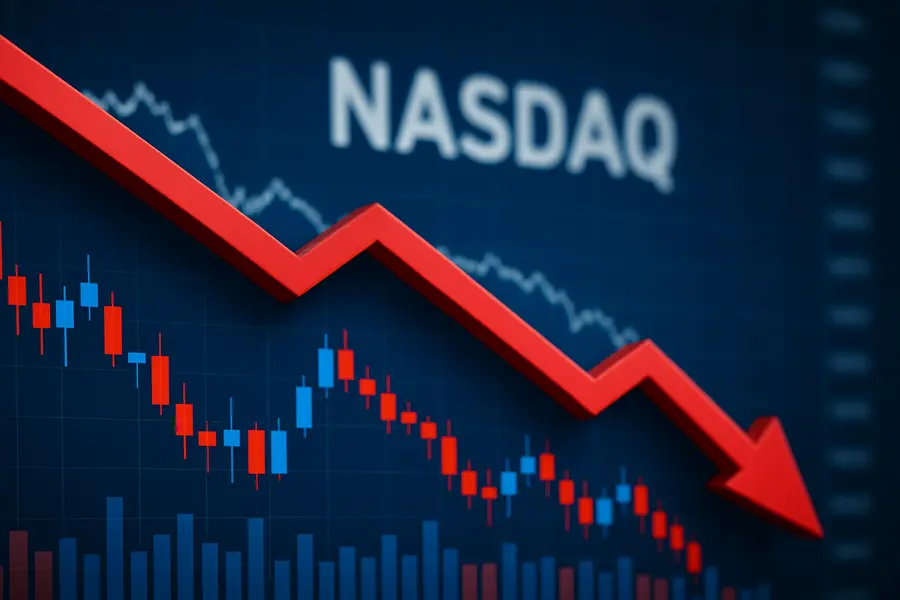
The Nasdaq Composite fell to 25,358 Thursday, completing its longest losing run since February as megacap tech stocks continued sliding on AI valuation fears and Federal Reserve rate concerns.
- The Nasdaq Composite closed at 25,358.60 on June 25, down 0.46%, recording its first four-session losing streak since February 2026.
- Apple shed 6.1% after analysts estimated 15–20% price increases on Mac computers, becoming the single heaviest drag on the S&P 500 that session.
- Over four days, Nvidia, Alphabet, Meta, Microsoft, and Amazon all retreated as investors demanded evidence that AI capital expenditure would translate into revenue.
Lead
The Nasdaq Composite fell 118 points, or 0.46%, to close at 25,358.60 on Thursday, June 25—its fourth consecutive session in the red and the index's longest losing run since February 2026. The four-day slide, which stripped more than 5% from the composite's June 2 high, reflects a broad reassessment of elevated artificial-intelligence valuations and growing conviction that the Federal Reserve could raise interest rates again before year-end.
What Happened
The retreat began Monday, June 22, when the Nasdaq shed roughly 1.3% as SpaceX shares tumbled 16% in a single session, erasing approximately $400 billion in market value from the newly public rocket and satellite company. The drop in SpaceX, which had traded above $225 per share just days earlier, intensified anxiety about stretched valuations across AI-adjacent names and set the tone for the days that followed.
Selling accelerated Tuesday: the Nasdaq fell 2.2%, dropping 580 points to settle at 25,587, with the Philadelphia Semiconductor Index losing close to 8% in its worst single session in months. Wednesday brought a more contained 0.43% decline to 25,476, followed by Thursday's 0.46% drop. The composite erased ground it had spent months accumulating.
The AI Spending Question
The common thread across all four sessions was broadening investor skepticism toward AI capital expenditure. Hyperscalers—the large cloud providers committing tens of billions annually to GPU clusters, data centers, and custom silicon—are being pressed to demonstrate that the spending is generating proportionate revenue.
Data circulated during the week showed that fewer than 3% of a major bank's consumer customers currently pay for any AI service, with average monthly spend around $20. The figure reinforced concerns that AI monetization timelines are being underestimated by markets even as infrastructure costs accumulate. Broadcom's quarterly earnings report, which failed to raise its AI chip revenue outlook, added further weight to the pessimistic read.
Nvidia lost 4.2% across the four days. Meta Platforms declined 2.3%, Microsoft fell 2.51%, and Alphabet shed between 0.8% and 2.3% depending on the session. Amazon dropped 4.8% on its worst day of the stretch.Apple's Price Shock
Thursday's session was dominated by Apple, which slumped 6.1% to become the single heaviest drag on both the Nasdaq and the S&P 500. Analysts estimated that the company raised prices 15% to 20% across its Mac computer and iPad product lines—a move widely interpreted as a tariff pass-through following months of trade friction on electronics manufacturing in Asia.
Apple's decline overshadowed two significant counterweights. Micron Technology surged 15.7% after reporting record quarterly earnings driven by AI memory demand, and Qualcomm gained 3.8% after upgrading its 2029 revenue target for non-handset applications to $40 billion from $22 billion. Apple's index weighting ensured that both gains were effectively neutralized at the composite level.
The Fed Factor
Macro conditions have become more adversarial for high-multiple tech stocks. At its June 17 meeting, the Fed held the federal funds rate at 3.50%–3.75% but revised its projections, with nine of eighteen committee members now anticipating at least one additional rate hike before year-end. The median 2026 projection shifted to 3.8% from 3.4%, reflecting a May consumer price index reading of 4.2% year-over-year—the highest since April 2023.
Higher-for-longer rate expectations compress valuations for growth equities. For the Nasdaq's heaviest constituents, each upward revision in the terminal rate translates directly into downward pressure on what investors will pay per dollar of future earnings.
Global Spillover
The four-day selloff extended beyond U.S. markets. South Korea's Kospi fell sharply as Samsung Electronics and SK Hynix, two of the world's largest memory chip producers, tracked the global semiconductor correction. Asian indices broadly weakened, adding pressure to U.S. futures ahead of each session. The synchronized nature of the pullback reflected how tightly linked global technology supply chains have become to AI sentiment on Wall Street.
The S&P 500 largely held its ground on Thursday, closing little changed at 7,357.49, while the Dow Jones Industrial Average edged up 0.1% to 51,960.62—underscoring that the selling remained concentrated in high-multiple technology names rather than spreading across the broader market.
Outlook
The Nasdaq's first four-day losing streak since February extends a pullback that began when the index was pricing in a best-case scenario: accelerating AI revenue growth and a cooperative monetary policy. Both assumptions are now under pressure. Near-term direction for the Nasdaq hinges on how the Fed communicates policy intentions in the weeks ahead, whether upcoming earnings from AI infrastructure providers show improving monetization metrics, and whether Apple's pricing actions signal a broader repricing of consumer hardware at tariff-inclusive cost levels. The streak is notable less for its magnitude than for what it signals: the early-2026 rally in tech was built on a thesis that investors are no longer willing to hold without corroborating evidence.