Pomegra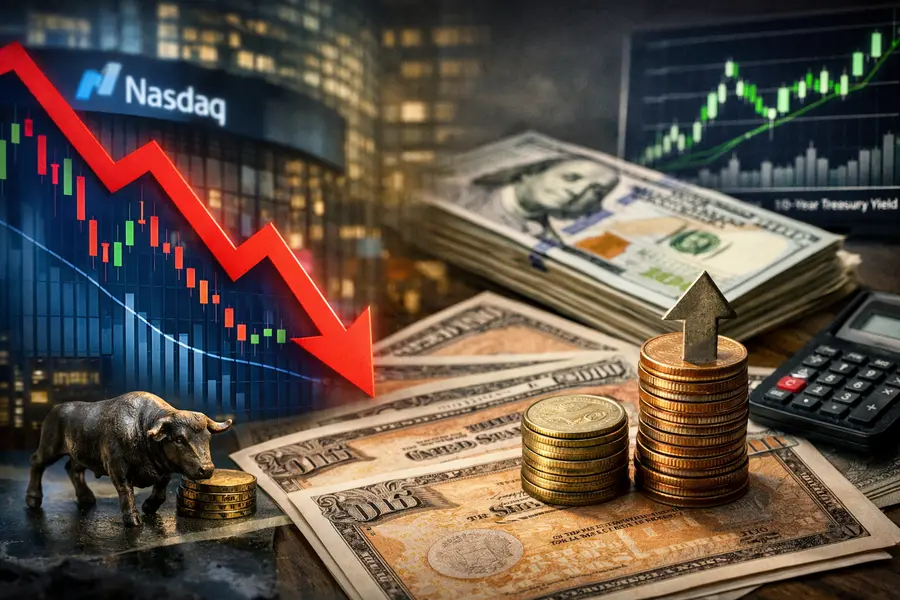
Treasury yields surged to multi-year highs in late July 2026, erasing an overnight Nasdaq futures rally exceeding 1% and signaling that inflation anxiety now outweighs strong corporate results on Wall Street.
- The 10-year Treasury yield climbed to 4.74%, its highest level since January 2025, triggering a sharp futures screen reversal.
- Nasdaq 100 E-Mini futures swung from gains above 1% to losses of 1.61% as bond markets dictated the session's tone.
- Despite 86% of S&P 500 reporters beating earnings estimates, inflation fear dominated price action on Wall Street.
Lead
A textbook futures screen reversal unfolded on Wall Street in late July 2026: the Nasdaq 100 had climbed more than 1% in overnight trading on the back of a solid earnings season, only to surrender every point — and then some — by the opening bell. The culprit was a renewed surge in Treasury yields, with the benchmark 10-year note touching 4.74%, its highest since January 2025, while the 30-year bond topped 5.20% for the first time since 2007. In a market still scarred by the rate shock of earlier years, the message from the bond market was unambiguous: inflation fear beats good earnings.
What Happened
Overnight futures markets appeared poised for a constructive session. Nasdaq 100 E-Mini contracts rallied past the 1% threshold as investors processed a run of better-than-expected corporate reports — at the time of the reversal, 86% of S&P 500 companies that had reported Q2 2026 results delivered positive earnings surprises, with 80% topping revenue estimates as well.
The rally collapsed as the U.S. cash session approached. The 10-year Treasury yield, which had spent most of July climbing steadily from 4.14% in early month, pushed through 4.73% and touched 4.74% in morning trading. The 2-year yield — the most sensitive to Federal Reserve expectations — rose to 4.29%. The 30-year at 5.20% rekindled memories of a financial era many investors had hoped was behind them.
By the time equity markets opened in New York, Nasdaq 100 E-Mini futures had swung to a loss of 1.61%. The broader Nasdaq Composite fell 0.73% in early trade. The futures screen reversal — from green to red before 9:30 a.m. Eastern — crystallized the inflation trade in real time.
Why Yields Rose
Several forces converged to push bond yields higher despite inflation data that, on its face, was not alarming. June's Personal Consumption Expenditures price index came in at 3.70% year-over-year, down from 4.10% in May. Core PCE moderated to 3.30%. Both readings moved in the right direction.
Yet markets focused on what remained structurally elevated rather than the month-over-month improvement. Brent crude oil surged back above $100 per barrel following fresh Houthi attacks on tankers in the Red Sea, reviving supply-shock inflation fears. Federal deficit concerns — a recurring pressure on the long end of the yield curve throughout 2026 — continued to weigh on the 30-year in particular.
The Federal Reserve held its benchmark rate steady at its July 29, 2026 meeting but left the door open to future increases. Policymakers' language reinforced the market's reading that the Fed is not yet prepared to pivot, keeping real yields elevated and sustaining pressure on growth and technology equities.
Market Reaction
The Wall Street session illustrated a dynamic that has defined much of 2026: strong corporate fundamentals cannot override the macro rate environment when yields move aggressively. Equity valuations, particularly in the technology sector where long-duration cash flows are discounted most heavily, compress in lockstep with rising yields.
Alphabet became the most visible casualty of the day's competing narratives. The company posted revenue growth that cleared estimates comfortably, yet shares fell 6.9% after management guided for a 2026 capital expenditure envelope of $195 billion to $205 billion. Investors interpreted the elevated AI infrastructure spending as a signal of slow near-term cash conversion — a concern amplified when the cost of capital, as expressed by the 10-year yield, was moving higher by the hour.The episode reinforced a pattern: earnings beats provide a temporary tailwind, but the rate environment determines whether that tailwind can sustain a rally or whether it simply delays a futures screen reversal.
Strategic Context
The divergence between earnings quality and price performance points to a structural tension in 2026 markets. Corporate America is generating profits; the question is how those profits are valued when the risk-free rate sits at levels last seen before the post-financial-crisis era of near-zero rates.
At 4.74% on the 10-year, the earnings yield of the S&P 500 offers diminishing premium over Treasuries. That compression forces portfolio managers to reweight — not necessarily out of equities entirely, but toward sectors with shorter duration earnings profiles: energy, financials, and industrials over technology and consumer discretionary.
The AI infrastructure spending cycle compounds the valuation challenge. The largest technology companies are deploying capital at a pace that delays free cash flow inflection points further into the future — precisely the wrong profile in a high-rate environment, even when the strategic rationale for that spending is sound.
What Comes Next
The next major inflation reading — the July CPI report, scheduled for August 12, 2026 — will be closely watched for confirmation of whether the June deceleration was a trend or a blip. Oil prices above $100 per barrel, if sustained, carry enough pass-through to consumer prices to complicate any Federal Reserve pivot.
Bond market positioning suggests investors are not yet pricing in rate cuts for 2026. The 30-year yield above 5.20%, last seen in 2007, functions as a broader warning about the fiscal trajectory and its interaction with monetary policy. Until that signal changes, Wall Street sessions that open green on earnings and close red on yields are likely to remain a recurring feature — not an anomaly.
Outlook
The late-July futures screen reversal on Wall Street distilled the central market conflict of 2026: strong earnings cannot independently sustain rallies when Treasury yields are rising and inflation expectations remain unanchored. With the 10-year at 4.74% and the 30-year at levels not seen in nearly two decades, the rate environment retains the power to override corporate performance. Until inflation data prints convincingly lower or the Fed signals a pivot, yield-driven reversals remain the dominant regime.
Mentioned tickers: QQQ, SPY, GOOGL, US10Y, US30Y, NQ