Pomegra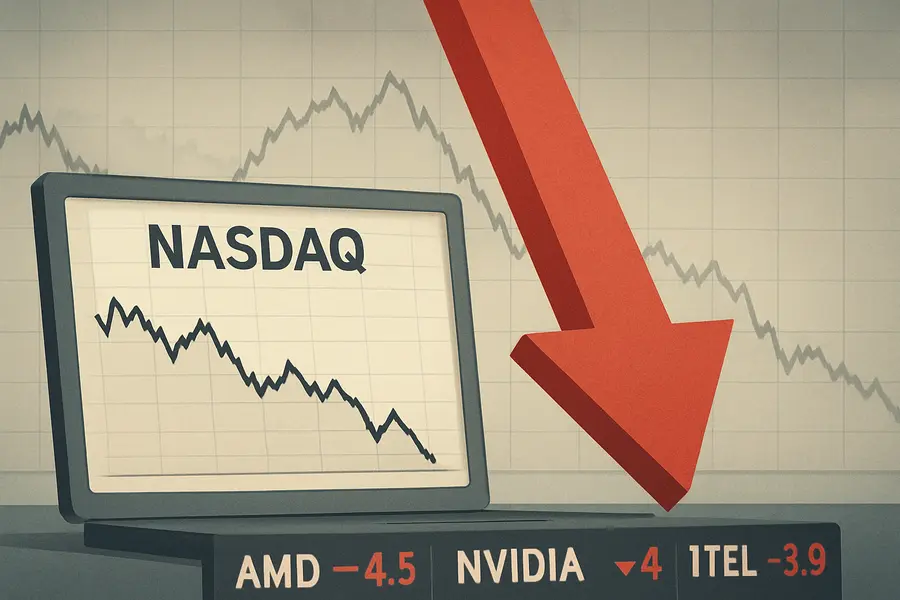
Investors rotated out of semiconductor hardware into AI software, sending the Nasdaq lower and erasing billions in gains from a historic first-half rally.
- The Nasdaq Composite fell 0.8% on July 1, closing at 25,832.67, as chip stocks extended a multiday slide.
- SanDisk plunged 14% on July 2; Micron dropped 7%, Applied Materials 7.4%, and Marvell 9.8%.
- The PHLX Semiconductor Index shed 6.7%, with the sector having roughly doubled during Q2 2026.
Lead
A sweeping chip stock selloff pulled the Nasdaq lower over back-to-back sessions this week, as investors who rode semiconductor equities to extraordinary gains in the first half of 2026 pivoted toward profit-taking and rotated capital into AI software names. The Nasdaq Composite closed at 25,832.67 on July 1, down 0.8%, while the PHLX Semiconductor Index fell 6.7% — erasing weeks of gains in a single session. On July 2, the selling intensified, widening into Asian markets and leaving few corners of the global chip sector untouched.
What Happened
The tech index news that dominated Wednesday and Thursday centered on a simultaneous unwinding of the most crowded trade in global equities: AI-related semiconductor hardware. SanDisk (SNDK) bore the heaviest losses, falling 14% on July 2 to an intraday low of $1,707.58 — a sharp reversal for a stock that had surged approximately 858% over the prior twelve months. Micron Technology (MU) fell 7% to around $1,130. Applied Materials (AMAT) dropped 7.4%, Marvell Technology (MRVL) lost 9.8%, and Advanced Micro Devices (AMD) shed 4.3%.
Intel (INTC) fell roughly 9%, while Western Digital (WDC) lost 6%, closing near $626.The market volatility was not confined to the United States. South Korean chipmakers were hit particularly hard: Samsung Electronics and SK Hynix each fell more than 12%, forcing circuit breakers to halt trading twice on the KOSPI, which itself dropped approximately 10%.
Why Investors Sold
The chip stock selloff stems from profit-taking rather than a deterioration in fundamentals. Semiconductor ETFs including SMH and SOXX had gained between 70% and 100% during the second quarter alone, driven by AI infrastructure spending cycles that lifted valuations well beyond historical norms. That extraordinary run left the sector exposed to any shift in sentiment.
The immediate catalyst on the hardware side was a combination of factors. Broadcom (AVGO) had flagged a more cautious near-term AI chip outlook in early June, and that tone lingered. Concerns about a memory chip supply-demand rebalancing and softening global smartphone demand added pressure. With valuations stretched following an uninterrupted rally, institutional investors moved first.
The capital rotation was explicit and deliberate: money moved out of AI chip hardware — memory, logic, and equipment makers — and into AI software names, where investors perceived greater relative value given that infrastructure buildout was already priced into chip stocks.
Market Reaction and Divergence
The divergence between the Nasdaq and the Dow Jones Industrial Average this week illustrates how concentrated the selloff was. While the Nasdaq extended its Nasdaq decline, the Dow surged 539 points, or 1.03%, on July 2 to close at 52,844 — a record — led by consumer-facing and industrial names including Apple (AAPL), McDonald's (MCD), and Walt Disney (DIS). Apple's 4.8% gain on that session underscored how investors distinguished between AI-adjacent hardware and platform businesses with diversified revenue streams.
The S&P 500 finished roughly flat for the week, with gains in defensive sectors offsetting semiconductor weakness. Tesla (TSLA) fell 7.5% despite a strong deliveries report, reflecting broader skepticism about high-multiple names amid the market volatility.
Fundamental Backdrop
Despite the severity of the price declines, the underlying business results remain robust. Micron's fiscal third-quarter earnings delivered $41 billion in revenue — a 346% year-over-year increase — with fourth-quarter guidance set at $50 billion. Analyst price targets remain elevated: Bernstein set a $3,000 target on SanDisk on June 30, and Bank of America reiterated a Buy with a $2,500 target, citing sustained supply-demand imbalance in the NAND market extending through 2027.
The gap between the selloff in equity prices and the strength in corporate results reflects a repricing of the speed and linearity of AI hardware spending, not a structural reversal. Long-term supply agreements with fixed pricing and upfront financial commitments signed between memory makers and hyperscalers provide a degree of revenue visibility that balance sheets rarely carried during prior chip cycles.
Geopolitical Dimension
The tech index news also carries a geopolitical undertone. The severity of the KOSPI decline — its largest single-day drop in years — reflects South Korea's concentrated exposure to global memory demand. Any perception that AI hardware investment is moderating hits Seoul's equity markets disproportionately. U.S. export controls on advanced chips, which constrain the addressable market for companies supplying Chinese customers, remain a background risk that investors weigh against otherwise bullish demand forecasts.
Outlook
The Nasdaq decline and broader chip stock selloff of early July 2026 represent a valuation reset within a structurally intact AI infrastructure cycle, rather than a turning point for the semiconductor industry. The PHLX Semiconductor Index had roughly doubled in a single quarter; a 6–7% single-session drawdown is consistent with normal corrective behavior after that kind of run. Micron's guidance of $50 billion in quarterly revenue underscores that AI compute demand has not reversed. The near-term risk is a continuation of the rotation trade and further profit-taking if software names continue to outperform hardware peers. The structural question — whether AI software spending growth can sustain at the pace implied by current valuations — will shape the next leg for the sector.
Mentioned tickers: SNDK, MU, AMAT, MRVL, AMD, INTC, WDC, AVGO, META, TSLA, AAPL, MCD, DIS