Pomegra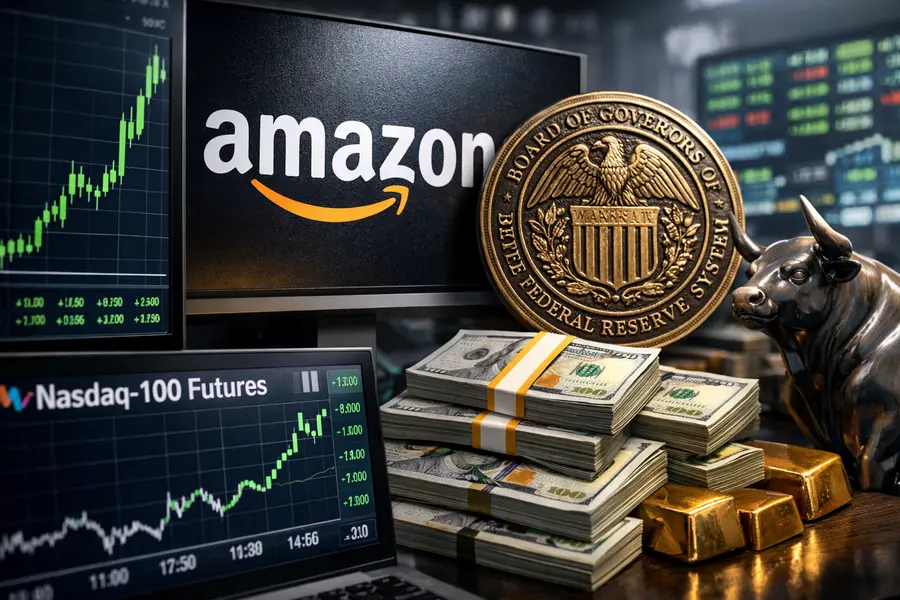
Amazon's record Q2 revenue above $200 billion and a less-hawkish Fed hold push Nasdaq-100 futures 1.2% higher, setting a risk-on tone for Friday's open.
- Nasdaq-100 futures advance 1.2%, Dow futures gain 330 points, and S&P 500 futures climb 0.5% in Friday premarket trading.
- Amazon posts $200.6 billion in Q2 revenue — the first quarterly total above $200 billion — with AWS cloud growth accelerating to 37% year over year.
- The Federal Reserve held rates at 3.5%–3.75% in a 9-3 vote Wednesday; cooler June PCE data reinforces a disinflation trend heading into August.
Lead
U.S. equity futures advanced broadly in early Friday trading as Amazon.com (AMZN) delivered a blowout second-quarter report that lifted sentiment across the technology sector. Nasdaq-100 futures climbed 1.2%, Dow Jones futures added 330 points, and S&P 500 futures rose 0.5% shortly before the July 31 open, extending a week already defined by a Federal Reserve rate hold and a string of high-profile Big Tech earnings reports.What Happened
Amazon reported second-quarter earnings of $5.75 per share on revenue of $200.6 billion, easily surpassing Wall Street estimates of $1.81 per share and $196.2 billion — the first time the company has cleared the $200 billion quarterly revenue threshold. Amazon Web Services contributed $42.2 billion, growing 37% year over year at its fastest pace in 18 quarters, against consensus expectations of 31%. Management raised full-year capital expenditure guidance to roughly $220 billion, directed almost entirely at AI and cloud infrastructure. AWS now carries an annualized revenue run rate of $169 billion with a contracted backlog of $496 billion.
Amazon shares surged 11% in premarket trading, providing the sharpest single-stock catalyst of the morning. An additional tailwind came from a $53.4 billion non-operating pre-tax gain tied to the company's investment in Anthropic, the AI safety firm.
Market Reaction
The futures screen green across all three major index benchmarks, though moves differ in composition. The Nasdaq-100 outperforms given its technology concentration, while the Dow's 330-point gain reflects a broader base of large-cap strength. S&P 500 futures at 0.5% capture a tug of war between megacap tailwinds and ongoing pressure from names that disappointed investors earlier this week.
Apple (AAPL) fell 7.3% in premarket trading despite reporting third-quarter fiscal 2026 results that beat both earnings and revenue estimates, as investors focused on the company's cautious tone around AI monetization timelines. Meta Platforms (META) shed 10% after reporting $60.8 billion in Q2 revenue — 28% growth year over year — but posting a 14% decline in net profit as its $125–145 billion 2026 capital expenditure program compressed margins beyond expectations. Monolithic Power Systems (MPWR) added 11.4% on a strong quarter, while Roblox (RBLX) tumbled 22.5% after issuing a weak third-quarter outlook and missing user-growth forecasts.Fed and Macro Context
The Federal Reserve held its benchmark rate at a target range of 3.5%–3.75% at its July 29 meeting — the fifth consecutive hold — in a 9-3 vote that proved less hawkish than many participants had anticipated. Fed Chair Kevin Warsh navigated a divided committee, with dissenting regional presidents Beth Hammack, Neel Kashkari, and Lorie Logan each advocating for a rate increase to address inflation that has remained above the Fed's 2% target for more than five years.
The hold was reinforced Friday morning by June personal consumption expenditures data showing the PCE price index declined 0.1% on a monthly basis, pushing the annual rate to 3.7%. Core PCE — which excludes food and energy — rose 0.1% for the month and 3.3% year over year, landing in line with forecasts. The softer reading gives the Fed room to remain on hold without signaling tightening before September.
AI and Technology Angle
Amazon's report crystallizes a theme that defined the wall street morning sessions all week: AI infrastructure spending is accelerating, and the companies with the most direct cloud revenue exposure are being rewarded while those whose margin impact is most visible are being penalized. Microsoft (MSFT), which reported Tuesday, surged 8% after posting roughly $90 billion in quarterly revenue — 18% growth year over year — with its Azure-embedded AI business reaching a $37 billion annual run rate, up 123% year over year.
The combined capital expenditure plans of Amazon, Alphabet (GOOGL), Meta, and Microsoft now stand at approximately $725 billion for 2026, a 77% increase from the prior year — a level of infrastructure investment reshaping semiconductor demand, power consumption, and data-center real estate globally. Alphabet fell 7% earlier in the week after free cash flow turned negative for the first time since its 2004 IPO, a direct result of $205 billion in projected full-year capex.
Strategic Context
The divergence within Big Tech this earnings season reflects a market recalibrating how AI spending translates to returns. Companies where cloud revenue growth directly absorbs infrastructure costs — Amazon and Microsoft — are being rewarded; companies where AI spending is broader and monetization less clearly defined — Meta and Alphabet — are being penalized despite strong revenue growth. That distinction is likely to persist into the second half of 2026, as investor tolerance for capex-heavy programs varies sharply by business model transparency.
Outlook
Friday's broad advance in futures signals the market intends to close July on a constructive note, anchored by Amazon's record-breaking quarter and a Fed posture that remains on hold despite internal pressure for hikes. Cooling June PCE data provides modest macro relief heading into August. Attention will shift quickly to whether the September FOMC meeting reopens the rate debate and whether the AI capex cycle continues to generate the revenue acceleration visible in AWS and Azure. For now, the tone heading into the open is firmly risk-on.