Pomegra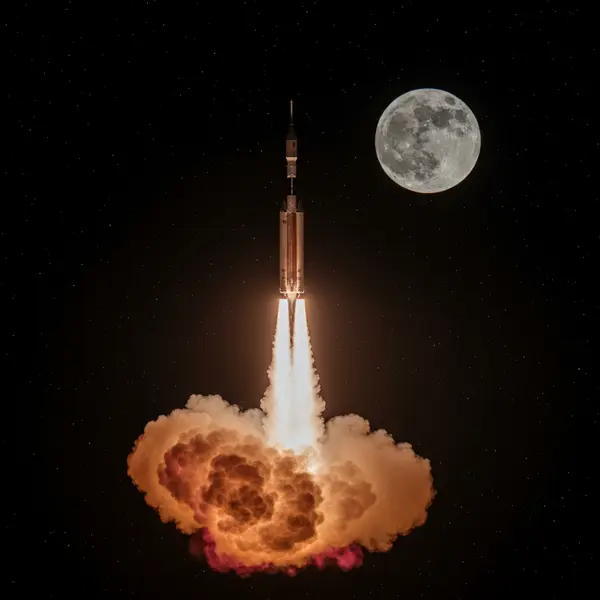
---
Historic Liftoff from Pad 39B
The Space Launch System (SLS) rocket ignited and cleared the tower at Launch Complex 39B at NASA's Kennedy Space Center in Florida at 6:35 p.m. EDT on April 1, 2026, after a tense final hour that included a resolved battery temperature anomaly in the launch-abort system and a flight termination system check by U.S. Space Force's Eastern Range. Weather ultimately cooperated at a 90% "go" probability, and the 322-foot-tall rocket — fueled with more than 750,000 gallons of cryogenic propellant — thundered into a clear Florida sky producing over 8 million pounds of thrust at liftoff.
The Orion spacecraft, named Integrity by its crew — continuing the Apollo-era tradition of naming lunar vessels — successfully deployed its four solar array wings approximately 38 minutes after launch, providing over 11 kilowatts of power to the capsule. Kennedy Space Center's visitor complex was sold out, and Google dedicated its homepage Doodle to the mission.
---
The Crew: Four Explorers Bound for the Moon
The four-astronaut crew represents a landmark in spaceflight history. Commander Reid Wiseman (NASA), pilot Victor Glover (NASA), mission specialist Christina Koch (NASA), and Jeremy Hansen of the Canadian Space Agency (CSA) are the first humans to travel to the Moon's vicinity in over half a century. Hansen is the first Canadian citizen to embark on a lunar mission.
"It's a great day for us, a great day for this team," Wiseman told the crowd during the pre-launch walkout at the Neil A. Armstrong Operations and Checkout Building.
---
Mission Architecture: Proximity Operations and a Lunar Slingshot
Within hours of launch, Glover executed a critical manual proximity operations (prox ops) demonstration, hand-flying Orion within 15 meters (50 feet) of the SLS rocket's Interim Cryogenic Propulsion Stage (ICPS) in Earth orbit. The test evaluated the spacecraft's Digital Autopilot (DAP) system and its ability to rendezvous with future hardware, including the lunar lander planned for Artemis III.
"Overall, guys, this flies very nicely. Very precise," Glover reported during the maneuver.
Following the prox ops, Orion completed its perigee raise burn — placing the spacecraft on an elliptical orbit with a closest Earth approach of 115 miles — followed by an 18-minute apogee-raising burn extending the spacecraft's farthest point from Earth to 43,730 miles. If all onboard systems remain nominal, mission controllers at NASA's Johnson Space Center in Houston will command the critical translunar injection (TLI) burn on April 2, a six-minute firing of Orion's European-built service module engine to send the crew on a lunar free-return trajectory.
---
A Minor Hiccup: Toilet Fan Issue in Deep Space
In one of the mission's first operational quirks, mission specialist Christina Koch worked with flight controllers on Earth to address a fan malfunction in Orion's onboard space toilet. The issue, while unusual, was confirmed non-critical to mission safety. NASA officials noted the incident reflects the purpose of Artemis II as a crewed test flight — designed precisely to identify and resolve such systems-level challenges before future surface missions.
---
Lunar Flyby Scheduled for April 6
If the TLI burn proceeds as planned on April 2, Orion and its crew will reach the Moon by Monday, April 6, executing a multi-hour lunar flyby at an altitude of 4,000–6,000 miles above the lunar surface. The crew will photograph and visually survey portions of the Moon's far side — terrain rarely seen by human eyes — under conditions where low-angle solar illumination will cast long shadows, enhancing topographical features including ridges, slopes, and crater rims.
Scientific experiments aboard Orion include the AVATAR tissue-on-a-chip investigation, a deep-space radiation shelter evaluation, and exercise equipment testing — all critical datasets for future long-duration lunar and Mars missions.
---
Four CubeSats Join the Mission
During the early orbital phase, the ICPS upper stage deployed four CubeSats from international partners: Argentina's CONAE, the German Aerospace Center (DLR), the Korea AeroSpace Administration (KASA), and the Saudi Space Agency — each conducting independent scientific investigations and technology demonstrations during the mission's early phase.
---
Road to Launch: A Mission Years in the Making
The April 1 liftoff came after a months-long countdown marked by technical challenges. The SLS rocket rolled to Pad 39B on January 17, 2026, but was rolled back to the Vehicle Assembly Building on February 25 following the discovery of a helium flow anomaly in the ICPS upper stage. After repairs, battery replacements, and a successful wet dress rehearsal, the rocket returned to the pad on March 20 and was cleared for the April 1 launch window. An X1.4 solar flare on March 29 prompted additional space weather monitoring but posed no threat to the crew.
NASA Administrator Jared Isaacman described the mission as "a defining moment" and outlined its place within a broader vision: "Artemis II marks our return to the Moon — not just to visit, but to eventually stay on our Moon Base, and lays the foundation for the next giant leaps ahead."
---
What Comes Next
Following the lunar flyby, the Orion crew will harness lunar gravity to slingshot back toward Earth on a free-return trajectory. On Flight Day 10, the spacecraft will reenter the atmosphere at approximately 25,000 miles per hour before descending under parachutes for a Pacific Ocean splashdown off the coast of San Francisco, where a U.S. Navy recovery vessel will retrieve the crew. Artemis III — targeting an actual crewed lunar surface landing — is the program's next major milestone, pending the outcome of this critical test flight.
---