Pomegra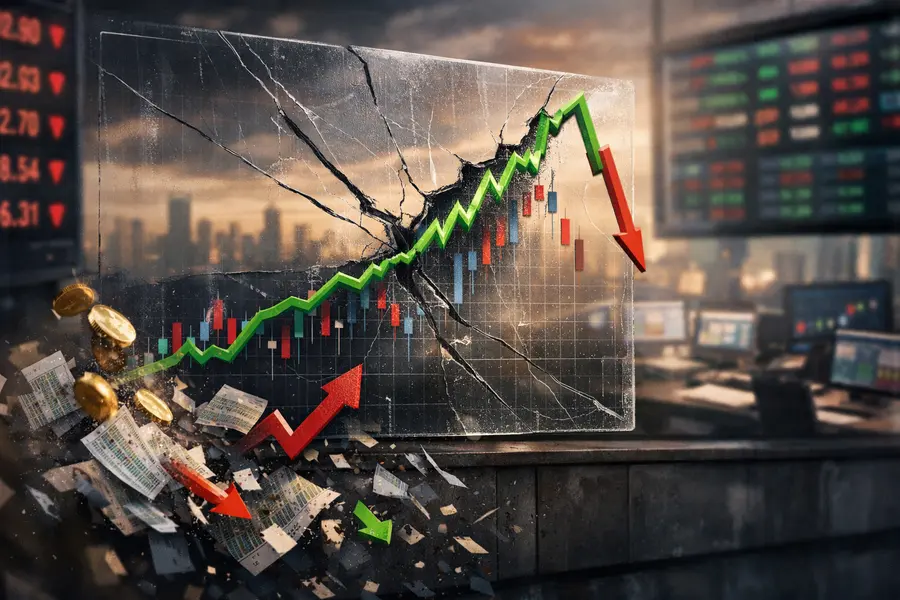
The momentum trade that drove US stocks to record H1 2026 gains is rapidly unwinding as a weak June jobs report and extreme crowding signal a durable shift.
- The momentum factor gained 28% through H1 2026—its strongest first-half run on record—before beginning to unravel on a weak June jobs report.
- June nonfarm payrolls added just 57,000 jobs—roughly half the consensus forecast—wiping rate-hike expectations for the rest of 2026.
- Retail cash equity volume ran 65% above 2025 levels through May and June, concentrated in AI, hyperscaler, and megacap technology names.
Lead
Wall Street's dominant bet of 2026 is fraying at the edges. The momentum trade—the strategy of systematically buying recent winners and selling recent losers—generated a 28% gain through the first six months of the year, the strongest first-half performance in the factor's tracked history. That run ended abruptly on July 2, when the Bureau of Labor Statistics reported that the US stock market's underlying labor engine added just 57,000 nonfarm payroll jobs in June, roughly half the consensus estimate of 110,000, triggering a rapid reprice of rate expectations and an accelerating unwind of the most crowded factor trade of the cycle.
What Happened
The June payrolls report delivered the softest monthly hiring figure in four months and arrived compounded by downward revisions of a combined 74,000 jobs to April and May data. Markets responded instantly. The 2-year Treasury yield, the most direct market proxy for near-term Federal Reserve action, dropped 3.5 basis points to 4.13%. Traders repriced July rate-hike odds to effectively zero and cut projected Fed moves through year-end to fewer than 30 basis points, from over 60 basis points the week prior.
For the momentum trade, the jobs data landed at a moment of acute vulnerability. By late June, crowding in high-beta and momentum factors had reached extreme levels by most institutional risk-desk metrics. Wall Street risk teams had been flagging the fragility of the trade internally since May, when the momentum premium in US equities reached levels not seen since the dot-com era. The factor's 28% H1 gain had attracted successive waves of allocator inflows, each reinforcing the next in a self-reinforcing price spiral—precisely the mechanism that makes momentum unwinds disorderly when they begin.
Market Reaction
High-beta momentum names fell nearly 10% in the days following the jobs report as the unwind gained traction. The sector leadership reversal was sharp and immediate. Energy and Consumer Staples—sectors that had trailed the broader market through most of H1 as capital flowed toward AI and technology—reached all-time highs as institutional repositioning drove money toward value and defensive exposures. Information Technology, the clear leadership sector of the first half, began underperforming the S&P 500 for the first time in 2026 as investors reassessed the timeline for AI capital expenditure payback.
One counterforce sustained the trade longer than historical models might predict: retail participation. Cash equity trading volume among individual investors ran approximately 65% above 2025 levels through May and June, with demand concentrated almost entirely in AI, hyperscaler, and megacap technology names. That retail bid cushioned the early phase of the institutional unwind, but the gap between institutional selling pressure and retail buying capacity is now widening.
H1 Market Recap
The H1 market recap shows a tale of two distinct phases. The S&P 500 bottomed on March 30 amid the escalation of the US-Iran conflict, which sent energy prices sharply higher and compressed risk appetite globally. The index and the Nasdaq Composite entered Q2 near their cycle lows before staging a historic recovery: the S&P 500 and Nasdaq posted Q2 gains of 14.9% and 21.4% respectively—the best second-quarter performances since 2020—while the Dow advanced 12.9%.
The recovery was not broad. S&P 500 EPS grew 27.93% on revenue growth of 11.71%, reflecting substantial operating leverage, but market leadership was extraordinarily narrow. The ten largest S&P 500 constituents now account for nearly 40% of the index's total weight. Semiconductor stocks have grown to represent 20% of the benchmark, four times their 2020 share and the highest concentration on record. That concentration inflated momentum returns throughout H1, as the same names occupied the top of the factor's buy list quarter after quarter.
Investment Trends Under Pressure
The dominant investment trends of H1—AI infrastructure spending, semiconductor supply-chain exposure, and factor-momentum convergence—are now entering a period of reassessment. The AI capital expenditure cycle remained the structural engine of the rally: combined capex among major technology companies is forecast to exceed $600 billion in 2026, sustaining demand for chips, memory, servers, and networking. Individual stocks directly exposed to that infrastructure buildout delivered triple-digit gains over the first six months.
Momentum strategies do not evaluate fundamentals; they evaluate price trends. When price trends invert—as they did sharply in early July—the factor sells regardless of underlying earnings quality. The rotation into energy and staples is not a judgment on AI fundamentals; it is a mechanical consequence of factor repositioning, amplified by the narrowness of the market's prior leadership.
The macro backdrop complicates the second half further. May inflation printed at 4.2%, the highest in three years, placing the Federal Reserve in a difficult position between sticky price pressure and a cooling labor market. That policy uncertainty limits the rate-environment clarity that momentum strategies depend on to sustain consistent returns.
Outlook
The momentum trade enters H2 2026 at a structural inflection point. The factor's historic first-half run created crowding conditions that are now mechanically unwinding, catalyzed by the June payrolls shock and sustained by macro uncertainty around Fed policy. Revised year-end S&P 500 targets of 8,000 reflect continued confidence in the earnings cycle, but the composition of returns is expected to broaden materially. Sector rotation toward value, defensives, energy, and software is already underway, suggesting the narrow, AI-driven momentum leadership that defined the first six months of 2026 will give way to a wider and more durable set of market drivers through year-end.
Mentioned tickers: SPY, QQQ, DIA, NVDA, AMD, MU, MSFT, META, GOOGL, XLE, XLP