Pomegra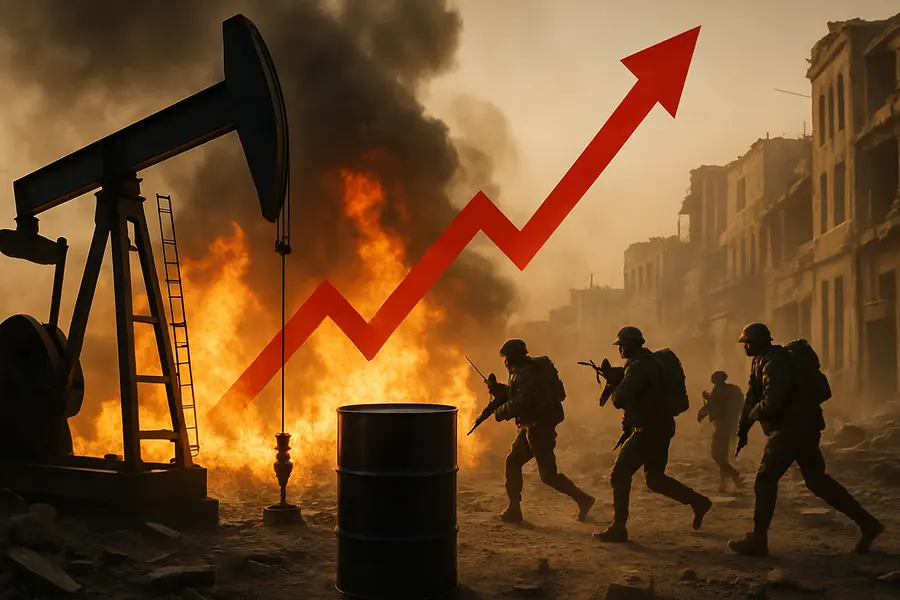
Brent crude remains roughly $20 above its year-start level as prolonged Strait of Hormuz disruptions and intermittent US-Iran diplomatic breakdowns sustain global market volatility and energy stock swings into late June 2026.
- Brent crude trades near $78/bbl in late June 2026, down from an April peak of ~$117/bbl but still $20 above where it opened the year.
- A US-Iran memorandum of understanding signed June 14 eased prices, but abruptly postponed Geneva talks and a June 25 vessel strike off Oman renewed security concerns.
- Energy stocks including XOM and OXY have outperformed the broader market year-to-date, supported by elevated realizations and record US crude export volumes.
Lead
LONDON/NEW YORK — Global crude markets are entering the final week of June 2026 in a state of unresolved tension, as the conflict that effectively shut down the Strait of Hormuz on February 28 continues to set the floor for Middle East energy prices even as a fragile diplomatic framework edges toward implementation. Brent crude futures settled near $78 per barrel as of June 26, roughly $20 higher than at the start of 2026 and still well above pre-conflict levels, despite retreating from an April monthly average of $107 per barrel. West Texas Intermediate last settled at $74.82 per barrel. The combination of sustained supply disruption, incomplete peace-deal implementation, and fresh shipping incidents is keeping global market volatility elevated and producing sharp intraday swings across equity and commodity benchmarks.What Happened
Military action beginning February 28 imposed a near-total restriction on shipping through the Strait of Hormuz, removing approximately 20% of global crude supply from accessible transit routes. The closure triggered an immediate price surge, with Brent approaching $100 per barrel in early April and touching an intraday high near $117 per barrel at the peak of the disruption. Markets had begun 2026 with Brent priced near $61 per barrel.
The disruption simultaneously redirected global demand toward US supply. American crude oil and petroleum product net exports reached a record 5.8 million barrels per day in April, as refinery buyers in Asia and Europe scrambled to replace Persian Gulf barrels. The LNG market absorbed a separate blow: one-quarter of global liquefied natural gas export capacity went offline in early April after Qatar's Ras Laffan facility — responsible for nearly 20% of worldwide LNG output — sustained damage to two of its 14 processing trains. Asian spot LNG prices surged as buyers competed for a reduced pool of cargoes.
Diplomatic Progress — and Fresh Setbacks
On June 14, Washington and Tehran signed a memorandum of understanding under which Iran agreed to reopen the Strait in exchange for the US lifting its blockade of Iranian ports. President Donald Trump confirmed the Strait would formally reopen upon signing. Markets front-ran the agreement aggressively: Brent fell to $78.24 per barrel by June 17, its lowest level since early March. The US Treasury subsequently issued a 60-day license authorizing the production, delivery, and sale of Iranian crude, including imports to the United States.
Relief was short-lived. Scheduled follow-on negotiations in Geneva were abruptly postponed on June 19, sending Brent back above $81 per barrel. On June 25, a cargo vessel was struck by an unidentified projectile off the Omani coast, reviving concerns about geopolitical tension in the waterway and whether Tehran retains effective control over traffic flows. By late June, Persian Gulf exports had recovered to roughly 75% of prewar levels, supported in part by ship-to-ship transfers in the Gulf of Oman and Saudi Arabia resuming tanker loadings at its Ras Tanura terminal. Mine-clearance operations remain ongoing, and full supply-chain normalization is expected to take several additional weeks at minimum.
Energy Stocks News and Market Reaction
The extended period of elevated Middle East energy prices has produced bifurcated performance across asset classes. Global market volatility — measured by intraday swings in oil benchmarks and equity indices — has remained persistently high throughout the second quarter as diplomatic signals and security incidents alternate in driving sentiment.
Within equities, energy stocks have been among the year's clearest sector winners, though gains are unevenly distributed. ExxonMobil (XOM) is up approximately 6.6% year-to-date, comfortably ahead of the S&P 500 and roughly in line with the broader energy sector's gain of 8%. Chevron (CVX) has added approximately 1.4% year-to-date, held back by assets with higher breakeven thresholds. Occidental Petroleum (OXY) delivered the quarter's most significant earnings beat, reporting Q1 earnings per share of $1.06 against Wall Street consensus of $0.59, benefiting from elevated price realizations and record domestic export demand. SLB (SLB), the oilfield services leader, has lagged upstream names, declining roughly 12% over the trailing twelve months as international operators maintained capital spending discipline. The Energy Select Sector SPDR ETF (XLE) has gained approximately 8% year-to-date, among the best-performing sector ETFs in 2026.
Geopolitical Dimension
The conflict has exposed structural vulnerabilities in global energy supply chains that will not resolve quickly even under a permanent settlement. The geopolitical tension surrounding the Strait of Hormuz has already accelerated investment decisions in alternative pipeline routes, floating storage capacity, and long-term supply contracts, particularly among Asian buyers seeking to reduce Hormuz transit exposure. The World Bank revised its 2026 average Brent forecast to $86 per barrel, up sharply from $69 per barrel in 2025, embedding the assumption that a residual risk premium persists throughout the year. The International Monetary Fund has identified the conflict as one of the principal near-term downside risks to the global growth outlook, citing direct impacts on Middle East energy prices, trade flows, and financial conditions.
Outlook
The trajectory of global market volatility and crude prices in the second half of 2026 will be determined by the pace and durability of the US-Iran peace process. Persian Gulf shipping lane clearance and supply chain normalization are expected to require several more weeks, and the June 25 vessel strike illustrates how quickly isolated security incidents can reverse market gains. Brent is broadly forecast to average $86 per barrel for the full year, with significant upside risk if geopolitical tension resurfaces and downside risk if the Strait reopens on an accelerated timeline. Energy stocks are expected to remain tightly coupled to crude price direction and diplomatic headlines, as investors continue to price an asset class caught between a historic commodity cycle and an unresolved conflict.
Mentioned tickers: XOM, CVX, OXY, SLB, XLE