Pomegra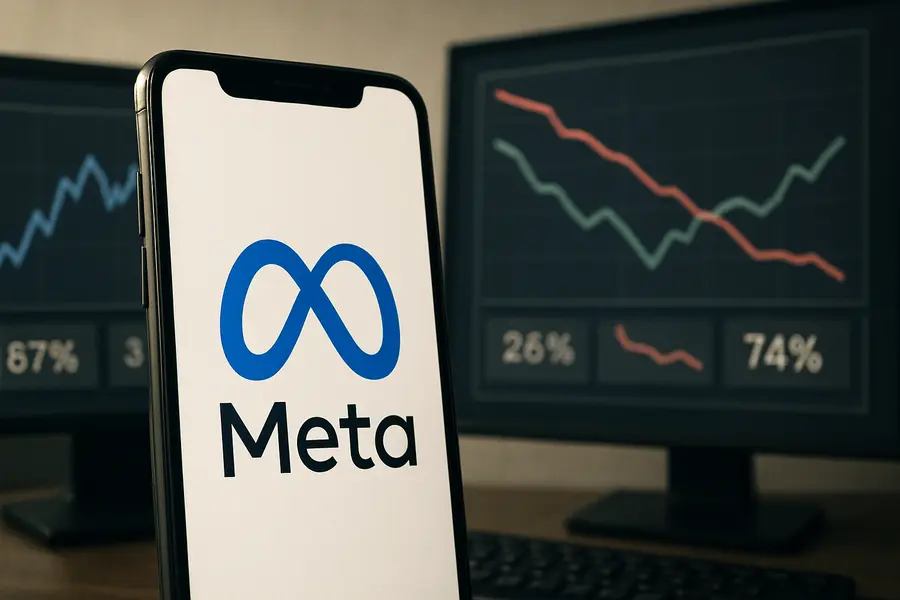
Meta's prediction-markets app Arena pressured DraftKings and Robinhood shares as the social-media giant targets a sector nearing $1 trillion in annual volume.
- DraftKings (DKNG) fell ~2% and Robinhood (HOOD) dropped ~2.33% on June 23 after news broke of Meta's prediction-markets push.
- Arena would launch with a points-based system, sidestepping CFTC regulation; real-money wagering remains a future option.
- The prediction-markets sector grew from under $5B in monthly volume in September 2025 to $24B by April 2026.
Lead
Meta Platforms is developing a standalone smartphone application, codenamed Arena, that would allow users to forecast outcomes across politics, sports, and entertainment — a direct entry into the fast-growing prediction markets sector whose combined monthly trading volumes have surged from under $5 billion in September 2025 to $24 billion by April 2026. The New York Times reported the project on June 23, 2026, citing employees with knowledge of the matter. Shares of DraftKings (DKNG) and Robinhood Markets (HOOD) fell as much as 2% and 2.33%, respectively, while Meta Platforms (META) edged higher by approximately 1.5% intraday.What Happened
Mark Zuckerberg dispatched a small internal team to develop Arena following the breakout success of Polymarket and Kalshi during and after the 2024 U.S. presidential election. The project is described internally as experimental but a top priority. Meta declined to comment on the report.
Arena would operate as a standalone app, walled off from Facebook, Instagram, WhatsApp, and Messenger — though those platforms could serve as funnels for new users. At launch, Arena would rely on a video game-style points system rather than real-money wagers, a structure that sidesteps oversight by the Commodity Futures Trading Commission. Real-money betting has not been ruled out for future iterations, contingent on regulatory evolution.
Meta is not new to this space. The company launched a similar product called Forecast in 2020 during the early months of the COVID-19 pandemic, then quietly shut it down in 2022. Arena would benefit from far greater network effects: Meta reported 3.56 billion daily active users across its family of apps as of April 2026, a distribution pipeline no existing prediction-market platform can match.
Market Reaction
The announcement hit shares of companies with existing prediction-market exposure hardest. DraftKings (DKNG), already down roughly 37% year-to-date entering the week amid rising competitive pressure from event contracts, fell approximately 2% on June 23. Flutter Entertainment (FLUT), parent company of FanDuel, dropped nearly 2% intraday before recovering to close up 0.4%. Robinhood Markets (HOOD), which hosts event contracts from multiple prediction-market platforms, declined approximately 2.33%.
META itself moved in the opposite direction, gaining close to 1.5% intraday as investors weighed the upside of the company entering a market with structural tailwinds and a potential multi-trillion-dollar ceiling.
Strategic Context
The prediction markets sector has attracted a combination of venture capital and mainstream attention at a pace few expected. Kalshi held approximately 57% market share by monthly trading volume as of May 2026, reporting $17.9 billion in monthly volume and carrying a $22 billion private valuation. Polymarket, the crypto-native platform that rose to prominence during the 2024 election cycle, reported roughly $7.1 billion in monthly volume as of May 2026, after peaking during the election period. Industry projections have placed the sector on a trajectory toward $1 trillion in annual trading volume by the end of the decade.
For Meta, Arena represents an effort to capture engagement — and potentially monetizable financial activity — from a user base that dwarfs every existing prediction-market platform combined. The app's points-based launch structure enables rapid deployment without federal regulatory approval, while leaving open a pathway to real-money contracts if and when the regulatory environment permits.
Regulatory Dimension
The CFTC issued proposed rules on June 10, 2026 — less than two weeks before the Arena report — that would ban event contracts tied to war, assassinations, and terrorism while potentially opening a formal framework for sports event contracts. A comment period of 60 to 90 days is expected to close in late August or mid-September 2026.
The broader sector has faced mounting legal scrutiny. A U.S. Army Special Forces soldier was federally charged in April 2026 for using classified military intelligence to win more than $400,000 on Polymarket. A Google engineer faces separate DOJ charges for using internal search data to trade on the same platform. The House Committee on Oversight and Government Reform has opened a probe into insider trading enforcement across prediction-market platforms.
Outlook
Meta's entry into prediction markets through Arena would give the sector its largest potential distribution channel to date. Near-term pressure on DraftKings, Flutter, and Robinhood reflects competitive concern rather than confirmed displacement; Arena remains in development and may not reach public release. Regulatory clarity from the CFTC expected in the third quarter of 2026 will shape whether any platform — including Meta — can move beyond points systems into real-money event contracts. The sector's trajectory toward the projections circulating on Wall Street will depend on both that regulatory outcome and the ability of major new entrants to convert Meta's vast general audience into active forecasters.