Pomegra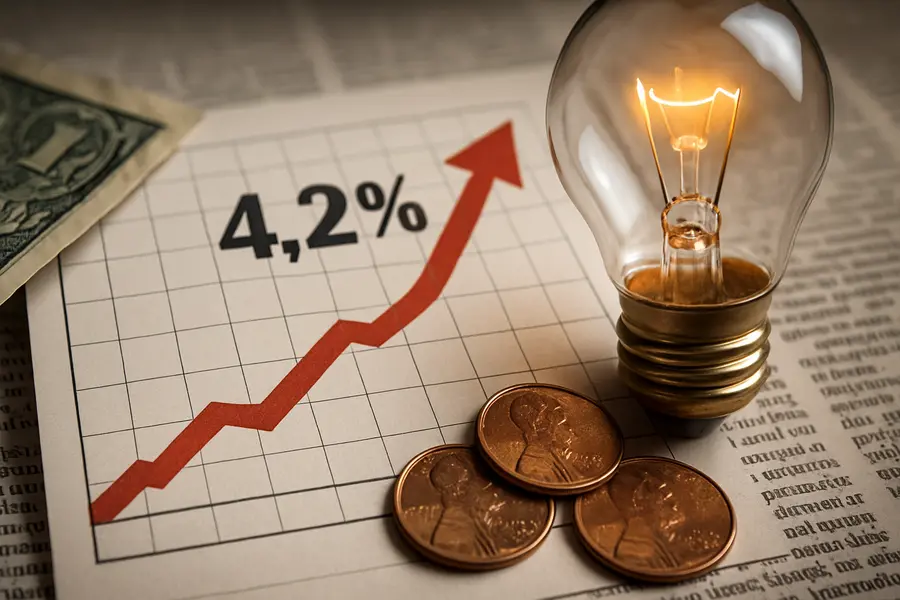
U.S. consumer prices rose 4.2% year-over-year in May 2026, the third straight monthly acceleration and the hottest reading since April 2023, as Iran-driven energy costs dominated the print.
- Headline CPI inflation reached 4.2% YoY in May, the fastest pace since April 2023, fueled by a 23.5% annual surge in energy prices.
- Gasoline prices climbed 40.5% from a year ago and 7.0% on the month, as Strait of Hormuz disruptions removed roughly 20% of global petroleum supply.
- Core CPI edged up to 2.9% YoY while rising just 0.2% monthly, signaling demand-side pressure remains contained beneath the headline surge.
Lead
The Bureau of Labor Statistics released the May 2026 Consumer Price Index on June 10, showing the all-items index rose 0.5% month-over-month and 4.2% year-over-year — up from 3.8% in April and 3.4% in March. The three-month acceleration marks the most sustained inflationary streak since the post-pandemic period, though the composition of the current episode differs sharply: the overwhelming driver is a supply-side energy shock rooted in geopolitical disruption rather than broad demand overheating.
What Happened
The energy index surged 3.9% in May and is now 23.5% above year-ago levels, accounting for more than 60% of the month's total CPI gain. Gasoline led the energy complex, rising 7.0% on the month and 40.5% year-over-year. Fuel oil climbed 58.9% annually. Electricity prices rose 0.6% in May and 5.9% from a year ago, while utility gas service edged down 0.5% monthly but remained 3.0% higher year-over-year.
Outside energy, the picture was more moderate. Food prices rose 0.2% in May and 3.1% year-over-year, accelerating from 2.3% in April, with both at-home and away-from-home categories contributing. Shelter inflation held relatively firm at 3.4% annually, ticking up from 3.3% in April.
Core CPI — which strips out food and energy — rose 0.2% on the month, below April's 0.4% gain and beneath the 0.3% consensus. The annual core rate moved to 2.9%, a level last seen in September 2025. The divergence between a cooling core and an accelerating headline underscores the supply-driven character of the current inflation episode.The Energy Shock Behind the Numbers
The proximate cause of the energy price surge is the effective restriction of traffic through the Strait of Hormuz following military operations against Iran earlier in 2026. The International Energy Agency characterized the resulting disruption as the largest in the history of the global oil market. With roughly 20% of worldwide petroleum consumption and significant volumes of liquefied natural gas transiting the strait, markets responded sharply: Brent crude rose from the mid-$60s to nearly $120 per barrel at the conflict's peak — approaching the all-time high of $147 set in July 2008 — before pulling back toward $83 as diplomatic signals emerged in mid-June.
U.S. retail gasoline prices reflected that trajectory directly. Pump prices rose more than $1.16 per gallon nationwide from pre-conflict levels, with California consumers facing prices above $6 per gallon in multiple counties at the March 2026 peak.
Market Reaction
Equity futures held negative territory in the session following the CPI release but recovered from their lows as traders parsed the widening gap between headline and core readings. Treasury yields were largely flat, reflecting the market's interpretation that the Federal Reserve faces limited tools against a supply-side price shock.
Federal funds futures priced a 96.3% probability that the Federal Open Market Committee would hold its benchmark rate in the 3.50%–3.75% target range at the June 17 policy meeting, which proved accurate. However, markets simultaneously priced a roughly 96% probability of at least one rate increase by December 2026, reflecting concern that persistently elevated headline inflation could feed into inflation expectations even if the core remains anchored.
Fed's Policy Dilemma
The Federal Reserve confronts a structural constraint: raising the federal funds rate curbs consumer borrowing and demand-driven price pressure, but cannot reopen a blocked waterway or substitute for disrupted crude oil volumes. Tightening policy aggressively into a supply shock risks choking growth without meaningfully reducing the energy component of CPI inflation. Holding rates risks allowing elevated headline prints to un-anchor longer-term inflation expectations — a dynamic the Fed has worked to prevent since 2021.
The April FOMC minutes signaled policymakers were watching energy prices closely and would distinguish between pass-through effects from supply disruptions and more durable core inflation dynamics. The May core print — 0.2% monthly — offered some reassurance on that front.
Outlook
The trajectory of May CPI inflation and the broader energy price shock hinges on the Strait of Hormuz situation. Diplomatic progress, confirmed in mid-June, has already pulled Brent crude from its highs, and a sustained reopening of the strait would remove the primary engine of headline acceleration. If energy normalizes in June and July, the year-over-year comparisons will shift markedly favorable by late summer. The more durable risk is whether elevated pump prices and food costs have already begun feeding second-round effects into wage negotiations and services inflation — the component the Fed watches most closely. June and July CPI prints will determine whether May's 4.2% marks a ceiling or a waypoint.
Mentioned tickers: SPY, QQQ, TLT, USO, XLE