Pomegra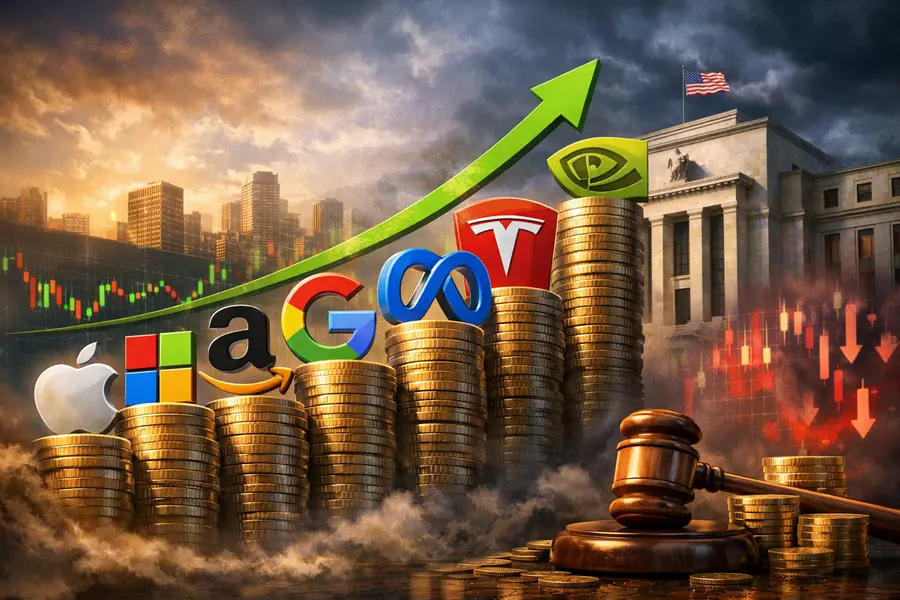
The S&P 500 closed the week up roughly 1%, rescued by a Magnificent Seven tech rally that offset a Fed-driven midweek plunge, as investors weighed an earnings scorecard that exposed deep fault lines within big tech.
- The S&P 500 finished the week up approximately 1%, recovering from a Wednesday selloff that sent the Dow down 1,000 points after the Fed held rates at 3.5%–3.75%.
- Microsoft and Amazon surged 8%–10% on strong AI demand signals; Meta and Alphabet fell 10%–15% on capex skepticism.
- The Federal Reserve's fifth consecutive pause drew three dissenting votes, with Chair Kevin Warsh signaling further tightening remains on the table.
Lead
The Magnificent Seven — Apple, Microsoft, Nvidia, Amazon, Meta, Alphabet, and Tesla — staged a decisive recovery across the trading week ending August 1, pushing the S&P 500 up roughly 1% and snapping the Nasdaq's six-day losing streak despite a jarring Federal Reserve-induced selloff on Wednesday that briefly erased more than 1% from U.S. equities. The divergence in outcomes within the group itself, however, marked one of the most fractured big-tech tech rally episodes in recent memory.
What Happened
The Federal Open Market Committee voted 9–3 on July 29 to hold the federal funds rate at 3.5%–3.75%, its fifth consecutive pause. The decision — and remarks from newly installed Fed Chair Kevin Warsh signaling that further tightening remains possible if inflation does not retreat — triggered an immediate equity sell-off. The S&P 500 fell 1%, the Nasdaq shed 0.9%, and the Dow Jones Industrial Average tumbled more than 1,000 points on the session.
The three dissenters — Cleveland Fed President Beth Hammack, Minneapolis Fed President Neel Kashkari, and Dallas Fed President Lorie Logan — each preferred a 25-basis-point increase, a hawkish minority signal that unsettled bond and equity markets alike. The 10-year Treasury yield surged on the news, steepening pressure on growth-oriented tech names.
Recovery came swiftly. By Thursday, the S&P 500 had rebounded 1.7%, settling near 7,437, while the Nasdaq surged 2.8% to 25,122 — powered largely by earnings-driven gains from Microsoft (MSFT) and Amazon (AMZN).
Earnings Split: Winners and Losers Within the Mag 7
The week's tech rally was shaped entirely by earnings quality, not momentum. The results sorted the Magnificent Seven into two distinct camps.
Microsoft gained 8%–16% after reporting that its AI business reached an annualized revenue run rate of $37 billion, representing 123% year-over-year growth. Azure's performance — driven by enterprise AI adoption and cloud migration — was cited as evidence that hyperscale capital expenditure is generating measurable demand returns, not speculative capacity. Amazon rose more than 10% after its quarterly results confirmed accelerating AWS growth and expanding advertising revenue. Like Microsoft, Amazon framed its $200 billion 2026 capital expenditure plan as demand-driven, a distinction the market rewarded. Meta fell nearly 10% after missing earnings-per-share estimates. Despite reporting $784 million in free cash flow, investors focused on guidance implying full-year capital expenditure of $125 billion to $145 billion, with insufficient revenue evidence to justify the scale of AI infrastructure commitment. Alphabet fell as much as 15% — its worst single session since the April 2025 tariff shock — after unveiling AI capital expenditure guidance of $175 billion to $185 billion for 2026, a figure that reignited investor concern about monetization timelines. The combination of Alphabet and Meta's sell-offs pushed an index tracking the Mag 7 down 4.8% on Thursday before the broader recovery took hold. Apple (AAPL) fell 3%–4% on modest AI integration progress, though the stock's year-to-date gain of roughly 25% remains the strongest in the group. Nvidia (NVDA) and Tesla (TSLA) were relatively stable on the week, with Nvidia supported by persistent data-center demand and Tesla by ongoing progress on autonomous software platforms.Market Context: Concentration and Capital
The Magnificent Seven carry a combined market capitalization of approximately $22.73 trillion, representing roughly 23.5% of total U.S. equity market capitalization. Their collective weight means earnings season for this cohort functions effectively as a macro event — and the bifurcation in outcomes this cycle reflected a broader investor debate about AI return-on-investment timelines.
Across Amazon, Alphabet, Meta, and Microsoft, combined 2026 capital expenditure is projected to reach $725 billion, a 77% increase from the prior year. The market is drawing a clear line: firms demonstrating AI revenue alongside that spending — Microsoft and Amazon — are rewarded. Those that have expanded infrastructure ahead of revenue conversion — Meta, Alphabet — are not.
The S&P 500 is now positioned in a context where the Magnificent Seven are projected to deliver 19% profit growth in 2026, compared with 17% for the rest of the index, with the spread expected to widen further into 2027. That fundamental advantage continues to anchor institutional exposure to the group even in volatile macro environments.
Fed and Macro Dimension
The Fed's policy stance adds structural complexity. With inflation running at a three-year high — more than twice the 2% target — Chair Warsh declined to signal a near-term easing path. The 3.5%–3.75% rate range, elevated by historical standards, compresses the valuation premium that high-multiple tech stocks command and raises the hurdle for AI spending to justify current equity prices.
Markets are now pricing a lower probability of rate cuts before year-end. The hawkish-hold posture from three FOMC members — combined with Warsh's emphasis on returning inflation durably to target — points to a policy environment in which the tech rally will need to be sustained by earnings, not liquidity expectations.
Outlook
The week's outcome reinforces a bifurcation that is likely to persist through the remainder of 2026. Microsoft and Amazon have established a credible narrative linking AI capital expenditure to realized demand; their premiums appear defensible at current rates. Meta and Alphabet face a higher burden of proof with investors before their spending cycles are re-rated positively.
For the S&P 500 overall, the 1% weekly gain masks ongoing fragility: a hawkish Fed, differentiated earnings quality within the Magnificent Seven, and elevated long-term yields create a narrower runway for further index appreciation than headline numbers suggest. The next catalyst will be Nvidia's earnings, which carry outsized weight given its role as the infrastructure supplier to every major AI platform — a result that could either consolidate the tech rally or test it once more.
Mentioned tickers: AAPL, MSFT, NVDA, AMZN, META, GOOGL, GOOG, TSLA, SPY, QQQ