 Pomegra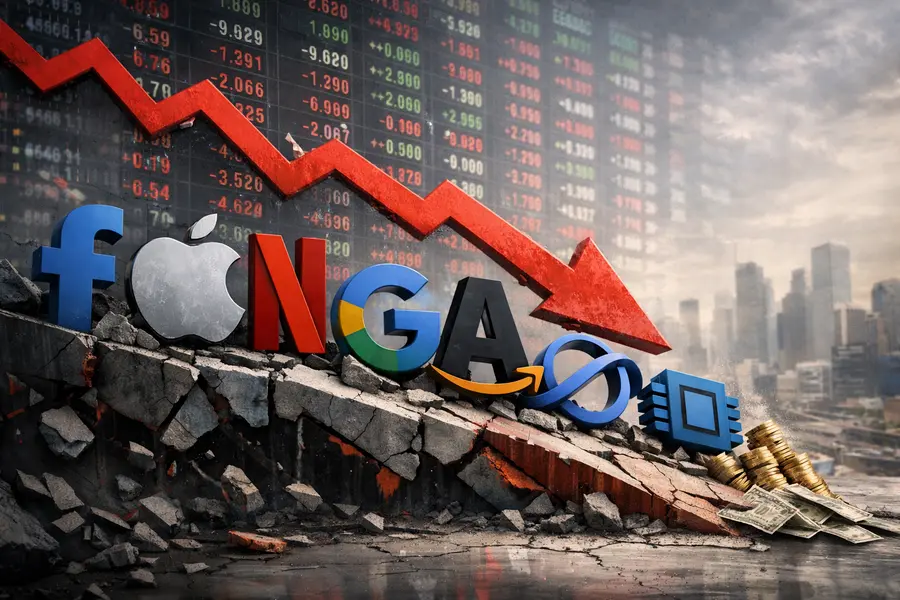
The Magnificent 7 now trades at just a 10% premium to the broader S&P 500 — the narrowest gap in over a decade — as mounting AI capital expenditure concerns compress tech stock valuations across the group.
- Morgan Stanley finds the Magnificent 7 valuation premium over the S&P 500 has narrowed to roughly 10%, the lowest in more than a decade.
- Hyperscaler AI capital expenditure for 2026 is forecast to exceed $725 billion, up 70% year-on-year, weighing on investor sentiment.
- Nvidia now trades near 18x forward earnings versus a historical average of ~36x; Meta's forward P/E has compressed to approximately 19x.
Lead
The seven largest U.S. technology companies — Apple (AAPL), Microsoft (MSFT), Nvidia (NVDA), Alphabet (GOOGL), Meta Platforms (META), Amazon (AMZN), and Tesla (TSLA) — have collectively reached their lowest relative Magnificent 7 valuation in more than a decade as of early July 2026. The group's premium to the rest of the S&P 500 has compressed from above 30% for most of the 2020s to approximately 10% today, a structural shift that reflects investor anxiety over ballooning capital expenditure programs and a demand for demonstrable returns on artificial intelligence infrastructure.
What Happened
The Roundhill Magnificent Seven ETF (MAGS), the primary vehicle tracking the group, slipped into correction territory on June 23, closing at $63.14 — down 11% from its May 14 record of $70.94. The fund had already fallen 16% from its prior peak by late March, making the first half of 2026 a period of sustained de-rating for a cohort that had driven the majority of U.S. equity returns for three consecutive years.
With one exception — Alphabet, which has gained 14.5% year-to-date versus the S&P 500's 8.8% advance — every member of the group has underperformed the broader index in 2026. The de-rating is not a function of earnings collapse: the Magnificent 7 still carries a roughly 45% annual earnings growth advantage over the other 493 constituents of the S&P 500. It is, instead, a reassessment of what that earnings power is worth relative to the capital required to sustain it.
AI Capex Alarm
The central driver of the US valuation reset is the sheer scale of artificial intelligence infrastructure spending. Hyperscaler capital expenditure commitments for calendar year 2026 now total between $700 billion and $725 billion, a year-on-year increase of approximately 70%. Meta has raised its capex forecast to a range of $125 billion to $145 billion. Microsoft is guiding toward $190 billion. Alphabet expects full-year capital spending of $180 billion to $190 billion. Amazon, while reporting separately, is on a similar trajectory.
The debate in markets has shifted materially. For most of the AI buildout cycle, investors tolerated heavy spending on the assumption that infrastructure leadership would translate into durable competitive moats. That tolerance has narrowed. The question now driving equity re-rating is not whether demand for AI compute exists, but whether the return on each marginal dollar of investment is rising or falling, and on what timeline revenue monetisation will match the scale of the outlay.
Individual Stock Valuations
The AI stock valuation compression is most visible at the individual company level. Nvidia — long the benchmark for premium AI pricing — now trades at approximately 18 times forward earnings, against a 10-year historical average near 36 times. The stock remains roughly 17% below its all-time high. Meta, once among the most aggressively valued of the group, has seen its forward price-to-earnings multiple fall to approximately 19 times — a level that ranks it the cheapest of the seven on that metric. Microsoft trades at roughly 24.5 times forward earnings, which Morningstar estimates implies a 38% discount to its assessed fair value of $600 per share.
GARP Reframing
The shift in valuation architecture is prompting a reframing of the Magnificent 7 from a pure-growth category to a Growth at a Reasonable Price (GARP) cohort. Nvidia presents the clearest GARP case at a price-to-earnings growth ratio near 1.05, supported by triple-digit earnings expansion. The broader group's 45% earnings growth advantage relative to the S&P 500, combined with the narrowing valuation premium, has led Morgan Stanley Wealth Management to describe the hyperscalers as looking "downright cheap" relative to the semiconductor sector — and to suggest rotating selectively back into the group from semiconductor positions.
The AI theme, measured across the technology sector, is trading at its widest discount to its own recent history since 2019, a data point that has attracted institutional interest even as retail sentiment remains cautious.
What Comes Next
Second-quarter earnings season, which opens in mid-July, will serve as the principal near-term catalyst. Markets will scrutinize capex guidance revisions, operating leverage trends, and any evidence of AI monetisation in the form of cloud revenue acceleration or advertising yield improvement. A single upward capex revision without corresponding revenue guidance is likely to extend the de-rating. Conversely, evidence that AI infrastructure is generating measurable return — whether through Microsoft Azure growth, Alphabet search monetisation, or Meta's ad-targeting improvements — could catalyse a reversion toward historical valuation premiums.
Outlook
The Magnificent 7 valuation has undergone a structural compression that reflects a market in transition: from pricing AI potential to pricing AI returns. With the group's forward earnings multiples at multi-year lows and the S&P 500 premium gap at its narrowest since the early 2010s, the setup for tech stock bargain hunting is more compelling on a relative basis than at any point in recent memory. Whether the re-rating proves to be the floor or a waypoint depends on what the coming earnings cycle reveals about the pace of return on a capital expenditure cycle unprecedented in corporate history.
Mentioned tickers: AAPL, MSFT, NVDA, GOOGL, META, AMZN, TSLA, MAGS