Pomegra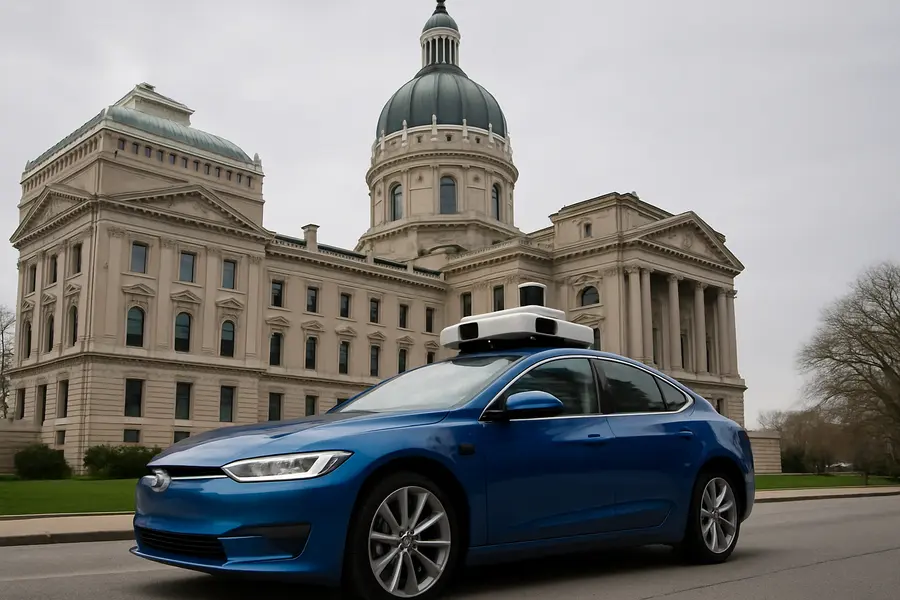
Lemonade's AI-powered autonomous car insurance reaches Indiana, offering Tesla FSD drivers a 50% per-mile rate cut in the insurtech's third state rollout since January 2026.
- Lemonade brings autonomous car insurance to Indiana — its third state — cutting Tesla FSD per-mile rates by 50% effective June 3, 2026.
- Real-time pricing via Tesla's Fleet API rewards FSD-engaged miles Lemonade's models rate as roughly twice as safe as human driving.
- LMND reported 71% revenue growth and a 32% rise in in-force premium in Q1 2026, with positive adjusted EBITDA targeted for Q4 2026.
Lead
Lemonade, Inc. (NYSE: LMND), the insurtech company, extended its autonomous vehicle insurance product to Indiana on June 3, 2026, making the Midwestern state the third U.S. market where Tesla owners receive a 50% discount on every mile driven with Full Self-Driving (Supervised) technology active. The expansion follows sequential launches in Arizona on January 26 and Oregon in late February, establishing a pattern of measured state-by-state rollout for a product category with no direct precedent in the U.S. insurance market.What Happened
Lemonade Autonomous Car uses Tesla's Fleet API to detect, in real time, whether a covered vehicle is operating under human control or FSD mode. Per-mile premiums are cut in half whenever FSD is engaged, a pricing signal derived from Lemonade's internal loss data, which shows FSD-driven miles incurring roughly half the accident risk of manually driven miles. Coverage eligibility in Indiana requires Tesla Hardware 4 or higher with compatible firmware.
Indiana Tesla drivers can obtain a quote in seconds via the Lemonade app or at tesla.lemonade.com/fsd. Bundling with Lemonade Renters, Pet, or Home policies unlocks additional savings. Lemonade's conventional car insurance already operates in ten states, Indiana included, giving the company an existing regulatory and distribution footprint on which to layer the autonomous product.
Shai Wininger, president and co-founder of Lemonade, framed the product as a structural repricing of risk: "Tesla's safe FSD (Supervised) tech reduces the chances of getting into an accident. Our intelligent pricing models see this in the data and can pass real savings, with high precision, on to Tesla customers."
Technology and Data Angle
The core innovation is actuarial rather than operational. Traditional carriers assess a Tesla as a high-value vehicle with elevated repair costs; Lemonade separates the miles a car is driven by its human owner from those driven by software, and prices each segment independently. The Fleet API integration captures not only whether FSD is active but also which software version is installed — a material variable because Lemonade's models expect further safety gains, and therefore further premium reductions, as Tesla pushes FSD updates. The company said it anticipates passing those improvements to customers automatically as new version data accumulates.
The product also arrives at a structural moment for Tesla (NASDAQ: TSLA). Tesla discontinued outright FSD purchases on February 14, shifting entirely to a $99-per-month subscription. That model increases the number of FSD-active vehicles on the road incrementally as subscription uptake grows, widening Lemonade's addressable pool of eligible policyholders with each passing quarter.
Tesla's own insurance subsidiary has faced headwinds in parallel: California's Department of Insurance initiated enforcement proceedings against it in late 2025 over claim-handling delays and denials, leaving an opening for third-party carriers that can underwrite autonomy-adjusted risk without the regulatory baggage.
Strategic Context
The Indiana launch is as much a positioning move as a growth one. Lemonade enters a segment of the auto insurance market — autonomous vehicle coverage — where pricing methodology remains unsettled and incumbents lack real-time telemetry integrations comparable to what the Tesla partnership provides. First-mover underwriting data from three states builds a proprietary loss curve that grows harder to replicate as the miles accumulate.
For Lemonade's broader financial narrative, the autonomous product arrives when the company's core metrics are inflecting. First-quarter 2026 revenue reached $258 million, a 70.6% year-over-year increase, exceeding consensus estimates. In-force premium climbed 32% to $1.33 billion. Gross profit rose 159% to $100.1 million, lifting gross margin to 39%. The customer base expanded 23% year-over-year, extending Lemonade's streak of accelerating growth to ten consecutive quarters. Management reiterated guidance for positive adjusted EBITDA in Q4 2026 and full-year profitability in 2027.
LMND shares have fallen approximately 40% from their 2025 peak amid investor scrutiny of loss-ratio trajectories and the timeline to profitability, yet remain up roughly 229% over a three-year horizon.
Outlook
Lemonade has not disclosed which states follow Indiana, but the sequential launch cadence — roughly one new state every five to six weeks since January — suggests continued expansion through the second half of 2026. The company is building toward a pricing model that updates dynamically with each FSD software release, a feedback loop between autonomous software performance and insurance cost that neither traditional carriers nor Tesla's own insurance unit currently replicates at scale. Whether the product generates material premium volume in its first year is secondary to the data and brand positioning it creates in a market segment expected to grow substantially as autonomous miles increase across the U.S. fleet.
Mentioned tickers: LMND, TSLATechnology