Pomegra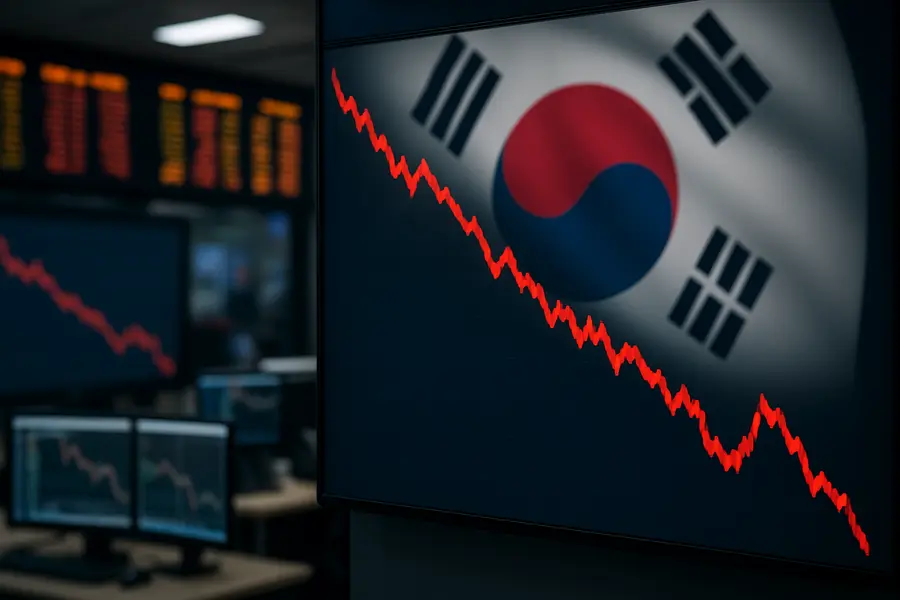
I now have sufficient cross-verified data. Writing the article.
- Kospi plunged more than 6% and Kosdaq fell 6.27%, triggering a program-trading halt as AI chip stocks led Korea's sharpest selloff of 2026
- Samsung Electronics shed over 7% and SK Hynix fell more than 9% after Broadcom guided AI chip revenue at $16 billion, roughly 7% below the $17.2 billion market consensus
- Foreign investors sold 5.43 trillion won in a single session, part of an estimated $22 billion outflow from Korean equities since May
---
South Korea's Kospi sank more than 6% and the Kosdaq fell 6.27%, leading Asia lower as an AI-trade selloff wiped months of gains from Samsung and SK Hynix.
Lead
Seoul — South Korea's Kospi plunged more than 6% on Friday and the Kosdaq declined 6.27%, leading losses across Asian equity markets as investors rushed to exit crowded artificial-intelligence positions following a guidance miss from one of the sector's most closely watched U.S. chip companies. A program-trading sidecar was activated after KOSPI 200 futures fell more than 5%, briefly suspending equity transactions for the third time this year. The session marked the most severe single-day reversal of South Korea's AI-driven rally, which had lifted the benchmark index by more than 100% at its 2026 peak.
What Happened
Samsung Electronics, the Kospi's largest constituent, declined more than 7% intraday. SK Hynix fell more than 9%. Together the two chipmakers represent approximately half of the Kospi's total market capitalization and accounted for an estimated 70% of the index's year-to-date gains heading into the session — making their reversal mechanically decisive for the benchmark.The Kosdaq, with a deeper concentration of mid-cap technology and growth names, lost 6.27%, reflecting the breadth of the selloff beyond the two mega-cap semiconductor companies.
The Trigger: Broadcom's Guidance Miss
The catalyst emerged after U.S. close on June 3, when Broadcom reported quarterly results and guided next-quarter AI chip revenue at $16.0 billion — approximately 7% below the $17.2 billion market estimate. Full-year AI revenue guidance came in at $56 billion, versus a $57.6 billion consensus. Broadcom shares fell more than 12% in extended trading. The Philadelphia Semiconductor Index retreated 5.45% on the session, with Micron Technology declining 7.74% and AMD falling 3.56%.
For Korean markets, the read-through was direct. Samsung Electronics and SK Hynix are primary suppliers of high-bandwidth memory (HBM) chips — the product most tightly coupled to AI accelerator demand. A softer-than-expected guidance from a major AI infrastructure buyer functions as a demand signal for the entire HBM supply chain.
Regional Contagion
Korea led Asia lower but was not alone. Japan's Nikkei 225 fell approximately 3.4% in early trading, while Taiwan's weighted stock index dropped 5.4% at the open. Taiwan Semiconductor Manufacturing Co. (TSMC) shed 5.7%, underscoring how closely the AI narrative has linked disparate markets. Any recalibration of U.S. hyperscaler AI capital expenditure assumptions is now priced simultaneously across Seoul, Taipei, and Tokyo.Leverage and Concentration Risk
The severity of the Korea selloff reflects structural vulnerabilities that accumulated during the rally. Retail margin debt in South Korea reached approximately ₩37.7 trillion as of early June — a record level. When leveraged positions unwind in concentrated markets, forced selling can amplify moves that a less-leveraged market would absorb more gradually. That dynamic was visible intraday: losses in the Kospi widened after the program-trading halt rather than stabilizing.
Foreign investors sold 5.43 trillion won (approximately $1.65 billion) during the session. Institutions added 798.9 billion won in net sales. Domestic retail investors absorbed 6.09 trillion won — a pattern characteristic of Korean market stress, in which retail participants attempt to buy dips that overseas and institutional sellers are actively pressing.
Since May, foreign funds have net sold approximately $22 billion in South Korean equities. SK Hynix alone recorded roughly $12 billion in monthly net foreign selling — a concentrated liquidation consistent with a deliberate reduction of crowded AI-linked positions rather than broad emerging-market outflows.
Strategic Signals Within the Sector
Compounding the pressure, local media reported that SK Hynix — holder of an estimated 61% global market share in HBM — is planning to reallocate production capacity toward conventional higher-margin DRAM products. Any strategic pivot at the world's dominant HBM supplier carries supply-chain implications across the AI memory stack and adds uncertainty to the demand-recovery timeline.
Korea's Kospi also entered the session without an MSCI catalyst. Exclusion from the MSCI Developed Markets index during the most recent review removed an anticipated foreign buying anchor that many investors had positioned for.Macro Backdrop
U.S. macroeconomic data amplified the risk-off move. The May non-farm payrolls report recorded 172,000 job additions, above consensus, reducing expectations for Federal Reserve rate reductions. CME FedWatch data showed markets pricing roughly 70% odds of a U.S. rate increase by year-end 2026 — raising the cost of carry for leveraged, high-multiple positions concentrated in markets like Korea and Taiwan.
Outlook
The breadth of the AI-trade unwind — spanning Broadcom's revenue guidance, Korean memory producers, and Taiwanese foundry names — signals a broader reassessment of AI infrastructure spending rather than a company-specific miss. The Kospi's more than 100% year-to-date advance left no margin for tolerance at any node in the supply chain. With foreign outflows running at historically elevated levels, record retail margin debt unwinding, and no near-term MSCI inclusion catalyst, the technical and fundamental backdrop for Korea points toward continued volatility. The central question for markets is whether Broadcom's guidance shortfall reflects a one-quarter inventory correction or the beginning of a structural deceleration in hyperscaler AI capital expenditure — an answer that will shape the Kospi's trajectory through year-end.
Mentioned tickers: 005930.KS, 000660.KS, AVGO, MU, AMD, 2330.TW, SOX