Pomegra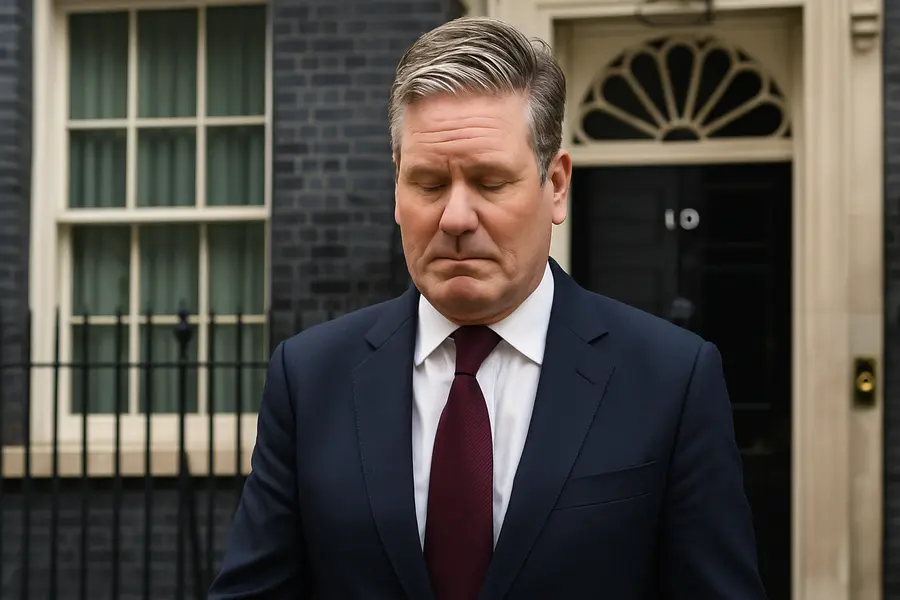
UK PM Keir Starmer resigned June 22 as Reform UK's surge exposed Labour's fragility, triggering a leadership contest set to install Andy Burnham as Britain's seventh prime minister in ten years.
- Starmer stepped down June 22, citing his parliamentary party's judgment that he could not lead Labour to victory at the next general election.
- Andy Burnham leads the succession race after winning the Makerfield by-election June 19; nominations formally open July 9, with a result expected by August 29.
- Sterling fell to approximately $1.319 against the dollar and 10-year gilt yields edged to 4.85%, reflecting renewed UK political uncertainty.
Lead
Keir Starmer resigned as UK Prime Minister and Labour Party leader on June 22, 2026, ending a tenure of less than two years and setting in motion the country's seventh change of prime minister in a decade. Starmer, who swept to power in July 2024 on a landslide mandate promising stability after years of Conservative disarray, announced his departure acknowledging the verdict of his parliamentary colleagues. "The question my party is asking now is whether I am best placed to lead us into the next general election," he said. "I have heard the answer of my parliamentary party to that question, and I accept that answer with good grace."What Happened
Starmer's resignation followed months of mounting pressure triggered by a string of political setbacks. Reform UK, the hard-right populist party led by Nigel Farage, consistently topped national opinion polls throughout 2025 and into 2026, cutting into Labour's working-class support in post-industrial heartlands. The May 2026 local elections proved decisive: Labour lost hundreds of council seats while Reform surged, exposing the depth of the government's popularity problem.
The final catalyst was a parliamentary by-election in Makerfield, a former Labour stronghold in northwest England, on June 19. The constituency's sitting MP stood down to allow Andy Burnham — formerly Greater Manchester Mayor and a long-standing Labour heavyweight — to re-enter Parliament. Burnham won comfortably, and within days his newly secured platform precipitated a reckoning inside the parliamentary Labour Party. Starmer announced his departure on June 22, the same day Burnham was sworn in as a Member of Parliament.
The Succession Race
Andy Burnham declared his candidacy for the Labour leadership within hours of Starmer's announcement, entering as the clear frontrunner. Former Health Secretary Wes Streeting, once viewed as a potential candidate himself, moved quickly to endorse Burnham. The National Executive Committee opens nominations on July 9, with the contest scheduled to conclude by August 29 — ensuring a new leader is in place before Parliament returns from its summer recess in September.If confirmed as leader, Burnham is expected to become British PM 2026, taking office without an intervening general election under Westminster conventions that award the prime ministership to the leader commanding a Commons majority. Labour retains its parliamentary majority from the 2024 election.
UK Political Instability: A Decade in Review
Starmer's exit crystallises a pattern of UK political instability that has defined British governance since the 2016 Brexit referendum. The country will have seen seven prime ministers in ten years: David Cameron, Theresa May, Boris Johnson, Liz Truss, Rishi Sunak, Keir Starmer, and a seventh yet to be confirmed. Truss's 45-day tenure in autumn 2022 became a symbol of the era's dysfunction, triggering a gilt market crisis that pushed borrowing costs sharply higher and forced a rapid reversal of fiscal policy.
The political volatility has become increasingly tied to structural economic underperformance. A June 2026 analysis estimated the UK economy is 6–8% smaller than it would have been absent the Brexit vote, with persistent shortfalls in trade, business investment, and productivity. Frequent leadership changes compound uncertainty for long-term investors, complicating infrastructure planning, fiscal credibility, and trade negotiations.
Market Reaction
Sterling fell to approximately $1.319 against the US dollar on June 22, near its 2026 low. The move was measured — the pound had already shed around 3% since February as Starmer's hold on power visibly eroded, meaning much of the political risk was priced in ahead of the formal announcement. UK gilt yields edged higher, with the 10-year benchmark settling at 4.85%. The FTSE 100 drifted marginally lower but registered no acute selloff.The medium-term fiscal outlook carries greater weight for bond markets. If new leadership moves to relax existing fiscal rules to fund additional public spending — a scenario with some support on Labour's left — gilt markets could respond with considerably more force than they did to the immediate resignation announcement.
Geopolitical Dimension
The change in leadership arrives at a delicate moment for UK foreign policy. Britain is navigating post-Brexit trade relationships with the European Union, managing its NATO commitments amid a reconfigured US alliance posture, and positioning itself within global supply chain realignments driven by US-China technology competition. Frequent turnover in Downing Street has complicated the UK's ability to project continuity in multilateral negotiations, and a new prime minister inherits immediate briefs on defense spending, energy security, and Atlantic trade talks.