 Pomegra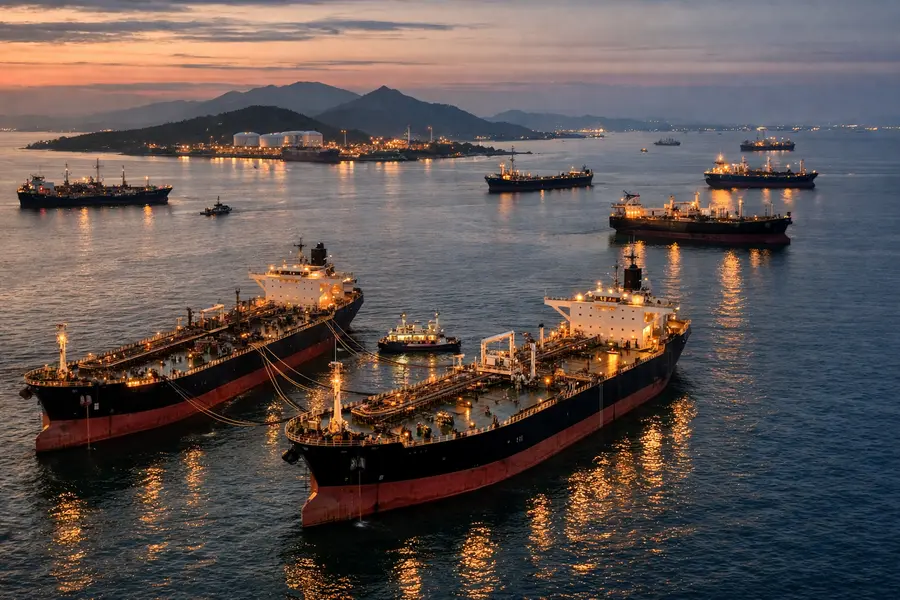
Indonesia's Karimun island, a free-trade zone 30 kilometers southwest of Singapore, has become the nerve center of Asia's $1.6 billion dark fleet sanctioned oil network, prompting the EU's first-ever sanctions on a non-Russian terminal.
- The Karimun Oil Terminal channeled $1.6 billion in Russian energy products from seven ports between July 2024 and May 2026.
- The EU's April 2026 sanctions package listed Karimun's terminal — the first non-Russian facility targeted in the campaign since 2022.
- Jakarta secured 150 million barrels of discounted Russian crude days after Brussels imposed the Karimun designation.
Lead
A 30-kilometer stretch of open water separates Karimun island from Singapore's port — and an entire enforcement universe separates the two territories. Since mid-2024, Karimun's Oil Terminal has processed more than $1.6 billion in Russian diesel, fuel oil, and refined products originating from seven Russian ports, according to Indonesian customs records, transforming a quiet free-trade zone into the operational heart of Asia's dark fleet oil logistics network. On April 23, 2026, the European Union responded with its 20th sanctions package, listing the Karimun facility in a port infrastructure ban — the first such designation of a terminal outside Russia since Moscow's invasion of Ukraine in 2022.
What Happened
In mid-2024, a UAE-based company acquired the Karimun Oil Terminal, establishing a dedicated transshipment node for Russian energy cargoes excluded from European markets. The island's free-trade zone designation proved critical: it places the terminal largely outside the reach of Indonesian customs authorities, creating a regulatory gray space exploited at industrial scale.
The operational model is straightforward. Shadow fleet tankers carrying Russian oil arrive at Karimun laden, discharge cargo at the terminal, and the fuel is blended with non-sanctioned product and relabeled as Indonesian in origin. It then departs aboard legitimate vessels — often bound for Singapore, one of the world's largest bunkering hubs — with documentation pointing away from Moscow's refineries.
Karimun is the fixed node in a much larger mobile network. By late 2025, approximately 130 shadow fleet vessels were clustered in the broader Riau Archipelago, with at least 27 transiting the Singapore Strait in early December. About 80 tankers carrying Russian and Iranian oil maintain near-permanent station in the area, using the open sea as a floating logistics platform for unregulated ship-to-ship transfers. A separate tracking investigation documented at least 13 vessels conducting covert STS operations near the Riau islands, moving approximately 22 million barrels of Iranian crude — a cargo valued at more than $2 billion. Vessels arrive laden, disable their AIS transponders during the transfer window, and reappear outbound through the Strait of Malacca with reoriented documentation.
EU Sanctions and the Geopolitical Dimension
By designating Karimun alongside two Russian shipping ports in the April package, Brussels extended its sanctioned oil trade enforcement architecture beyond Russian borders for the first time — a strategic escalation that signals willingness to apply liability in sovereign third-party jurisdictions.
PT Oil Terminal Karimun denied any shadow fleet affiliation, arguing the EU regulation named physical infrastructure rather than the corporate entity, and framed its operations as supporting Indonesian energy security rather than facilitating evasion. Brussels rejected that distinction.
The designation widened an already visible fracture between Western enforcement priorities and Southeast Asian energy politics. Indonesia's Foreign Ministry said authorities were reviewing the legality of activities in the area and stated that Jakarta does not permit its maritime zones to be used for unlawful activities — language calibrated to avoid confrontation without conceding ground.
Indonesia's Strategic Calculus
Jakarta's tolerance for Karimun's role is rooted in structural energy vulnerability. Indonesia imports close to 1 million barrels of oil per day, and domestic fuel reserves stand at 20 to 25 days of consumption — far below the 90-day net import buffer recommended by the International Energy Agency. That deficit makes discounted Russian oil a strategic instrument, regardless of diplomatic cost.
Days after the EU announced the April sanctions, Jakarta disclosed that President Prabowo Subianto had secured a commitment from President Vladimir Putin for 100 million barrels of Russian crude at preferential pricing, with a broader deal encompassing 150 million barrels. Presidential Regulation 26/2026, enacted earlier in the year, established a new import framework through Public Service Agencies to channel sovereign energy procurement — effectively creating a state-level pipeline for the sanctioned oil trade.
Washington adds a competing pressure. Under the bilateral Agreement on Reciprocal Trade signed in February 2026, Jakarta committed to purchasing approximately $15 billion in U.S. energy commodities annually — nearly half its total oil and gas import volume. The arithmetic tension between that pledge and the concurrent Russian crude commitment has not been resolved in public diplomatic channels.
Global Energy Security Implications
The Indonesia dark fleet oil hub reflects a structural reorientation of the global sanctioned oil trade that accelerated after 2022. As European ports and maritime insurance markets tightened, the trade migrated to the Malacca and Singapore corridors — the world's highest-throughput energy chokepoints. The Riau Archipelago's geography, straddling both straits, makes it resistant to interdiction: rerouting around Indonesia adds weeks and hundreds of millions of dollars in freight costs to any alternative.
At an estimated 1,900 vessels, the global dark fleet is no longer a marginal workaround. It constitutes a parallel energy system with dedicated logistics, opaque financing, and alternative insurance networks, operating at volumes that materially blunt the economic pressure Western price caps were designed to impose on Russia and Iran.
Environmental exposure scales with the opacity. Shadow fleet vessels are typically older, under-maintained, and uninsured under standard Protection and Indemnity club coverage — raising collision and spill risk in waters that carry approximately 30 percent of global seaborne trade.
Outlook
The Karimun designation marks a tactical escalation in Western sanctions enforcement, but the structural incentives keeping the Indonesia dark fleet oil hub operational remain intact. Jakarta's import deficit, the geographic logic of the Riau Archipelago, and sustained Asian appetite for below-market crude create conditions the sanctions architecture cannot unilaterally neutralize. Western governments face a constrained menu: extending liability to trading partners risks fracturing alliances critical to other strategic objectives; declining to do so leaves the price-cap regime visibly permeable. The resolution of that dilemma will determine both the long-term trajectory of global energy security and the geopolitical alignment of Southeast Asia's largest economy.
Mentioned tickers: N/A