Pomegra
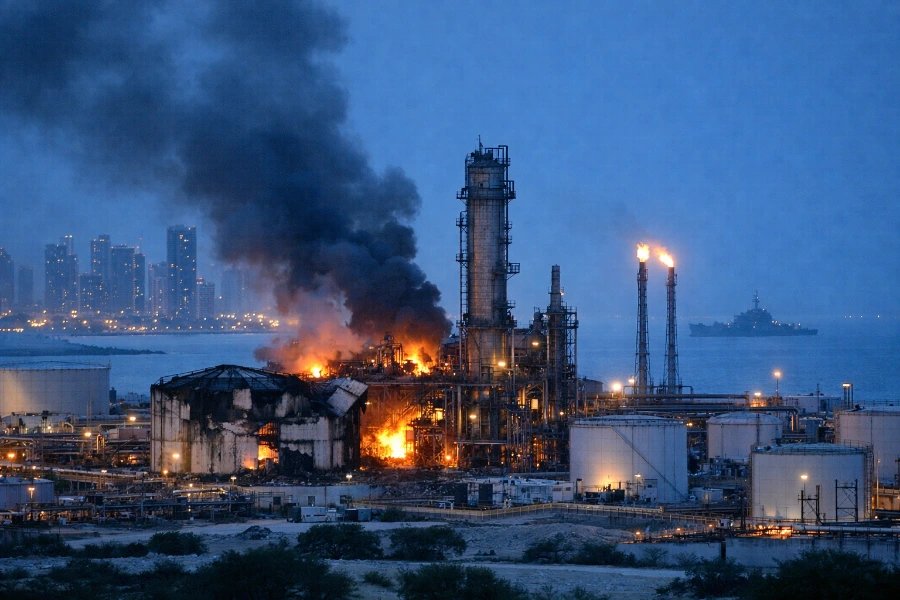
Iran launched drones at a US base in Bahrain for the second time in three days after Trump said no deal is needed, lifting oil and dimming peace prospects.
- Iran sent drones at a US base in Bahrain on Sunday, its second attack on the kingdom in three days.
- US forces shot the drones down, with no damage or injuries reported.
- Brent crude jumped 3.3% to $95.82 after Trump said the US does not need a deal.
Lead
Iran fired drones at a US military facility in Bahrain on Sunday, November 15, the second attack on the Gulf kingdom in three days. US and Bahraini air defenses intercepted the drones, and no damage or casualties were reported. The strike came days after President Donald Trump said on November 12 that the US "doesn't need a deal" with Tehran. It narrowed the diplomatic window that had briefly opened over the Strait of Hormuz.
What Happened in Bahrain?
Iran attacked Bahrain twice in three days. On Friday, November 13, US Central Command said it had shot down two Iranian one-way attack drones headed toward the kingdom. On Sunday, Iran's Islamic Revolutionary Guard Corps said six drones from its Aerospace Force targeted a US air defense radar system at the Al-Riffa helicopter base. The Bahrain Defense Force said it destroyed several Iranian aerial attacks over its territory.
Both episodes ended without reported losses. They were the first Iranian attacks on Bahrain in about two months, ending a lull in strikes on Gulf states. Bahrain hosts the US Navy's Fifth Fleet headquarters, which makes it one of Washington's most important military footholds in the region.
Why Are Hopes for a Deal Fading?
Hopes for a deal are fading because Trump publicly closed the door and Iran answered with force. On November 12, Trump wrote on Truth Social that "we don't need a deal with Iran" and that "that era is long gone." He also told Vice President JD Vance, who had been working to restart negotiations, to focus on domestic politics.
Tehran has said its door to peace remains open despite the Bahrain strikes. That position coexists with continued military pressure on US assets. Diplomacy has not stopped entirely. Qatar's prime minister traveled to the White House on Monday carrying an Iranian proposal for an interim arrangement to reopen the Strait of Hormuz. Whether Washington engages with the plan after Trump's remarks is the main open question.
What Is Happening to the Crude Oil Price?
The crude oil price has swung with each signal from Washington and Tehran. After Trump's remarks on November 12, December West Texas Intermediate settled 2.55% higher at $88.74 a barrel. Brent crude gained 3.3% to $95.82. Brent traded around $96 after the Sunday attack, then eased toward $94 on Monday as news of the Qatari mediation reached the market.
The moves show how little risk premium has left the market. Brent has traded above $100 earlier in the conflict, and the Strait of Hormuz carries roughly a fifth of global oil supply. Any sign that Hormuz will reopen pushes prices down, and any sign of escalation pushes them back up. Because the drones were intercepted, Sunday's attack added less to prices than Trump's comments did.
Geopolitical Dimension
The pattern is limited retaliation aimed at US facilities rather than civilian or energy infrastructure. Striking Bahrain lets Iran show reach and resolve without a response that would force a major US escalation. Intercepted drones also show the strength of the integrated air defenses that the US and Gulf partners have built around bases in the region.
For Gulf states, the risk is that they become the arena for a conflict they did not choose. Bahrain, the United Arab Emirates and Kuwait have all been exposed to Iranian fire during the war. Their governments have an interest in an interim deal that reopens shipping lanes and lowers the threat to their territory and economies.
For the US, the political calculation is different. Trump's public stance signals that he sees no pressure to make concessions. His position leaves room for a narrower, transactional arrangement on Hormuz if it reopens shipping without a broader settlement.
What Comes Next?
Three scenarios shape the next three to twelve months:
- Interim Hormuz arrangement: A limited deal that reopens the strait could push Brent back toward the low $90s or below, even without a wider peace.
- Continued low-level exchange: Periodic drone attacks that are intercepted keep prices in the mid-$90s range and keep shipping insurance costs elevated.
- Escalation: A strike that kills US personnel or damages energy infrastructure would likely draw a stronger US response and send crude back above $100.
Outlook
Iran's second drone attack on Bahrain in three days, following Trump's rejection of a deal, has pushed diplomacy to a delicate point. The attacks caused no harm, but they show that neither side is stepping back. The Qatari-carried proposal on the Strait of Hormuz is the most concrete path to de-escalation, and the response from Washington will largely determine whether the crude oil price stays near $95 or moves decisively in either direction.
Mentioned tickers: None